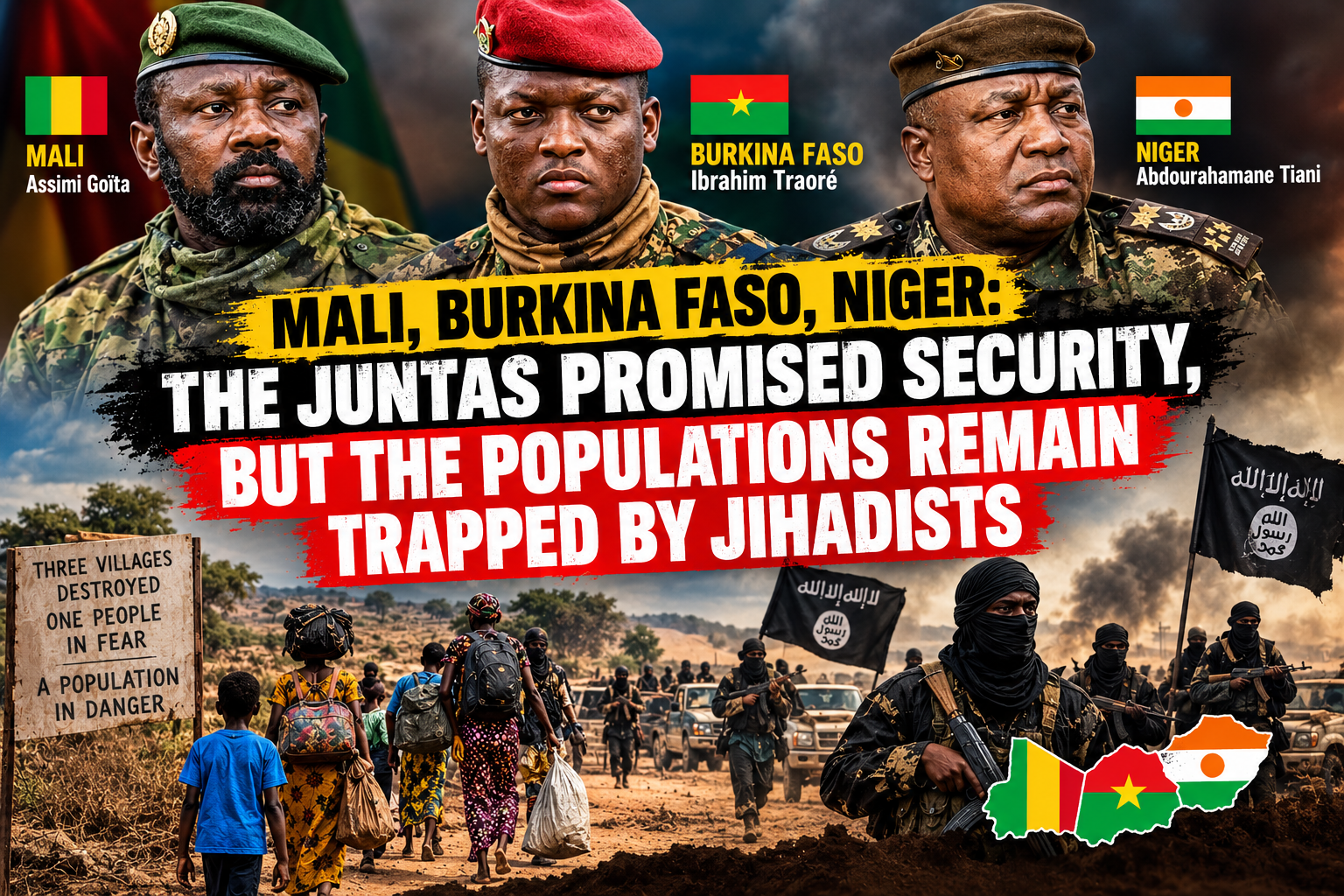
Unprecedented jihadist turf war grips the Sahel’s most volatile region
The tri-border zone where Mali, Burkina Faso and Niger meet has become the epicenter of a brutal jihadist power struggle. For weeks, the Islamic State in the Greater Sahara and the Group for the Support of Islam and Muslims (JNIM), Al-Qaeda’s regional affiliate, have been locked in deadly clashes, each claiming scores of casualties. This escalation has exposed the glaring gap between the military juntas’ security pledges and the grim reality faced by civilians in the most exposed areas.
The violence has escalated beyond attacks on state forces. Both groups are now vying for control over key territories, trade routes and local resources, with communities caught in the crossfire. For residents in remote and isolated areas, daily survival has become a precarious balancing act amid the chaos.
The juntas’ security promises under scrutiny
Since seizing power in Mali, Burkina Faso and Niger, the military regimes have framed their rule around restoring security and reclaiming national sovereignty. They have severed diplomatic ties, restructured military partnerships and emphasized their autonomy in the fight against jihadist groups. Yet, the continued violence in the tri-border zone raises a critical question: How can these governments justify their political and military overhauls when civilians remain trapped in the grip of armed factions?
True sovereignty, as residents see it, is measured not by declarations of independence or strategic realignments, but by the state’s ability to shield its people from harm. Can military juntas claim progress when entire communities live in perpetual fear, unable to farm their land, send their children to school or travel without risking their lives?
The civilian cost of jihadist infighting
The violent rivalry between the Islamic State in the Greater Sahara and JNIM does not signal an inevitable weakening of the broader jihadist threat. In fact, such internal conflicts often fuel further reprisals against civilians. Suspected of supporting one group or the other, entire villages become targets. Displacement surges, economic activities stall and the humanitarian crisis deepens.
While armed groups frequently inflate their claims of victory or minimize their losses in propaganda, the human toll of these clashes cannot be ignored. Independent verification of casualties remains scarce, but the impact on local communities is undeniable. Who guarantees access to healthcare, education or safe passage for traders and farmers when battles rage near their homes?
The burden of protection increasingly falls on the most vulnerable. Without a stable state presence, public services collapse, markets shrink and agricultural land becomes inaccessible. Families are forced to make impossible choices: remain in dangerous conditions or abandon their livelihoods entirely.
Security beyond military operations
The military juntas of Bamako, Ouagadougou and Niamey must do more than broadcast their battlefield successes. Security in the tri-border zone depends on far more than sporadic military operations. It requires consistent protection for civilians, reliable intelligence, cross-border cooperation, access to justice and the restoration of essential services.
For these regimes, the challenge is clear: sovereignty must translate into tangible safety for their people. Civilians do not measure their government’s legitimacy by speeches or foreign policy shifts alone. They judge it by their ability to live without fear, work their land, educate their children and move freely. Until that becomes a reality, the promise of security will remain hollow for those living in the shadow of jihadist violence.
Accountability in the face of persistent insecurity
The rise of the Alliance of Sahel States has been hailed as a bold step toward regional self-reliance in security. But this strategy will be judged by results: fewer attacks, safer villages, restored public services, secure trade routes and the ability for displaced families to return home in safety.
Civilians in the tri-border zone cannot afford to wait for historical grievances to be resolved or foreign partners to take the lead. They need concrete action now. It is not enough for the juntas to blame past failures or external actors. They must demonstrate how their plans will directly improve the lives of those most at risk.
The jihadist conflict shows no signs of abating. For the military regimes of the Sahel, the test of their legitimacy lies in how effectively they protect the people they claim to serve. The clock is ticking.
The lesson for Sahel states: sovereignty demands results
The crisis gripping the tri-border zone is a stark reminder that security in the Sahel will not be won by slogans or reshuffled alliances alone. It demands a multi-faceted response that prioritizes civilian protection, adaptive security strategies and the restoration of state authority in every corner of the country.
For the juntas in Mali, Burkina Faso and Niger, the road ahead is fraught with challenges. But one truth remains unassailable: a government’s claim to sovereignty rings hollow if its citizens cannot live in safety. The time to prove otherwise is now.
