Mali armed conflict intensifies with coordinated attacks by Touareg rebels and jihadists
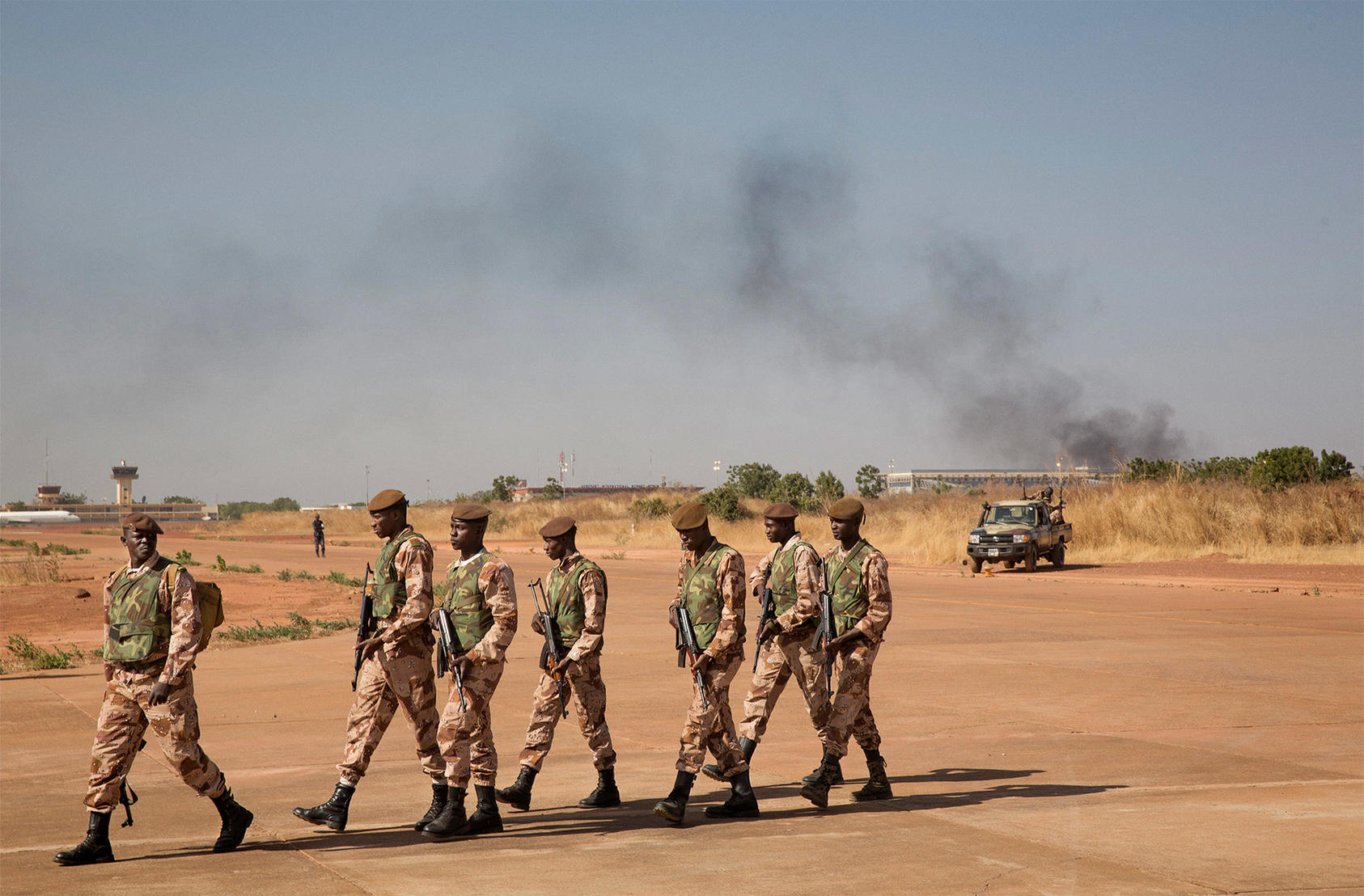
The Mali armed conflict has reached a critical juncture following a major offensive launched by Touareg rebels from the Front de Libération de l’Azawad (FLA) and jihadist factions of the Group for the Support of Islam and Muslims (JNIM), an Al-Qaeda affiliate. This coordinated assault, targeting multiple cities across the country, has exposed vulnerabilities in the military junta’s defenses and its alliances with Russian-backed forces.
Key cities targeted in simultaneous assaults
The offensive, which began at dawn on Saturday, April 25, struck seven strategic locations:
- Bamako and its military stronghold in Kati (near the capital);
- Strategic centers in Konna, Mopti, and Sévaré (central Mali);
- Key northern cities Gao and Kidal, with the latter falling entirely under insurgent control.
The attackers deployed a range of tactics, including:
- Vehicle-borne improvised explosive devices (VBIEDs);
- Improvised explosive devices (IEDs);
- Kamikaze drone strikes;
- Indirect and direct fire on military positions.
The assaults were jointly claimed by the JNIM and the FLA, marking a significant escalation in collaboration between separatist Touareg groups and Islamist militants—despite their differing long-term objectives.
Government response and shifting alliances
In a televised address, Oumar Diarra, Chief of Staff of Mali’s armed forces, described the attacks as a “coordinated destabilization plan orchestrated by internal and external actors”, aimed at plunging the nation into perpetual insecurity. The government reported 16 civilian and military casualties and imposed a 72-hour curfew in Bamako, while the Modibo Keita International Airport remained closed.
The Africa Corps—a Russian paramilitary group that has succeeded Wagner in Africa—announced its withdrawal from Kidal in coordination with Malian authorities. The group claimed to have repelled the attacks, neutralizing over 1,000 jihadists and destroying more than 100 vehicles, while preventing what they described as an attempt to replicate a “Syrian scenario” in Mali. However, reports indicate significant losses among pro-government forces, including the deaths of high-ranking officials.
High-profile casualties shake the junta
The conflict claimed the life of Sadio Camara, Mali’s Defense Minister, who was killed in a suicide bombing targeting his residence in Kati. The attack also resulted in the deaths of two of his wives, two children, and several civilians, along with the destruction of a nearby mosque. Assimi Goïta, the military junta leader, was evacuated from Kati for his safety. Additionally, Modibo Koné, head of the national security agency, was critically wounded.
The loss of Camara—considered the de facto number two of the junta and a key architect of Mali’s strategic realignment with Moscow—represents a major blow to the transitional government. His death underscores the fragility of the current regime amid escalating violence.
Emergence of a fragile Touareg-jihadist alliance
This offensive signals a growing, if tactical, alliance between Touareg separatists and Islamist militants, two groups with historically divergent goals. While Touaregs seek greater autonomy or independence for the Azawad region, jihadist factions aim to establish an Islamic state. Their collaboration appears driven by mutual opposition to the junta and the presence of Russian mercenaries.
The unity between these factions was first visibly demonstrated in July 2024 during the Battle of Tinzaouaten, where coalition forces inflicted heavy losses on Russian-backed troops. Analysts suggest intelligence support from the Ukrainian military intelligence (GUR) may have played a role in recent operations, a claim denied by Kiev but supported by Malian authorities, who have since severed diplomatic ties with Ukraine.
The collapse of the 2015 Algiers Accords—once a framework for peace with Touareg groups—has further fueled this alliance. With the withdrawal of the UN Multidimensional Integrated Stabilization Mission in Mali (MINUSMA) in 2023, the Malian army resumed hostilities in the north, pushing Touareg factions to seek new tactical partnerships.
Regional and international implications
The offensive highlights the complex web of regional conflicts intersecting in the Sahel. The involvement of the Africa Corps—a successor to the controversial Wagner Group—adds a geopolitical dimension, as Moscow seeks to maintain influence in West Africa. Meanwhile, accusations of external support for rebel factions point to a broader proxy dynamic, with the junta accusing Western intelligence services and Ukrainian operatives of aiding insurgents.
The Malian government has vowed to restore order, but with Kidal under insurgent control and the capital under curfew, the path to stability remains uncertain. As the junta grapples with internal fractures and mounting casualties, the future of Mali’s transition—and its alliances—hangs in the balance.