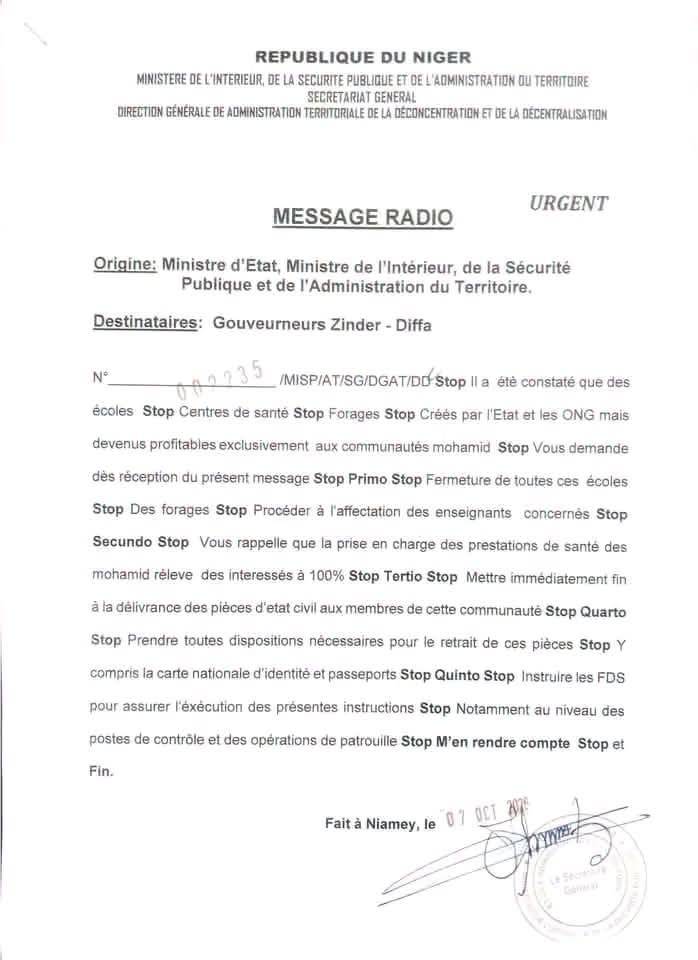
State-issued directives target schools, water access and healthcare for Mohamid families
On October 7, 2026, Niger’s Ministry of Interior broadcasted an urgent directive to regional authorities in Zinder and Diffa, ordering immediate action against the Arab-speaking Mohamid community. The measures included school closures, water source disconnections and the suspension of collective healthcare support, while provisions for the withdrawal of official documents like national IDs and passports were also outlined. Security forces were instructed to enforce these directives promptly.
Reports confirm the measures are already in effect, raising urgent questions about the legal and human rights implications of targeting an entire community based on collective identity rather than individual conduct.
Basic rights weaponized in state-sanctioned exclusion campaign
Education, access to clean water, healthcare and legal documentation are fundamental rights, not privileges to be granted or revoked arbitrarily. Their restriction—particularly in a Sahelian region where these resources are scarce—threatens the most vulnerable households.
For children, school closures disrupt learning and development. For pastoral families, cutoffs to water points endanger livestock and livelihoods. Restrictions on healthcare jeopardize health outcomes for communities already facing medical deserts. Losing identity documents risks permanent legal vulnerability, potentially rendering people stateless or unable to access formal employment, banking, or mobility.
While authorities may argue these measures address misuse of public services, proportional responses require targeted interventions against those violating the law—not collective punishment of an entire ethnic group. Discrimination disguised as security policy undermines Niger’s constitutional equality guarantee.
Collective punishment has no place in counterterrorism strategy
Niger faces real security threats, especially in Diffa where armed groups and trafficking networks operate. Yet conflating entire communities with criminal elements violates core legal principles: personal accountability, due process, and the presumption of innocence.
If individual Mohamid citizens are suspected of involvement in illegal acts, authorities must follow established legal procedures—gathering evidence, respecting fair trial rights, and applying penalties only to proven offenders. Administrative orders targeting an entire ethnic community bypass these safeguards, effectively criminalizing identity itself.
Without transparent legal justification or accessible avenues for appeal, such policies risk institutionalizing discrimination under the pretext of national security.
Erosion of rights under Tiani’s transitional regime
Since seizing power in July 2023, General Abdourahamane Tiani’s military-led administration has faced criticism for tightening controls over political space and public freedoms. Civil society groups and international observers have documented a pattern: bans on political parties, restrictions on NGOs, arrests of journalists, and even denationalization orders against opposition figures in exile.
While denationalization targets specific individuals, the blanket measures against the Mohamid community reflect a broader trend: the use of administrative power to restrict rights without adequate legal guarantees or accountability. This cumulative pattern demands scrutiny of how authority is exercised—and who ends up paying the price.
Impact: from daily survival to regional economic ripple effects
The Mohamid community contributes to local commerce, transport, and pastoralism—sectors that support entire towns. School closures affect all children in the area, not just Mohamid families. Water service interruptions hurt farmers and herders across communities. Healthcare cuts increase health system burdens for neighboring populations. Identity document revocations complicate not only personal lives but also regional trade and mobility.
These measures risk destabilizing fragile local economies and deepening trust gaps between citizens and state institutions. Families enduring hardship today may face generational setbacks.
Time for review, remedy and respect
Niger needs effective security and governance—but not at the cost of fundamental rights. The government should immediately:
- Suspend all measures that deny access to education, water, healthcare, or legal documentation;
- Launch an independent review of the October 7 directive and its implementation;
- Guarantee transparent legal recourse for affected individuals and communities;
- Publicly explain the factual and legal basis for targeting the Mohamid community collectively.
No community should pay for the actions of a few. No sovereign power has the right to strip citizens of their dignity under the banner of national interest. The treatment of the Mohamid is not just their struggle—it is a test of whether Niger can uphold equality before the law. And that test begins now.