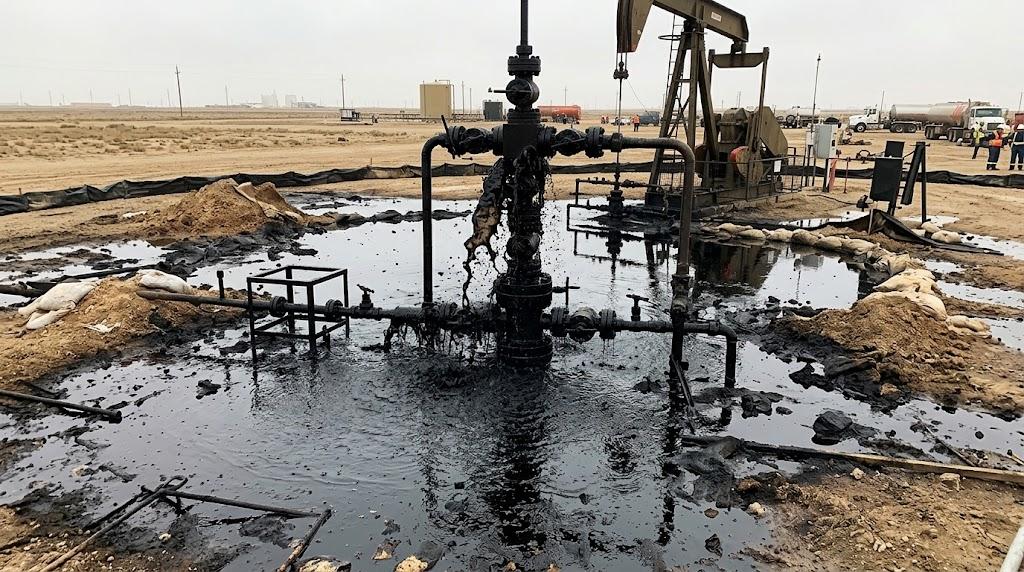
The failure of industrial actors and government inaction has turned a technical mishap into a ticking environmental time bomb. Since September 25, 2026, a catastrophic hydrocarbon and toxic gas eruption has engulfed the Goumeri W8 well, located in the Agadem block deep within Niger’s Sahara desert. Over 1,700 kilometers from Niamey, crude oil floods have spread unchecked, while a poisonous plume chokes the atmosphere.
Government silence prolongs environmental disaster
For 17 straight days, Niger’s government remained silent before finally acknowledging on October 12 that an ‘exceptionally severe environmental incident’ was underway. During this critical delay, the China National Petroleum Corporation (CNPC), the well’s operator, maintained complete secrecy—no public updates, no transparency on cause or volume of emissions. This deliberate opacity reflects the cynical approach of global oil giants that treat Africa’s subsoil as an unregulated environmental free-for-all.
Undisclosed climate catastrophe: methane flood exceeds expectations
The Ministry of Petroleum’s brief televised statement mentioned black liquid spewing up to ten meters high and risks to adjacent wells Goumeri W3 and W4. Crucially absent was any mention of gas emissions. Data from the European Sentinel-5P satellite under the Copernicus program exposed the full picture:
- Silent killer: The well is unleashing a massive methane leak estimated at over 40 tonnes per hour.
- Global warming acceleration: In just three weeks, more than 17,000 tonnes of methane have been released—potent greenhouse gas with over 80 times the warming power of CO₂ over 20 years.
- Unrelenting plume: Authorities claim ‘partial control’ of the situation, yet space observations confirm the gas flux has never waned since the eruption began.
Profit-driven drilling tramples on safety and lives
This disaster was not an isolated accident—it is the predictable outcome of an extractive frenzy. Eager to boost oil production to 90,000 barrels per day to feed the pipeline to Benin, Niger’s regime prioritized output over basic safety standards and routine maintenance. Two injured workers bear the human cost of this collective negligence, while authorities scrambled to bring in Algerian Sonatrach experts to drill a relief well—a last-minute bid highlighting the stark gap between oil ambitions and industrial risk management.
Sahara’s fragile balance faces irreversible damage
The desert is no dumping ground for hydrocarbons. The absence of immediate fatalities does not absolve the CNPC of responsibility, nor the state for its passive complicity in this open-air poisoning. With every passing hour, the methane surge from Goumeri W8 deepens the ecological fracture in the Sahara, turning a local failure into a worldwide climate crisis.
