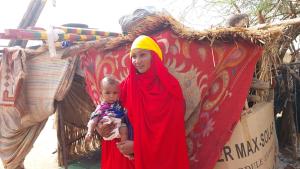
In the heart of Chad’s capital region, the Mandjafa nomadic camp serves as a temporary home for families who rely on livestock for their survival. Among them is Afia, a mother of five traveling with her four-month-old daughter, Fatma, to access vital health services during a One Health-driven outreach program. For Afia, these services are lifelines: “Vaccines keep my children healthy. Whenever they fall ill, I take them to the nearest health center without hesitation,” she shares.
The nomadic lifestyle, shaped by seasonal migrations and remote living, often leaves families like Afia disconnected from essential healthcare. With pastoral communities making up about 3.5% of Chad’s population, traditional healthcare models struggle to reach them effectively. To bridge this gap, the Chadian government has adopted the One Health strategy, uniting health, livestock, environmental, and agricultural sectors to deliver tailored services for nomadic populations.
a tailored approach for pastoral communities
On June 9, 2026, Mandjafa became the site of a pioneering One Health intervention, where 134 beneficiaries—including 11 children—received integrated health packages. The initiative combined human and animal vaccination, with 96 livestock immunized, alongside vitamin A supplementation, deworming, and the distribution of insecticide-treated mosquito nets. This model not only streamlines access but also maximizes efficiency by addressing multiple needs in a single visit.
Professor Mahamat Béchir, National Coordinator of One Health and Permanent Secretary of the national platform, highlights the strategy’s origins: “Early 2000s studies revealed alarmingly low vaccination coverage among nomadic groups. We realized standard approaches wouldn’t suffice—we needed to adapt to their way of life.”
collaborative campaigns for lasting impact
Veterinary services have long been a staple for pastoralists, who frequently rely on them for their livestock’s well-being. By aligning human and animal health interventions, outreach teams can reach more families while minimizing travel. Youssouf Idriss, a local herder with sheep, cattle, and camels, attests to this: “Our animals are the backbone of our survival. Their health directly impacts our food security and livelihoods. These joint campaigns protect both our families and our herds.”
Raphaël Neni, a veterinary officer with five years of field experience, has witnessed the transformation firsthand. “Since we intensified vaccination efforts, we’ve seen a marked decline in preventable diseases. Herders themselves notice the difference in their animals’ health,” he observes. Beyond livestock, these interventions also curb zoonotic disease risks, enhancing community safety.
strengthening national resilience through collaboration
The One Health platform in Chad coordinates cross-sectoral efforts to fortify disease prevention, surveillance, and response. Professor Béchir emphasizes the urgency: “Health challenges no longer respect sectoral boundaries. Zoonotic threats, climate shifts, and environmental pressures demand unified action to safeguard populations.”
The World Health Organization (WHO) has been a key ally in this endeavor, supporting the platform’s expansion, International Health Regulations assessments, and the National Health Security Plan. Dr. Tamadji Mbaïhol, WHO Chad’s routine vaccination lead, reflects on two decades of engagement with nomadic communities: “These populations are eager for adapted health services. The challenge lies in delivering them where they live. When interventions align with their reality, participation soars.”
Afia, now preparing to return home with Fatma, echoes this sentiment. Her advice to other parents is straightforward: “Illness strikes fast—seek care immediately. It’s the only way to keep your children safe and healthy.”
In Mandjafa, the One Health model is more than a strategy—it’s a lifeline. By bringing essential services directly to nomadic families, it ensures no one is left behind in the pursuit of health and resilience.