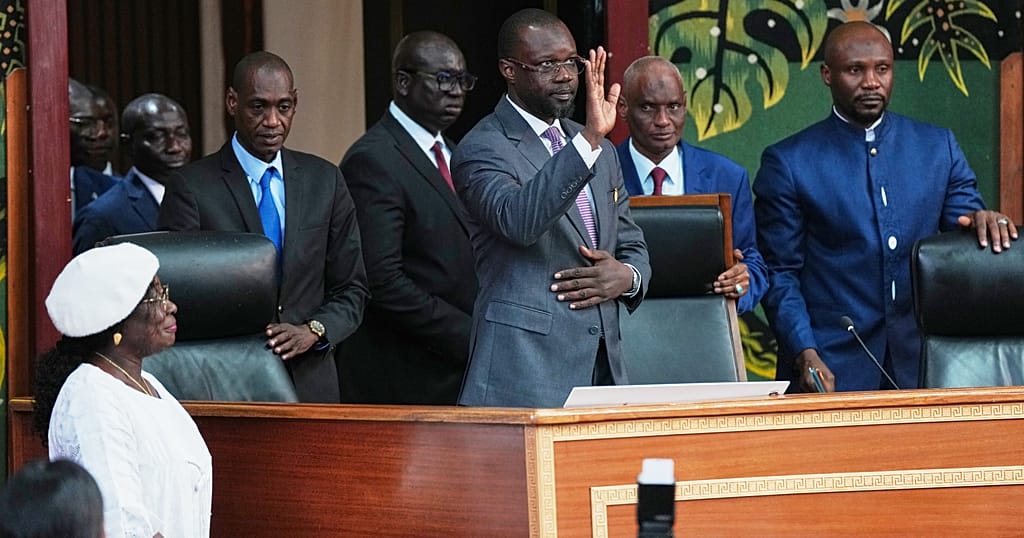
The president of Senegal’s National Assembly and former prime minister Ousmane Sonko was overwhelmingly re-elected on Saturday to lead his party, Pastef, a political victory that quickly became a warning directed at his political opponents, amid Senegal’s ongoing political crisis.
Delegates from national branches and the diaspora gathered in Diamniadio, near Dakar, for the party’s first congress.
As head of Pastef since its creation in 2014, Ousmane Sonko retains his position for a new six-year term.
“I am fully aware of the weight of this responsibility because Pastef is no ordinary party in Senegal’s political landscape,” he declared from the podium after his election.
“Revolutions can be diverted, absorbed, or emptied of their content if they are not equipped with both a clear doctrine and an organisation capable of embedding change over the long term. That is why this congress is historic, two years after we assumed the highest responsibilities,” he added.
President Bassirou Diomaye Faye won the presidency in 2024 with Pastef’s backing, after Ousmane Sonko was barred from running in the presidential election.
After months of tension, Bassirou Diomaye Faye eventually dismissed Ousmane Sonko from his post as prime minister on 22 May.
He was elected president of the National Assembly a few days later.
Addressing Pastef delegates, Ousmane Sonko warned against attempts to “sabotage” the political project advanced by his party.
“No plan to sabotage this revolution will succeed because the people, standing alongside Pastef, will provide the necessary guarantees so that we can finally liberate our country,” he cautioned.
Pastef’s leadership boycotted the government appointed on Monday by Bassirou Diomaye Faye, despite the presence of some members of Ousmane Sonko’s party in the new ministerial roster.
Pastef holds 130 of the 165 seats in the National Assembly and can at any time file a motion of no confidence to topple the government.
Bassirou Diomaye Faye, for his part, can form a new government after a no-confidence vote and will be able to dissolve the National Assembly starting in November 2026.