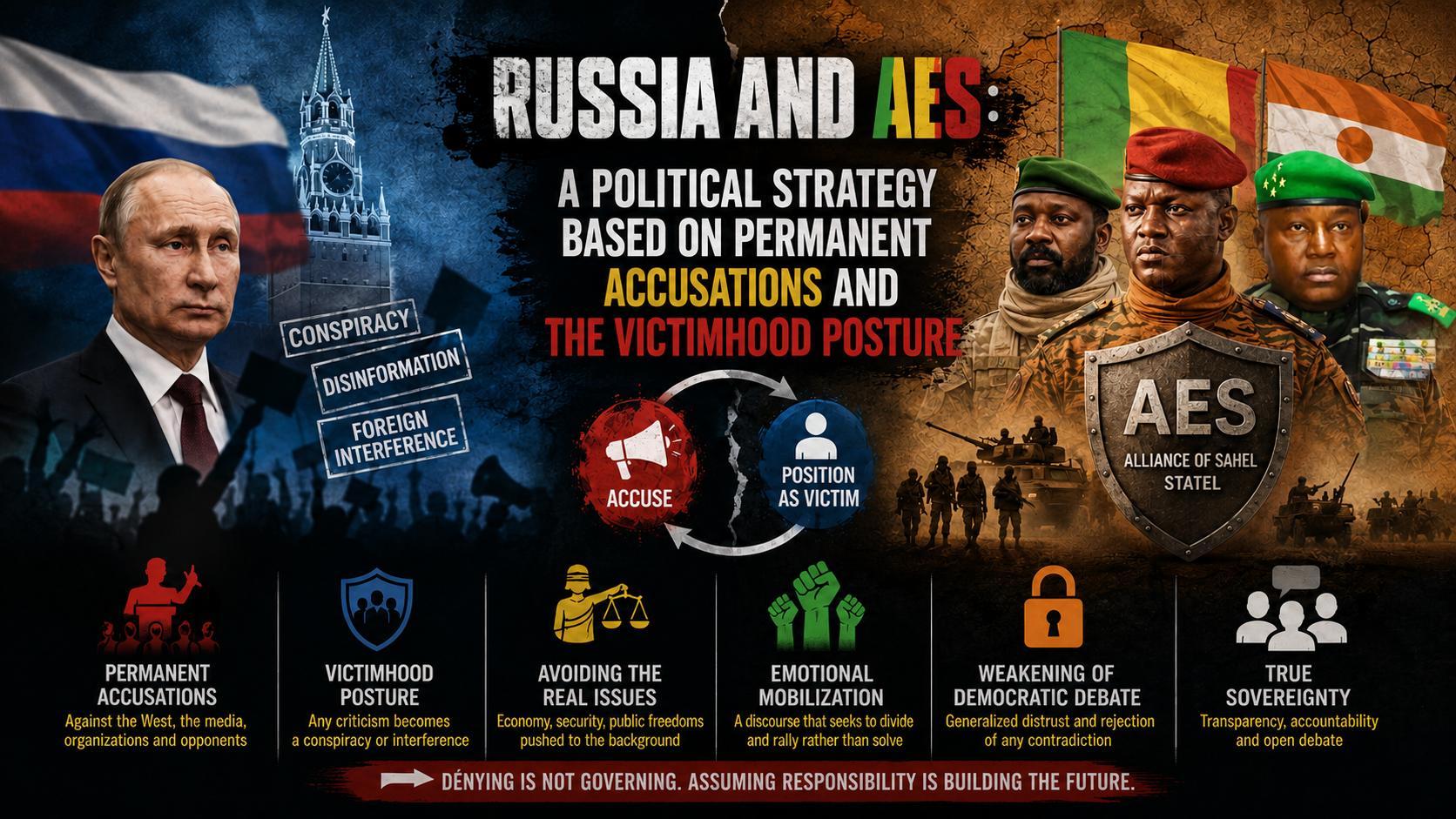
The governments of Russia and the Alliance of Sahel States (AES) have institutionalized the denunciation of critics as a cornerstone of their political communication strategies. This recurring tactic targets Western powers, international media outlets, regional bodies, and domestic opponents alike, with accusations flowing in a relentless stream. Yet, an enduring paradox emerges: whenever these same entities face questioning, they swiftly abandon their accusatory stance to adopt a posture of victimhood.
the duality of accusation and victimhood
This communication framework operates with remarkable consistency. Any dissent regarding their policies is met with immediate allegations of conspiracy, disinformation campaigns, or foreign interference. Criticism is framed not as a legitimate concern but as a coordinated effort to undermine their authority or obstruct their pursuit of sovereignty. Such a narrative serves a dual purpose: it deflects attention from pressing domestic issues while reinforcing a narrative of resilience against external adversaries.
deflecting responsibility through manufactured victimhood
The strategic advantage of this approach is clear. By portraying themselves as victims of orchestrated attacks, leaders sidestep scrutiny over tangible challenges such as economic hardship, persistent insecurity, authoritarian overreach, or the shortcomings of their policies. Public discourse shifts from substantive debate to emotional mobilization, prioritizing solidarity against perceived enemies over tangible solutions to citizens’ concerns.
Within the AES, this pattern is especially pronounced. Authorities routinely attribute setbacks to external sanctions, historical colonial legacies, or foreign actors. However, when local voices—whether journalists, civil society representatives, or human rights advocates—raise internal grievances, their critiques are dismissed as fabrications of a broader destabilization plot hatched abroad. The content of such objections is rarely engaged with; instead, they are dismissed outright as part of an orchestrated smear campaign.
Russia, too, deploys a similar logic on the global stage. Criticisms of its foreign interventions, military actions, or human rights records are consistently countered with the assertion that the nation is subjected to unrelenting hostility from the West. This rhetoric not only diverts attention from legitimate concerns but reframes any opposition as proof of a premeditated campaign of defamation.
the erosion of credibility and democratic norms
While this strategy may offer short-term political cover, it carries significant long-term risks. Sustainable governance demands the ability to engage with dissent, address criticisms through reasoned argument, and remain accountable to the citizenry. A consistent recourse to conspiracy narratives undermines democratic discourse and fosters a climate of generalized mistrust.
Accusations, though convenient, are not substitutes for accountability. Responsibility, transparency, and the acceptance of dissent are the true hallmarks of sovereignty—not the perpetual construction of external enemies. When criticism is automatically labeled a plot, it ceases to serve as a mechanism for improvement and becomes merely a tool for political deflection.
In time, the credibility of such narratives wanes. A posture of perpetual victimhood, once exposed as a rhetorical device rather than a reflection of reality, risks being dismissed as cynical maneuvering. Sovereignty, in its truest sense, is not built on the demonization of others but on the capacity to govern with integrity, transparency, and responsiveness to the governed.