coordination and collaboration for Niger’s health financing
The Republic of Niger, a landlocked West African nation, has grappled with armed conflicts and persistent droughts. These significant challenges have severely impacted the country’s health system, resulting in some of the highest maternal and infant mortality rates globally. This critical situation has spurred the Government of Niger to commit to achieving Universal Health Coverage (UHC), drawing lessons from previous efforts to broaden access to essential health services.
In 2006, facing unprecedented health outcomes, the government initiated an ambitious free healthcare policy. This initiative aimed to provide complimentary reproductive health and family planning services for women, alongside a wide array of health services for children under five. Despite initial successes, health progress was hampered by inadequate funding. By 2011, only half of the necessary resources for full implementation had been secured. Over time, this led to an accumulation of unpaid medical bills, preventing healthcare providers from delivering consistent services. Furthermore, as the initiative exclusively targeted women and children under five, other health service users faced substantial out-of-pocket expenses. The World Health Organization (WHO) estimates that direct out-of-pocket payments account for over 40% of total health expenditures in Niger.
Overall, the Government of Niger has struggled to boost resources allocated to health, with health spending declining from 5.4% to 4.9% of GDP between 2007 and 2011. While it increased from 4.9% to 5.6% of GDP between 2016 and 2018, it then plateaued around 5.7% from 2018 to 2020.
Even before implementing its free healthcare policy, Niger recognized the importance of coordination among health financing partners. In 2006, the Ministry of Health, the Agence Française de Développement (AFD), and the World Bank established the Fonds Commun Santé (FCS) to support the funding of Niger’s health development plan. By 2020, four additional international partners were contributing: UNICEF, UNFPA, Gavi, and the Spanish Agency for International Development Cooperation (AECID). The funding issues associated with the free healthcare policy stemmed from poor assessments and insufficient resource provision, underscoring the urgent need for reforms to ensure sustainable financing for UHC and other SDG3 targets.

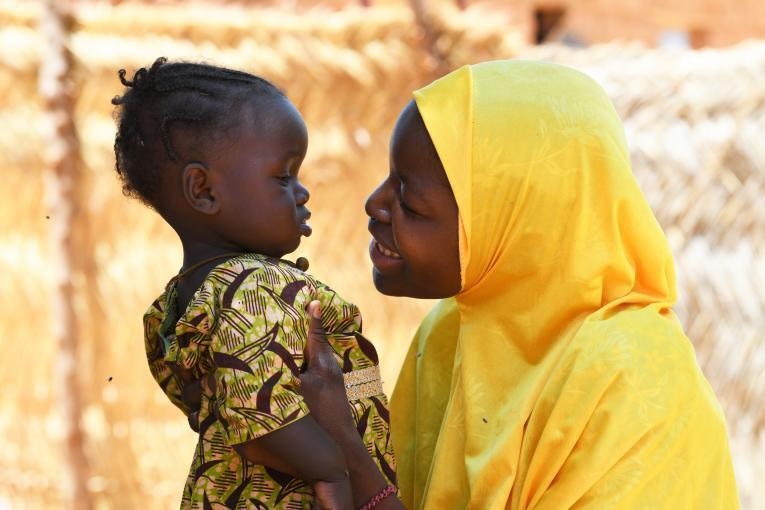
A mother cuddling her baby in Soki village, central Niger.©UNICEF/Dejongh
P4H network and the global action plan for SDG3: leveraging existing collaboration for sustainable health funding
Given the critical importance and urgency of establishing free healthcare to achieve UHC in Niger, the government has initiated ambitious reforms to its health financing system. This move was partly driven by the highly fragmented nature of external health funding, which necessitated improved coordination and harmonization among partner organizations providing health financing support and technical assistance. Learning from previous initiatives like the FCS, Niger has focused on enhancing coordination among health partners, notably through Providing for Health (P4H), the global health financing and social protection network, active in Niger since 2018. In 2021, members of the P4H network and signatory organizations of the Global Action Plan for Healthy Lives and Well-being for All (Global Action Plan for SDG3) joined forces to recruit an in-country focal point. This individual’s role is to support and facilitate health financing coordination and pragmatic research, with the leadership and backing of the government.
The process of recruiting this country focal point, including validating shared objectives and developing the terms of reference, was facilitated by Gavi in collaboration with all health financing partners in Niger. Gavi’s national mandate as the official “co-rapporteur” for health financing partners was then assumed by the national focal point for the P4H and Global Action Plan financing accelerator in January 2022. Within the Ministry of Health, this focal point serves as a crucial interface with technical and financial partners. Their primary role is to help coordinate partner support for funding and implementing projects aligned with national health priorities, thereby enabling the Ministry of Health to be “less agency-centric.” The financing mechanism for this new position, previously managed by WHO with AFD funding, has been transferred to the World Bank, supported by the Global Financing Facility, with predictable co-financing arrangements for the role currently under consideration. These efforts are laying the groundwork for more harmonized and collective support, enabling Niger to realize its ambitious vision for UHC.
strengthening Niger’s health financing system: key initiatives and impact
Before 2020, resource fragmentation led to “underfunding or overfunding of many initiatives,” recalls Charlotte Pram Nielsen, Senior Specialist for Sexual and Reproductive Health, Rights, and Gender at the Global Financing Facility. In the realm of health financing, partners from different areas were not accustomed to collaborating effectively. Thanks to the partnership between the P4H network and the Global Action Plan’s financing accelerator, numerous partners are now enthusiastic and committed to supporting the government’s health financing efforts. This partnership allows for “framing discussions within the broader context of social protection programs and considering the expansion of fiscal space policies that impact health outcomes, such as social protection for women and children,” states Lou Tessier, Health Protection Specialist at the ILO.
In 2020, health financing partners prioritized supporting Niger in areas such as COVID-19 response, domestic resource mobilization, resource optimization, effective development cooperation, and transversal investments. The government identified the following key priorities for support:
- Alignment of budget support with strategic and harmonized health expenditure indicators.
- Reform of the FCS to enhance its fungibility and transition it from a management tool to a financing system.
- Implementation of strategic purchasing, with practical support from the National Institute for Medical Assistance (INAM).
- Improved predictability of technical and financial partner contributions and annual activity planning.
Specific objectives were established to achieve these priorities:
funding harmonization:
- Mapping donors, health financing flows, and channels, along with a critical analysis of health financing harmonization (supported by the Global Financing Facility).
- Trajectory and future of the FCS (supported by WHO/P4H).
- Financing channels for the investment case (supported by the Global Financing Facility).
support harmonization:
- Mapping and critical analysis of technical assistance for health financing.
financing system and tools:
- Analysis of operational modes for free healthcare and universal health insurance strategies (supported by WHO/P4H, AFD, and FCS).
efficiency and optimization tools:
- Development and deployment of a calculation tool to simulate production and financing costs for peripheral care (supported by AFD, FCS, and the Global Financing Facility).
- Identification of strategies for improving and reforming the healthcare chain from the bottom up to identify and disseminate low-cost innovations in various contexts (supported by AFD, FCS, and the Global Fund).
domestic resource mobilization and improved health expenditure allocation:
- Engaging with the IMF to design its programs to include expenditures on indicative targets, such as vaccination and nutrition;
- Advocating for greater resource allocation to primary healthcare and vaccination during high-level missions and meetings between Global Action Plan for SDG3 signatory organizations and the government.
Additional support is required for analyses on streamlining/reorganizing technical committees within the Ministry of Health as part of program budget reform, and for policy analyses and proposals aimed at enhancing the national financing system and the efficiency of health spending.
While not yet fully operational, this collaborative strategy for health financing, focused on the country’s main priorities, will ultimately improve health service delivery. For instance, the Global Financing Facility, employing a resource optimization approach, is tasked with identifying and tracking resources to understand what each agency funds. This prioritization of resources and approaches among different partners helps to “avoid duplication and, consequently, intervene more targetedly, which would ultimately improve the lives of more people,” notes Moussa Bizo from the WHO Niger Office. Furthermore, the resource optimization methodology could bring additional benefits, such as enabling the Global Fund or Gavi to invest more strategically in funding services for HIV, tuberculosis, malaria, and vaccination, respectively. As the free healthcare policy covers these programs, financing reform would contribute to better operationalization of INAM, thereby reducing out-of-pocket expenses for poor and vulnerable populations.
learning, challenges, and future outlook
Joint focal points, integrated within the Ministry of Health and sustainably funded, add significant value by facilitating coordination and alignment of partner support to the government. This is particularly relevant in a context where a substantial portion of health sector funding originates from external sources.
Despite the enthusiasm surrounding this ambitious initiative, challenges persist. The focal points from the agencies participating in this partnership face heavy workloads, which could negatively impact the initiative’s sustainability. Ensuring that personnel can dedicate the necessary time within each organization is therefore crucial.
Another challenge involves clarifying the long-term funding modalities for the in-country focal point position, a central pillar of these collective efforts. The Global Financing Facility has extended its funding for six months, and Gavi is currently leading discussions on support from other partners who are keenly interested in improving the sustainability of health financing in Niger.
Lessons learned from this pilot partnership will be shared with other countries and partner organizations to address the demand for joint focal points and more harmonized, coordinated support for health financing.
what is the global action plan for SDG3?
The Global Action Plan for Healthy Lives and Well-being for All (Global Action Plan for SDG3) represents a set of commitments made by 13 key organizations involved in health, development, and humanitarian action. Its purpose is to assist countries in accelerating progress towards health-related SDG targets. The added value of the Global Action Plan for SDG3 lies in strengthening inter-agency collaboration to undertake joint actions and provide more coordinated support, aligned with country-led national plans and strategies. The Global Action Plan for SDG3 was updated with a recovery strategy (October 2021) to ensure an equitable and sustainable recovery post-COVID-19 pandemic, aiming to achieve health-related SDG targets.
The objective of these case studies is to monitor the implementation of the Global Action Plan at the national level.