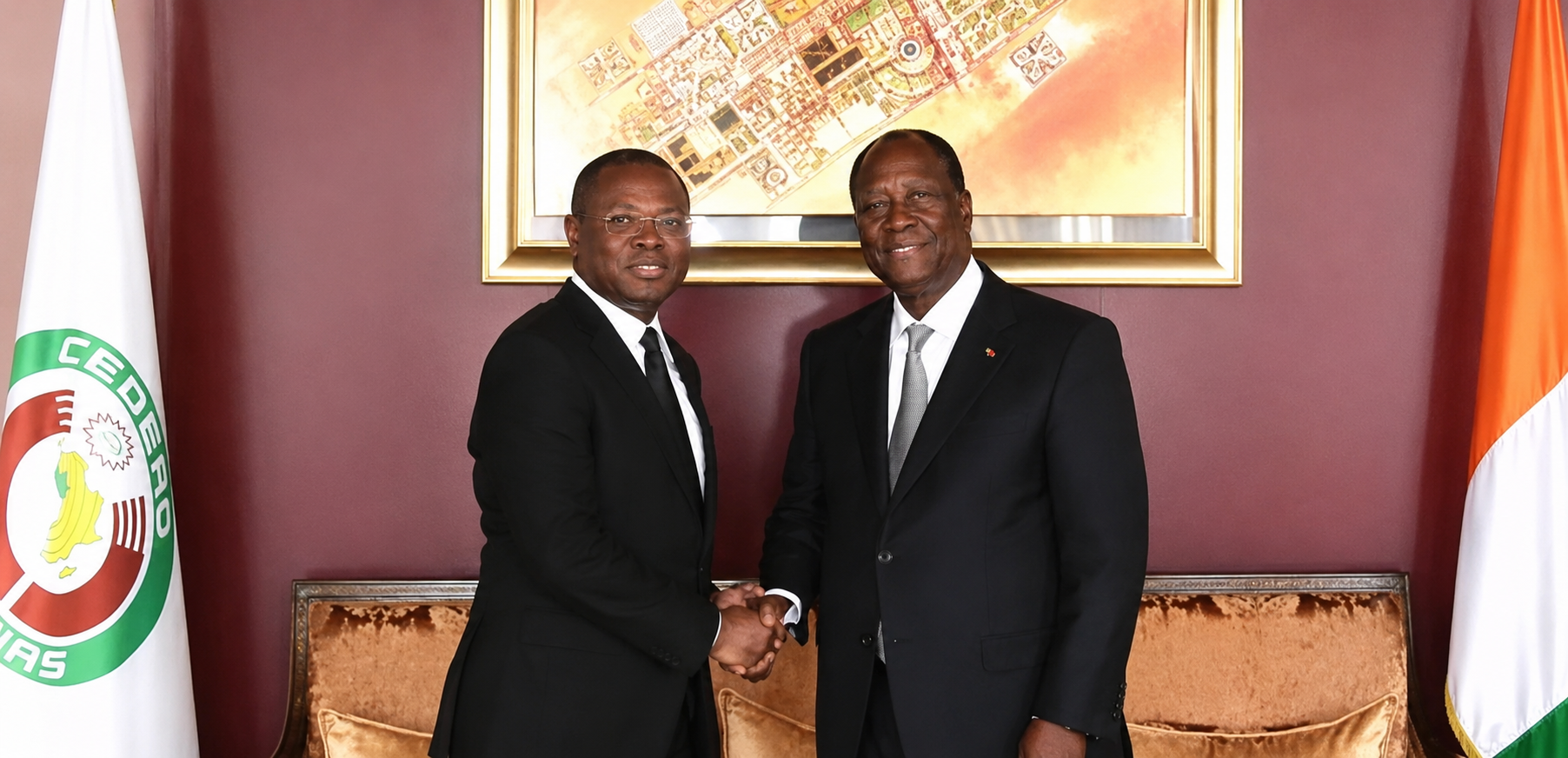
Following his inauguration, Bénin’s newly elected President Romuald Wadagni has opted to embark on his first official foreign visit to Côte d’Ivoire. This decision transcends mere protocol; it represents a pivotal diplomatic shift anchored in economic pragmatism and regional cooperation.
The choice of Abidjan as the destination for this high-level engagement underscores both boldness and calculated strategic foresight. By prioritizing Côte d’Ivoire, President Wadagni signals a clear intention to anchor Bénin’s foreign policy in models of proven economic success.
Abidjan as a benchmark for economic transformation
Côte d’Ivoire, under the leadership of President Alassane Ouattara, has emerged as a regional economic powerhouse within the West African Economic and Monetary Union (UEMOA). The country’s trajectory—marked by sustained growth, modernized infrastructure, and unprecedented financial attractiveness—positions it as an ideal partner for Bénin’s own developmental ambitions.
For President Wadagni, a seasoned technocrat and former Minister of Economy and Finance, this visit is more than a diplomatic gesture; it is an opportunity to engage with a leadership that embodies managerial excellence and fiscal discipline. The discussions in Abidjan are expected to center on infrastructure development, debt management, and strategies to enhance regional financial integration—key pillars of Bénin’s own economic roadmap.
Strengthening regional ties in a shifting landscape
The timing of this visit is particularly significant. West Africa faces evolving challenges, from security concerns to the imperative of industrial transition. Bénin, already advancing through structural reforms and flagship projects such as the Glo-Djigbé Industrial Zone (GDIZ), stands to benefit substantially from deeper collaboration with Côte d’Ivoire, the region’s economic heavyweight.
The anticipated outcomes of this engagement include:
- Economic and financial alignment: Harmonizing debt management strategies, attracting foreign direct investment, and reinforcing regional financial markets to foster shared prosperity.
- Institutional knowledge exchange: Studying Côte d’Ivoire’s successful strategies in large-scale infrastructure projects and economic recovery initiatives.
- Enhanced security cooperation: Strengthening joint responses to regional geopolitical challenges and consolidating positions on critical security matters.
A diplomatic doctrine rooted in excellence
This inaugural international engagement sets the tone for President Wadagni’s foreign policy vision: an unapologetically results-driven approach, prioritizing partnerships with high-performing economies. By aligning Bénin with Côte d’Ivoire’s trajectory, he signals a commitment to positioning the country among Africa’s most dynamic and forward-thinking nations.
The message is clear: Bénin is not merely engaging in diplomacy for the sake of protocol. It is forging alliances that will drive sustainable development, economic resilience, and regional leadership. As Cotonou and Abidjan lay the groundwork for a new chapter in their bilateral relationship, the broader West African community is closely observing this strategic realignment—a move that could redefine the subregion’s economic and political landscape.