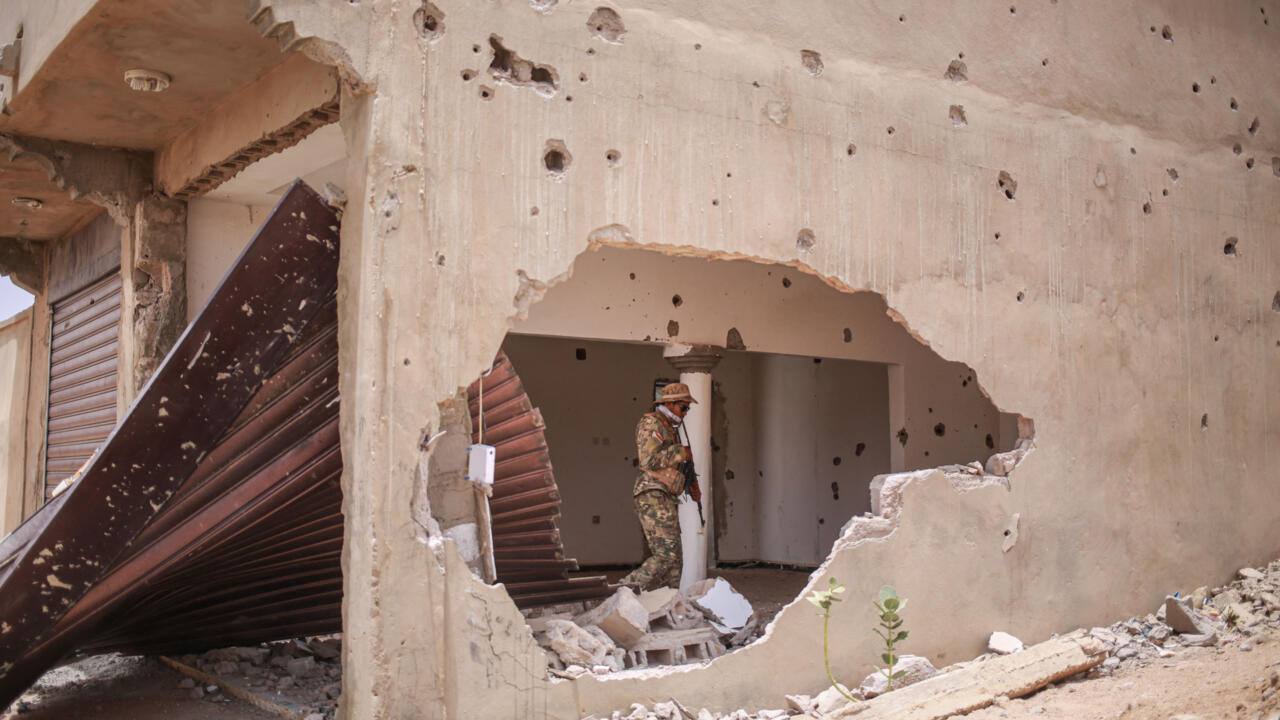
The Timbuktu Institute, an African peace research center based in Senegal, has published a critical analysis titled “Mali: anatomy of a security earthquake”. This report examines the recent surge in coordinated attacks that resulted in the death of Mali’s Defense Minister, General Sadio Camara, and the fall of Kidal to armed groups on April 25th. These events raise urgent questions about Mali’s security framework, its partnerships with Russia and the Alliance of Sahel States (AES), public sentiment within Mali, and the unexpected alliance between the Group for Support of Islam and Muslims (JNIM) and the National Liberation Front of Azawad (FLA).
Russia’s security partnership with Mali under scrutiny
Bakary Sambe, Director of the Timbuktu Institute in Dakar, asserts that the April 25th attacks have exposed the “failure of security outsourcing” to external actors like Russia. The death of General Sadio Camara and the chaotic withdrawal of the Africa Corps from Kidal symbolize what he describes as “the collapse of the Wagner-Africa Corps myth” in Mali. Following the withdrawal of Barkhane forces, which had at least some civil-military development aspects, outsourcing security to Moscow has proven ineffective against locally entrenched guerrilla warfare.
Sambe notes that while attacks are inevitable when a country faces armed groups, the Africa Corps remains visibly present alongside Malian forces. However, the chaotic retreat from Kidal and Tessalit demonstrates that outsourced security solutions have not delivered results in Mali.
the AES alliance’s limited role in Mali’s crisis
The analysis also highlights the limitations of the Alliance of Sahel States (AES), designed as a mutual defense pact. Despite the Liptako-Gourma Charter invoking solidarity akin to NATO Article 5, neither Niger nor Burkina Faso provided military support after the April 25th attacks. While regional leaders condemned the attacks as a “monstrous plot”, practical mobilization did not follow. Burkina Faso, already grappling with its own security challenges, prioritized domestic concerns over collective action.
public sentiment and the paradox of regime support
Sambe describes public reaction in Mali as “paradoxical”. Despite unmet security promises, the regime of General Assimi Goïta has seen a temporary surge in patriotic rallying. The legitimacy of the transitional government now hinges almost entirely on its security narrative, and recent attacks have paradoxically reinforced national unity behind the flag. This dynamic, though perplexing to external analysts, reflects a uniquely Malian response to crisis.
the fragile jihadist-rebel alliance
The coordinated attacks have forged a tactical alliance between the JNIM, linked to al-Qaeda, and the FLA, an independence movement. This partnership presents a “new strategic constraint” for Malian authorities but is unlikely to endure. Sambe argues that the alliance is driven by shared opposition to the Bamako regime and pragmatic interests, such as illicit trafficking and the influence of Iyad Ag Ghaly.
The fundamental differences in objectives—JNIM’s push for Sharia law versus FLA’s demand for Azawad autonomy—pose significant challenges to long-term cohesion. Additionally, the dominance of Katiba Macina elements within JNIM raises questions about their willingness to support Azawad’s independence. Sambe suggests this alliance may be a temporary convergence rather than a lasting coalition.
However, the JNIM’s evolving discourse, positioning itself as a national political actor, could signal a shift. Figures like Bina Diarra exemplify efforts to rebrand JNIM as a homegrown movement, potentially opening doors to future negotiations. This strategic repositioning may position JNIM as a potential participant in national dialogue, a prospect increasingly discussed among Malian political actors.
the inevitability of dialogue
Sambe emphasizes that dialogue has become an “inescapable necessity” in addressing Mali’s security crisis. The “endogenization of jihad” means that militant groups are now embedded within Malian society, with fighters indistinguishable from ordinary citizens. Public sentiment increasingly favors inclusive dialogue, with even those considered lost to extremism being seen as part of the nation’s fabric. This shift underscores the urgency of addressing the crisis through negotiation rather than solely military means.