The current political landscape in Sénégal is far more than a mere clash of personalities—it exposes a deep-seated tension between institutional legitimacy and the authority vested in a charismatic leader. This phenomenon, often dissected in political science, can lead to what scholars describe as hubris, where power becomes synonymous with the individual rather than the system.
Ousmane Sonko’s rise: a challenge to the status quo
Ousmane Sonko’s meteoric rise in Sénégal’s political arena is rooted in a bold rejection of the traditional power structures that have long dominated the country. His discourse—centered on national sovereignty, dignity, and the empowerment of citizens—has resonated deeply with a younger generation disillusioned by perceived corruption and opacity in governance. While he once floated the idea of a “harmonious cohabitation” with the presidency, recent events have reshaped the balance of power in unforeseen ways.
A rapid political reshuffle
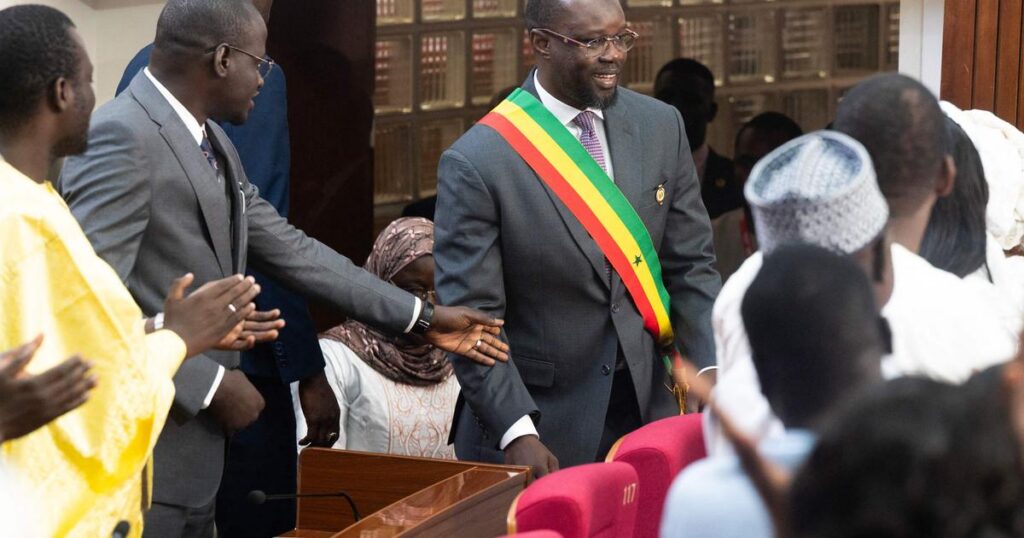
The events of late May unfolded with remarkable speed. On May 22, President Bassirou Diomaye Faye removed Ousmane Sonko from his role as Prime Minister. The very next day, Malick Ndiaye, then Speaker of the National Assembly, resigned, strategically clearing the way for a new parliamentary leadership. By May 25, Ahmadou Alhaminou Mohamed Lô had been appointed Prime Minister, and on May 26, Ousmane Sonko was elected Speaker of the National Assembly with an overwhelming 132 votes out of 165 deputies. This historic shift has positioned him as the leading opposition figure within his own party, the Pastef, which he founded. While some hail this as a landmark moment, critics have framed it as an institutional coup, pitting Sonko against his former ally, President Faye.
The Pastef, which unanimously supported Sonko’s election, now faces a critical question: will it endorse the new government led by the technocratic Prime Minister? The ruling party has made its stance clear, insisting on adherence to the 2024 election manifesto—a document largely shaped by Sonko himself. His recent statements reflect a delicate balance between reassurance and firmness, warning that the National Assembly will “fully exercise its constitutional prerogatives” while expressing frustration over the lack of consultation in the Prime Minister’s appointment. Meanwhile, Sénégal’s sovereign credit rating has been downgraded from “stable” to “negative,” underscoring the economic and political uncertainties at play.
Charismatic leadership vs. institutional stability
The allure of a charismatic leader cannot be underestimated. Such figures often galvanize public support by embodying the aspirations of a nation, but their dominance can also undermine the very institutions meant to ensure democratic continuity. The current crisis in Sénégal exemplifies this paradox: where does true power reside—with the elected president or the movement leader? Is legitimacy derived from the ballot box or from grassroots mobilization? These questions highlight a fundamental truth: no democracy can thrive when power is concentrated in a single symbolic figure.
Ousmane Sonko’s influence extends far beyond his role as Prime Minister. He represents not just the head of government but also the leader of a movement, a militant voice, and the emotional embodiment of a significant segment of Sénégal’s youth. This multifaceted role, while inspiring, carries inherent risks. When a leader becomes synonymous with the state, the movement, and the people, the boundaries between personal ambition and collective governance blur dangerously. The danger lies not in overt authoritarianism but in the gradual erosion of institutional independence, as other actors—including Parliament—struggle to assert themselves as independent counterweights.
The test of institutional resilience
The core challenge facing Sénégal today is not moral but structural: Can Ousmane Sonko accept the supremacy of institutional legitimacy over personal charisma? Can he embrace the idea that the movement he spearheaded is no longer solely his to command? The transition from opposition leader to statesman demands a different set of skills—compromise, deference to institutional hierarchies, and even the willingness to step back for the greater good of the nation.
Across Africa, numerous movements have thrived in opposition only to falter when confronted with the complexities of governance. Leadership in power requires a different kind of vision—one that prioritizes the durability of the state over the cult of personality. The fate of the Pastef and, by extension, Sénégal’s democratic stability, hinges on whether Sonko can navigate this delicate transition. His choices in the coming months will determine whether charisma will serve as a bridge to stronger institutions—or a wedge that deepens divisions.
The coming weeks will reveal whether Sénégal can reconcile the energy of its political movements with the necessity of institutional robustness. The answer to this question will shape not only the future of the Pastef but also the very foundations of the country’s democracy.