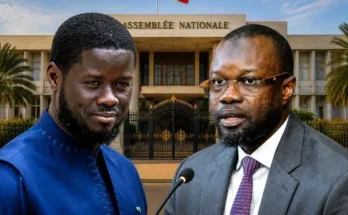
Recent political analysis highlights a growing rift between President Bassirou Diomaye Faye and Prime Minister Ousmane Sonko in Senegal. This perceived personal conflict is viewed by observers as a crucial test for Senegal’s democratic transition, impacting the nation’s political stability.
An enduring African proverb, warning that the grass suffers when two elephants clash, aptly describes the current situation in Senegal. Just two years ago, Senegal was celebrated as a beacon of democratic renewal across West Africa. The election of Bassirou Diomaye Faye, significantly propelled by Ousmane Sonko and the Pastef movement, ignited widespread optimism, extending far beyond Senegalese borders.
The triumph of Faye was born from unique circumstances. Barred from the 2024 presidential race due to legal issues, Sonko made an extraordinary decision: instead of delaying the democratic process or prolonging political confrontation, he channeled his entire political capital behind Bassirou Diomaye Faye. This transformed a relatively unknown candidate into a historic victor. Such a profound act of personal sacrifice, analysts suggest, was instrumental in securing massive voter support for their joint ticket.
Debt management sparks divergence
The current divergence, according to political commentators, doesn’t stem from deep ideological differences but rather from the complexities of managing a national budget. A higher-than-anticipated public debt level was discovered, creating a more challenging fiscal landscape. Sonko advocates for a philosophy of economic sovereignty and has publicly opposed any debt restructuring. In contrast, President Faye aims to reassure financial markets and development partners while carefully avoiding the economic and political risks associated with formal debt restructuring. The Minister of Economy and Finance recently confirmed that the government is not considering this option.
These differing approaches, while not entirely opposing economic doctrines, underscore the tension between the transformative ambitions that galvanized the electorate and the pragmatic constraints of governing. However, observers note that long-term political calculations are increasingly influencing perceptions of these disagreements, potentially overshadowing the reform agenda itself.
Institutional reforms and the test of trust
Ironically, the political movement that ascended to power promising to strengthen democratic institutions now finds itself challenged by the very institutional questions it vowed to address. Recent proposals for constitutional revision, intended to rebalance executive and parliamentary powers, have become a new focal point of national debate. Supporters link these proposals to Pastef’s historical platform and the National Assizes, while detractors question their timing and implementation methods.
This scenario highlights a fundamental democratic lesson: constitutional reform is judged not solely by the quality of its legal text but also by the political trust surrounding its execution. Democracy, as emphasized by analysts, relies as much on the constitutional conduct of leaders as it does on the legal framework itself.
For the average Senegalese citizen, the true stakes are not about who prevails in this political dynamic, but whether jobs will be created for the burgeoning youth, if the cost of living will be controlled, and if schools and hospitals will improve. Every day spent navigating political tensions is, in their view, a day not fully dedicated to implementing the transformative agenda that inspired so many Senegalese to vote for change. Despite these internal challenges, Senegal’s democratic institutions demonstrate resilience; the judiciary continues to operate, Parliament remains active, and political disagreements are, for now, strictly contained within constitutional processes, unlike other regional crises marked by coups or insurrections.