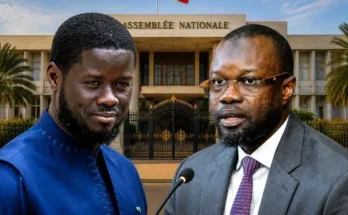
The terse official statement conceals a seismic shift at the heart of Senegal’s political leadership. Less than two years after their historic 2024 victory, the duo that embodied a generation’s aspirations has publicly fractured—potentially ending the most transformative political narrative Senegal has witnessed since the landmark 2000 transition.
The rise of Ousmane Sonko and Bassirou Diomaye Faye was built on an unshakable promise of solidarity. « Diomaye moy Sonko » (Sonko is Diomaye and Diomaye is Sonko, in Wolof), chanted by Senegalese youth in the streets of Dakar, Ziguinchor, and Thiès, became the rallying cry of a movement.
From campaign slogan to political trap
Yet the rupture did not materialize overnight. Tensions simmered long before the duo took office in April 2024. At the time, Diomaye Faye was not the party’s first choice; barred from running due to a defamation conviction, Sonko had tapped his loyal lieutenant to carry the Pastef’s banner. The « Diomaye moy Sonko » slogan served as an electoral bridge, convincing voters that backing Faye equated to backing Sonko. The strategy proved devastatingly effective: buoyed by Sonko’s popularity, Faye secured a first-round victory with nearly 54% of the vote.
Once in power, however, the balance grew increasingly unsustainable. Sonko remained the regime’s de facto gravitational center, aggressively asserting his influence and repeatedly reminding observers that the « vision » belonged first to the Pastef. Meanwhile, Faye began carving out his own identity as head of state, particularly on security and diplomatic files—a development some party loyalists viewed as a departure from the movement’s foundational ideals.
The cracks widened long before the fall
Officially, no justification was provided for the dismissal. Yet in Dakar, few were surprised. For months, signs of discord had mounted between the two men. The president accused his prime minister of an « excessive personalization of power » and an oppressive media presence. In early May, Faye delivered a televised warning that echoed like a preemptive strike: « As long as he remains prime minister, it is because he enjoys my trust. When that is no longer the case, there will be a new prime minister. »
Sonko, meanwhile, showed no restraint. As the undisputed leader of the Pastef—which secured a parliamentary majority in November 2024—he continued to speak to party militants as the true steward of the project that had opposed Macky Sall’s administration. Behind the scenes, two factions had crystallized: « legalists » loyal to the president, eager to establish an autonomous presidency, and « Sonko loyalists », convinced that Faye was merely a temporary vessel for the popular mandate embodied by Sonko.
By late 2025, the president had begun consolidating his own political machinery under the « Diomaye Président » movement, systematically sidelining Sonko’s inner circle. In response, Sonko’s camp escalated public warnings, framing Faye’s moves as a betrayal of the Pastef’s original promises. The electoral reform passed in April—widely seen as paving the way for Sonko’s potential 2029 candidacy—only deepened the rift. In Dakar, many interpreted it as the launch of an early presidential campaign.
The IMF, debt, and fuel: the economic fault lines
The most profound disagreement, however, centered on economic governance. As the new administration took stock of Senegal’s staggering debt—allegedly underreported by the previous administration—negotiations with the International Monetary Fund (IMF) became a flashpoint. The IMF suspended a $1.8 billion program, forcing the executive into precarious talks with international creditors.
Within presidential circles, Sonko was criticized for adopting a stance perceived as too rigid in negotiations with the IMF, particularly on fiscal reforms and energy subsidies. Meanwhile, his allies accused Faye’s camp of abandoning the Pastef’s sovereignist and social promises. The Finance Minister, Cheikh Diba, reportedly warned of the mounting cost of fuel subsidies amid soaring debt—now equivalent to 132% of GDP, according to IMF estimates—with disagreements over potential price hikes paralyzing the government.
The final provocation
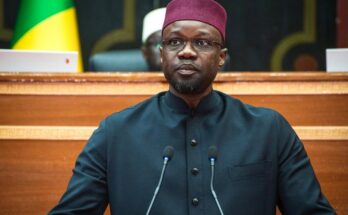
Just hours before his dismissal, Sonko addressed parliament with characteristic defiance. When questioned about a contentious law criminalizing homosexuality, he railed against what he termed « Western tyranny », accusing foreign powers of seeking to « impose » their values on Senegal. His refusal to entertain even a « moratorium » on the law’s enforcement drew thunderous applause from Pastef lawmakers but alarmed Western partners at a time when Dakar was desperate to restore financial credibility with the IMF. Within hours, Faye moved to reclaim control.
A night of unrest in Dakar
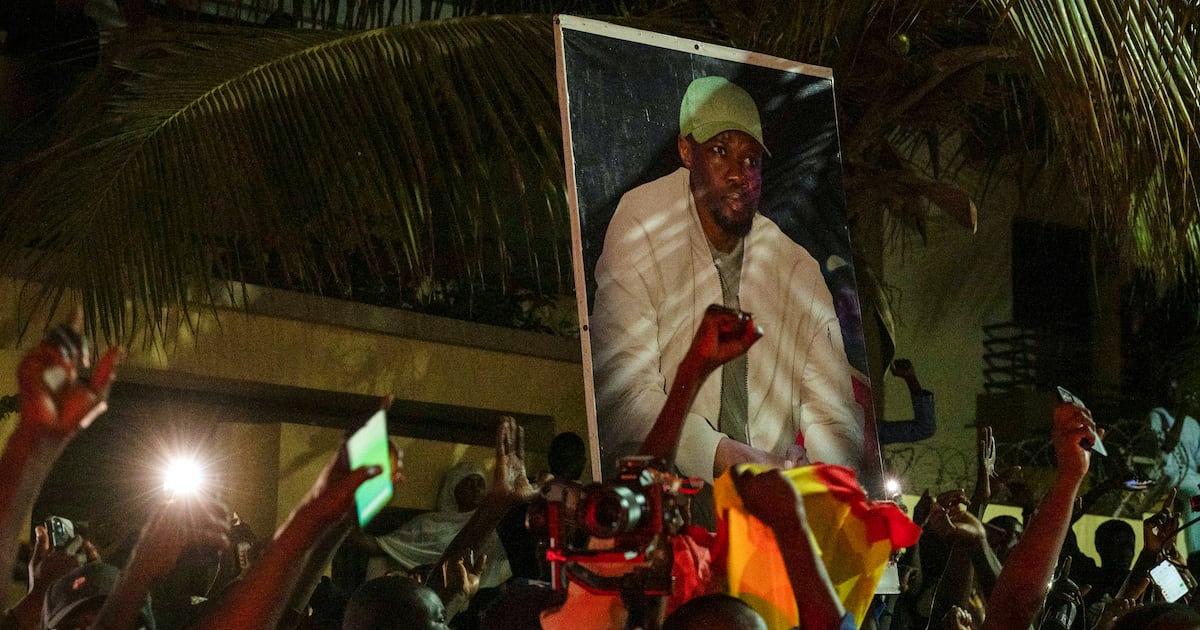
The presidential decree had barely been announced when social media erupted. By midnight, hundreds of supporters had gathered outside Sonko’s home in Keur Gorgui, chanting his name and denouncing what they called a « betrayal. » Within minutes, Senegal’s digital sphere had become a cauldron of outrage over an inevitable rupture months in the making.
Reactions poured in swiftly. Former Dakar mayor Barthélémy Dias urged calm while decrying a « grave institutional crisis. » Franco-Spanish lawyer Juan Branco, a longtime ally of Sonko, went further, labeling it « the greatest betrayal in Senegal’s modern history. »
The morning’s headlines captured the shock: « The fracture, » « Diomaye seizes power, » « Farewell to the duo, » and « War at the summit. » Foreign diplomats in Dakar now watch with unease, as the fallout extends beyond ego clashes—it signals the end of the fragile equilibrium that enabled the 2024 alternance after years of turmoil under Macky Sall, marked by deadly protests, mass arrests, and deep institutional distrust.
The impossible cohabitation
At its core, the crisis exposes an inherent contradiction: could Senegal’s government sustain two centers of power indefinitely? Faye held constitutional legitimacy as head of state, while Sonko commanded immense militant legitimacy, particularly among urban youth and Pastef cadres. For two years, the regime attempted to reconcile the two figures. But in Senegal, where the presidency has historically monopolized political authority, duality was never sustainable.
By May 2026, Faye had publicly cautioned that the government risked sinking into « personal ambition. » Weeks later, he reminded the nation that he alone held the constitutional power to appoint—and dismiss—his prime minister. On Friday evening, he acted.
The divorce ushers in a perilous new chapter. Sonko retains control over the Pastef and parliamentary majority, while Faye wields the state apparatus and presidency. The battle for 2029 has likely begun. Yet for many Senegalese, the graver concern lies elsewhere: youth unemployment, soaring living costs, record debt, and the unfulfilled promises of the 2024 alternance. Amid the power struggle, the fear is that the hope born from that historic transition may dissolve into the fractures of governance.
The president must now appoint a new prime minister, subject to parliamentary approval within three months.