In Benin, traditional leaders hold a pivotal sociocultural role, deeply embedded in the nation’s institutional fabric. They serve as guardians of local heritage, embodying the values and identities that define communities while acting as moral compasses for their people (Affo, Sina, & Gnanvi, 2019).
To formalize their contributions—particularly in conflict resolution and social cohesion—the Beninese government enacted Law No. 2025-09 of April 3, 2025, establishing a legal framework for traditional chieftaincies. This landmark legislation categorizes and legally recognizes 16 kingdoms and 90 traditional chieftaincies, acknowledging their role in socioeconomic development, social cohesion, and cultural preservation (Fatondji, 2025).
Despite their institutional standing, traditional leaders often find themselves entangled in the political arena. Political parties frequently enlist their support to sway voter preferences, sometimes offering material incentives in return (Cessou, 2017). In response, Benin has prohibited traditional rulers from engaging in partisan politics to curb these practices (République du Bénin, 2025).
Amid this evolving landscape, public perception of traditional leaders has come under scrutiny. Recent data reveals nuanced views among Beninese citizens: nearly a quarter reported interacting with traditional leaders in the past year, with a majority expressing trust in their ability to influence local governance. There is even a strong desire among citizens to see this influence expand.
However, concerns about integrity are mounting. Three-quarters of respondents believe some traditional leaders are involved in corruption—a perception that has grown since 2022—while confidence in their leadership has declined compared to 2020.
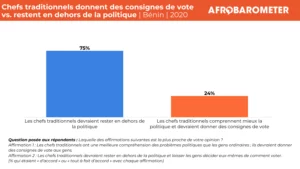
Despite their respected position, the majority of citizens argue that traditional leaders should refrain from political involvement, insisting that voting decisions remain in the hands of the electorate.