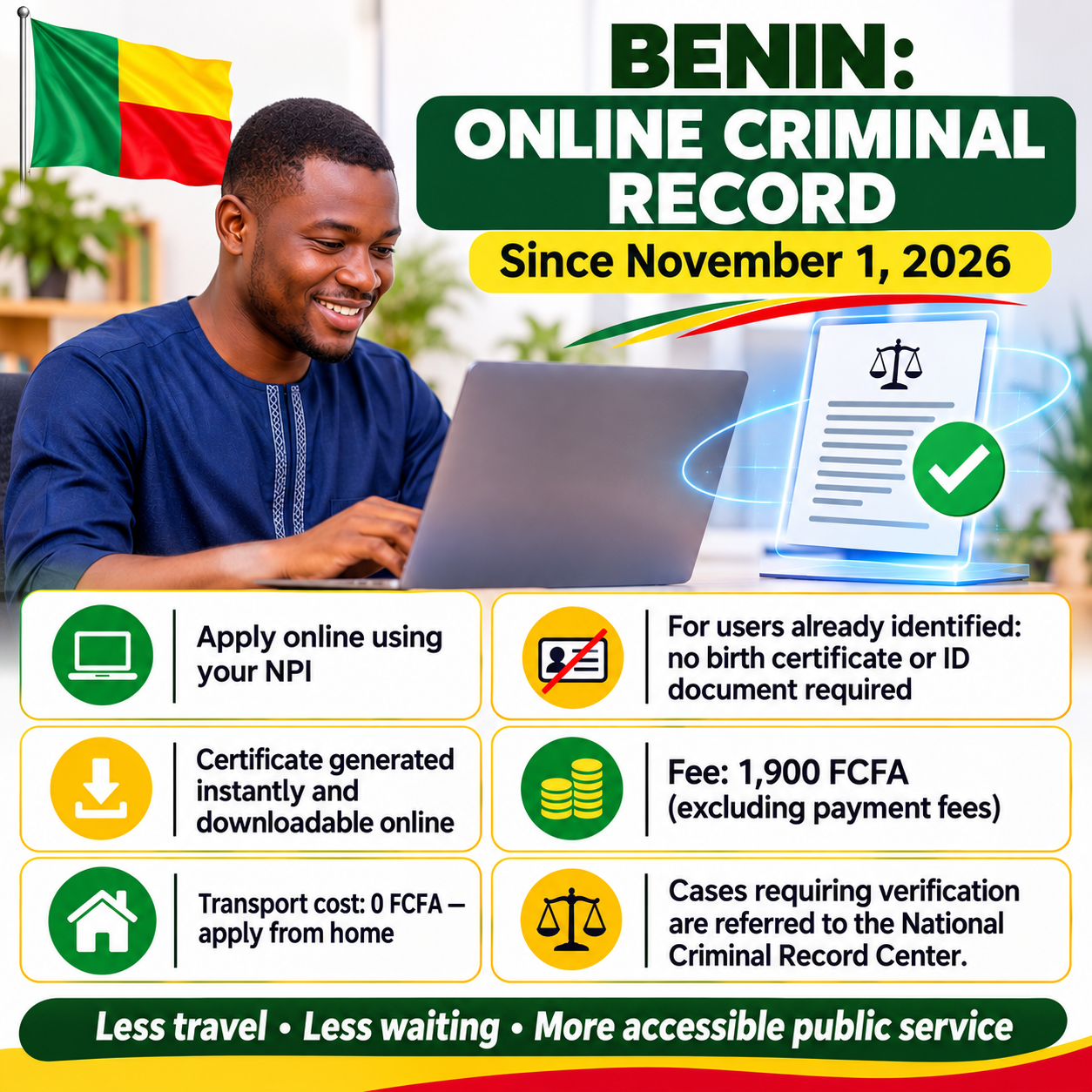
Benin has launched a streamlined digital system for obtaining criminal records, eliminating the need for in-person visits and reducing bureaucratic delays. Citizens with registered national identification numbers can now download their official documents instantly through an online portal, marking a significant step in the country’s digital governance reforms.
Eliminating the burden of physical document requests
Previously, obtaining a criminal record certificate required multiple trips to government offices, often involving long waits, travel expenses, and lost work hours. This process disproportionately affected residents in remote areas, diaspora communities, and professionals unable to take time off for administrative tasks.
Under the new system, individuals with verified identification can access their records online by using their Numéro Personnel d’Identification (NPI), eliminating the need to submit additional supporting documents such as birth certificates or national identity cards.
Key benefits of the digital shift
Zero travel costs: No more spending on transportation to government offices.
Time savings: Requests are processed and delivered instantly, removing waiting periods.
Remote accessibility: Diaspora communities can now request documents from abroad without intermediaries.
How the new process works
Citizens initiate requests through Benin’s national public services portal. Once verified via their NPI, the system automatically generates and releases the document for download at a fixed fee of 1,900 FCFA (excluding payment processing charges).
While most requests are processed digitally, cases requiring manual review are flagged and redirected to the Centre national du casier judiciaire for validation. This ensures document authenticity while maintaining efficiency.
A wider digital governance strategy
The criminal record service is part of a broader modernization initiative launched in 2020 to digitize administrative procedures. Earlier reforms allowed residents to apply for certain documents online from anywhere, including abroad. The latest expansion prioritizes accessibility and operational efficiency, positioning Benin alongside other African leaders in digital public service delivery.
Who benefits most from the change?
The simplified process particularly supports:
Working professionals: Reduced absenteeism from workplace obligations.
Students and job seekers: Faster document acquisition for applications.
Rural residents: Elimination of long-distance travel burdens.
Diaspora communities: Seamless access without physical or intermediary assistance.
A model for other African nations
Benin’s approach demonstrates how digital innovation can transform public service delivery across Africa. Many countries still require citizens to travel long distances, queue for hours, and incur repeated costs to obtain basic official documents. Benin’s model shows that remote, real-time document access is possible, aligning public administration with modern citizen expectations.
The country’s ongoing reforms reflect a commitment to administrative efficiency, data protection, and equitable service access. While challenges remain for digitally excluded populations, the system prioritizes inclusivity by simplifying procedures and maintaining high standards of document integrity.
Looking ahead: balancing progress with accessibility
Benin’s digital transformation is not merely a technological upgrade it is a shift toward citizen-centered governance. By removing administrative barriers, the government is reinforcing trust in public institutions and demonstrating that digital solutions can serve real human needs.
The success of this initiative underlines the broader potential for African governments to leverage technology in creating faster, fairer, and more affordable public services. As Benin continues to refine its systems, its experience offers valuable lessons on how digital governance can bring administrations closer to the people they serve.
By Nicolas Biyong — Journalist