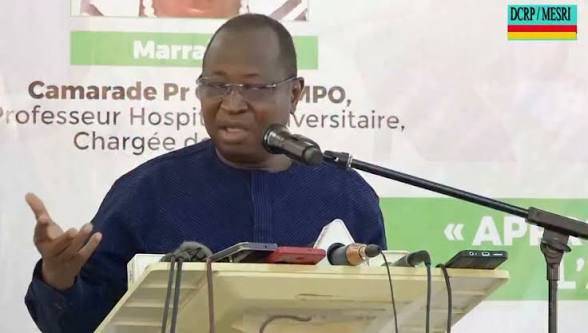
Burkina Faso’s higher education system is facing a stark erosion of academic freedom after the country’s minister of higher education, Professor Adjima Thiombiano, issued a sweeping ultimatum to students in the diaspora. During a flag-raising ceremony at the Ministry of Education, the minister publicly condemned young graduates studying abroad for voicing concerns—however mild—about the nation’s educational system or broader governance. His response was not one of dialogue or reform but a blunt directive: students who find fault with Burkina Faso should simply “go back where they came from”.
Criminalising dissent: the new university policy
This alarming declaration is not an isolated incident but part of a broader pattern under the current administration. The government’s intolerance for criticism has reached such a point that even constructive feedback on public policy is treated as an act of subversion. Students who question the status quo are no longer seen as engaged citizens but as threats—as potential infiltrators, destabilisers, or traitors. Such rhetoric fosters an environment of pervasive fear, where faculty and students alike practice self-censorship to avoid reprisal.
In a chilling call to action, the minister urged ministry officials and educators to “stand as a bulwark against behaviour approaching rebellion”. This thinly veiled incitement to surveillance and denunciation signals a dangerous shift toward institutionalised policing in universities, where students may now be flagged and targeted for their intellectual dissent.
Nationality under threat: who belongs in Burkina Faso?
The minister’s words raise a critical question: Is Burkinabè citizenship now conditional? By equating dissent with disloyalty and equating loyalty with silent obedience, the regime has blurred the line between patriotism and authoritarianism. This approach sends a stark message to the diaspora—a group often encouraged to return and contribute their skills—that their value lies only in unquestioning compliance.
They are told they are welcome to return—but only if they abandon their critical voice. This is not nation-building; it is ideological control disguised as national pride.
The NEKRÉ Pact: education by decree, not inquiry
The clampdown coincides with the government’s rollout of the NEKRÉ Pact, described as a sweeping reform initiative to overhaul education from preschool to university. Yet what kind of educational renaissance can emerge when the free exchange of ideas is suppressed? Historically, universities have thrived on debate, contradiction, and intellectual risk. They are meant to be spaces where knowledge is questioned, refined, and expanded—not where it is dictated.
By turning lecture halls into ideological barracks and scholarship into a display of blind allegiance, the authorities are gutting the very essence of education. A system that silences its students fears its own inadequacy. Behind the rhetoric of pride and institutional protection lies a calculated assault on academic independence, freedom of thought, and the right to intellectual autonomy within Burkina Faso’s universities.
A university without dissent is a university without a future
The NEKRÉ Pact may promise a ‘rebirth’ of Burkina Faso’s education system, but at what cost? If the price of reform is the eradication of critical thinking and the exile of talented minds, then the nation stands to lose far more than it gains. The universities of today are incubators of tomorrow’s leaders. When they become echo chambers for state propaganda, the damage to national progress is irreversible.
The message from the government is clear: conform or leave. But a nation that equates loyalty with silence is not building the future—it is burying it.