The dismantling of a decades-old financial exploitation scheme
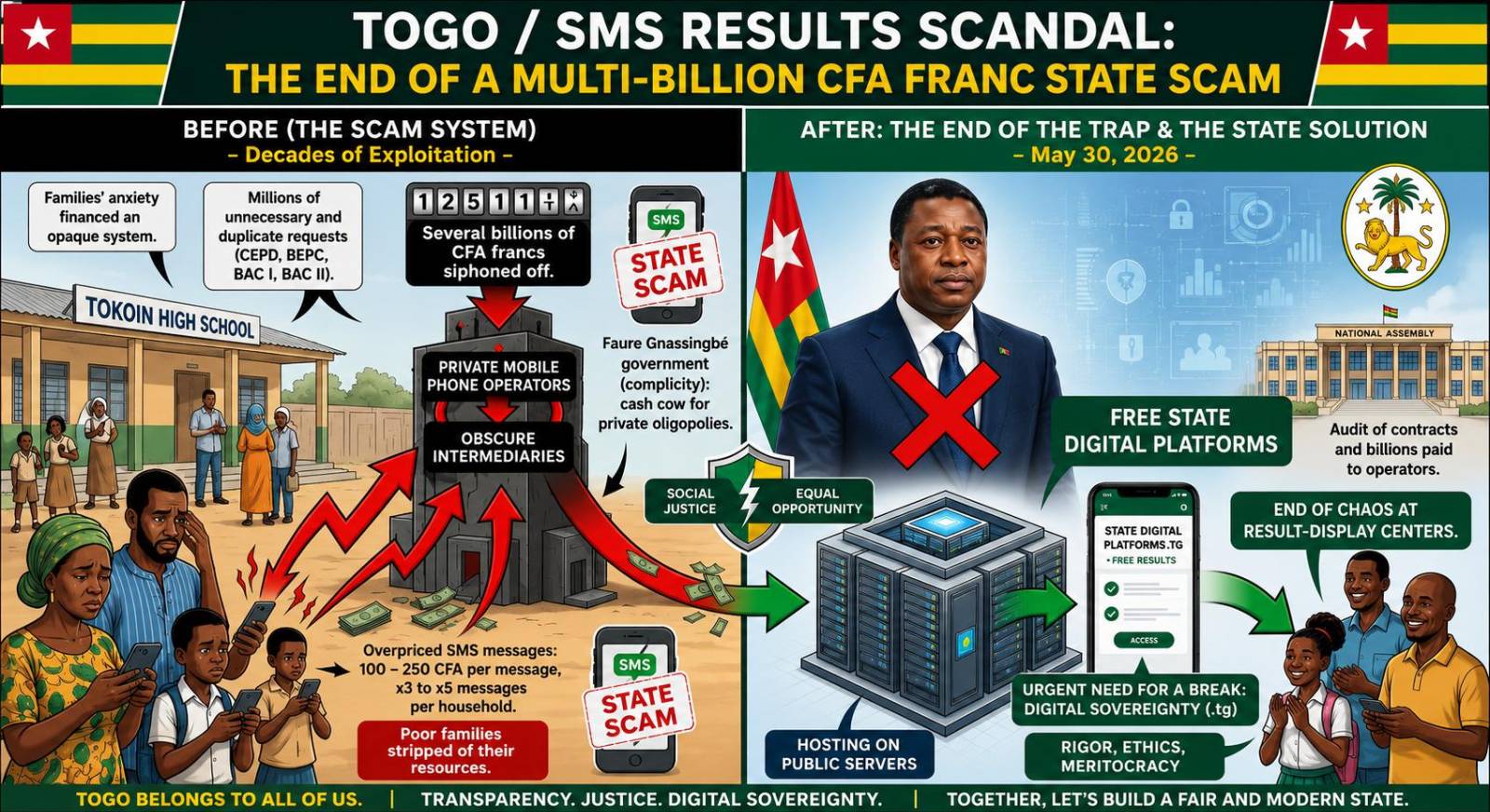
For more than twenty years, Togo’s education system operated a clandestine revenue stream that drained the resources of countless families. The abrupt announcement by the newly appointed Minister of National Education, Mama Omorou, to discontinue the transmission of exam results via SMS has exposed a systemic financial malfeasance perpetuated during the administration of former President Faure Gnassingbé.
The mechanics of deception: how families were ensnared
During an unannounced inspection on May 30, 2026, at the BAC I correction centers in Tokoin and Agoè-centre, Minister Omorou delivered a scathing indictment of the SMS result notification system, labeling it an outright fraud and a financial drain on the nation’s most vulnerable households.
The modus operandi was as insidious as it was lucrative. With each national examination cycle—whether the CEPD, BEPC, or BAC I and II—families were coerced into a cycle of anxiety-driven expenditure. A single result would prompt multiple SMS queries from various household members, each costing between 100 and 250 francs CFA. The redundancy was staggering: a father, mother, uncle, and the student themselves would each send identical messages, generating millions of redundant, overpriced transmissions with no added value.
The staggering scale of financial embezzlement
While the minister has yet to release formal financial audits, preliminary estimates reveal a breathtaking scale of exploitation. By aggregating the annual number of candidates across all national exams in Togo—spanning hundreds of thousands of students—and factoring in the multiplicity of SMS transmissions per household (often three to five per family), the total volume reaches tens of millions of messages per exam session.
Extrapolating these figures over the past fifteen to twenty years of the current regime’s tenure suggests that billions of francs CFA were siphoned from the pockets of Togolese families. The funds did not, however, bolster the public education system. Instead, they enriched private telecommunications operators and shadowy intermediaries who secured state concessions without scrutiny. This amounted to a brazen transfer of wealth from the populace to private oligopolies, facilitated by the passive or complicit approval of outgoing authorities.
Charting a path forward: digital transparency as a cornerstone
Minister Omorou’s decision to abolish SMS result notifications is a critical first step, but it introduces a pressing challenge: replacing a flawed system without reverting to the chaos of previous decades, where anxious families gathered in chaotic crowds outside exam centers, risking injury and distress.
Togo, long touted for its digital integration initiatives—particularly under the auspices of the Ministry of Digital Economy—must now prioritize the establishment of secure, state-run digital platforms for result dissemination. This transition is not merely about convenience; it is a matter of national sovereignty and educational equity.
Principles for a sustainable solution
- Public infrastructure: Exam results must be hosted on state-managed servers under the .tg domain, ensuring full governmental control and data integrity.
- Universal access: Results should be accessible free of charge, funded through the national education budget to eliminate financial barriers for all socioeconomic groups.
- Modern delivery: Utilizing email waves or lightweight web portals optimized for mobile devices is a cost-effective, technologically straightforward solution that aligns with Togo’s digital ambitions.
A call for ethical renewal in education
Beyond the financial scandal, the minister used the inspection tour to reinvigorate the morale of examiners, emphasizing that rigor, ethical conduct, and meritocracy must once again guide Togo’s educational institutions. This announcement signals a profound ideological shift—one that seeks to protect families from institutionalized fraud while laying the groundwork for a fairer, more just school system.
The question remains: Will the government demonstrate the resolve to follow through? Will it conduct comprehensive audits of historical contracts with telecom operators to uncover the full extent of the financial hemorrhage that has diverted billions of francs CFA from the future of Togolese youth?