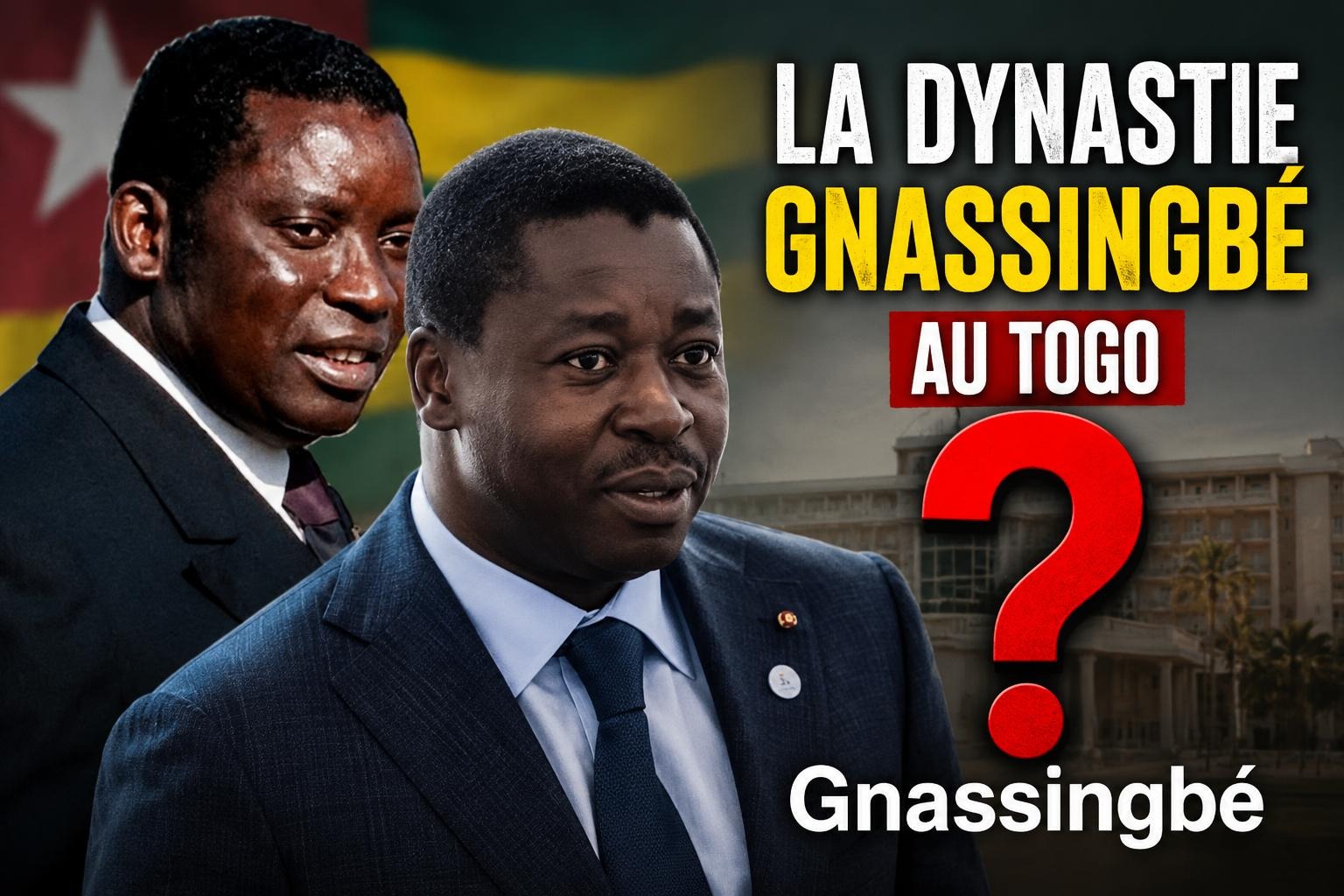
The Republic of Togo holds a grim distinction: Africa’s longest-ruling political dynasty. Since 1967, the Gnassingbé family has governed without interruption, first through Gnassingbé Eyadéma and now through his son, Faure Gnassingbé. With over 30 years in power and no sign of relinquishing control, the younger Gnassingbé appears determined to perpetuate the autocratic tradition, mirroring his father’s iron-fisted legacy.
The clan trap: power as a family inheritance
To grasp why democratic change has become impossible in Togo, one must look beyond politics and into the heart of the regime. This is not merely a political party in power; it is a tightly-knit dynastic network where leadership is treated as a hereditary right. For the inner circle of the Gnassingbé family and their allies, the presidency is no public office—it is a private entitlement passed down through generations.
For Faure Gnassingbé, stepping down would amount to more than a political risk; it would be an existential threat to his entire entourage. Relinquishing power would expose decades of financial mismanagement, systemic corruption, and the bloodshed of past crises—most notably the violent upheaval of 2005, which left hundreds dead. For the clan, holding onto power is no longer a matter of governance; it is a desperate bid for survival, both physically and legally. This fear has locked the president into a cycle of perpetual rule.
A constitutional coffin for democracy
The recent shift to a parliamentary system has effectively buried any hope for a peaceful transition. By assuming the title of Prime Minister and reshaping the constitution, Faure Gnassingbé has sidestepped electoral limits and direct public suffrage. The changes were not merely procedural—they were engineered to ensure irreversible control.
Under the new framework:
- No more direct elections: The people no longer vote for their head of state, eliminating the possibility of a punitive vote against the regime.
- Unlimited mandate through proxy: As long as his party, Union pour la République (UNIR), wins elections—orchestrated by state-controlled mechanisms—he remains in office indefinitely.
This constitutional engineering mirrors Eyadéma’s playbook. In 2002, the father amended the constitution to remove term limits, paving the way for his lifelong rule. The son has merely refined the strategy: where the father relied on brute force to ignore the law, the son now uses the law to legitimize his grip on power.
The military shield: a dynasty’s iron fist
The final pillar of this dynastic stranglehold is the Togolese Armed Forces (FAT). Established under Eyadéma with deep regional and clan loyalties, the FAT remains the regime’s backbone. Senior military officers share not only economic interests with the ruling family but also a deep-seated fear of losing their privileged status.
“In Togo, the army does not defend the nation—it defends a dynasty against its own people.”
For the generals, Faure Gnassingbé’s departure would mean the collapse of their influence and the unraveling of their web of power. The president, in turn, is a willing hostage to this system. He understands that his survival depends on maintaining his grip on power, and the military—bound by loyalty and self-interest—would never tolerate a successor outside the familial or established circle. This unholy alliance has fused his fate irrevocably to the presidency.
Faure Gnassingbé has inherited more than a throne—he has inherited a prison. Trapped by a clan that refuses to forfeit its privileges, shielded by an army that fears change, and shielded by laws he himself crafted, he has sentenced himself to eternal rule. History repeats itself: like his father, Faure Gnassingbé will govern Togo until nature takes its course. But by denying the nation a peaceful exit from this cycle, he risks leaving behind a ticking time bomb—one where the dynasty’s fall may well plunge the country into chaos.