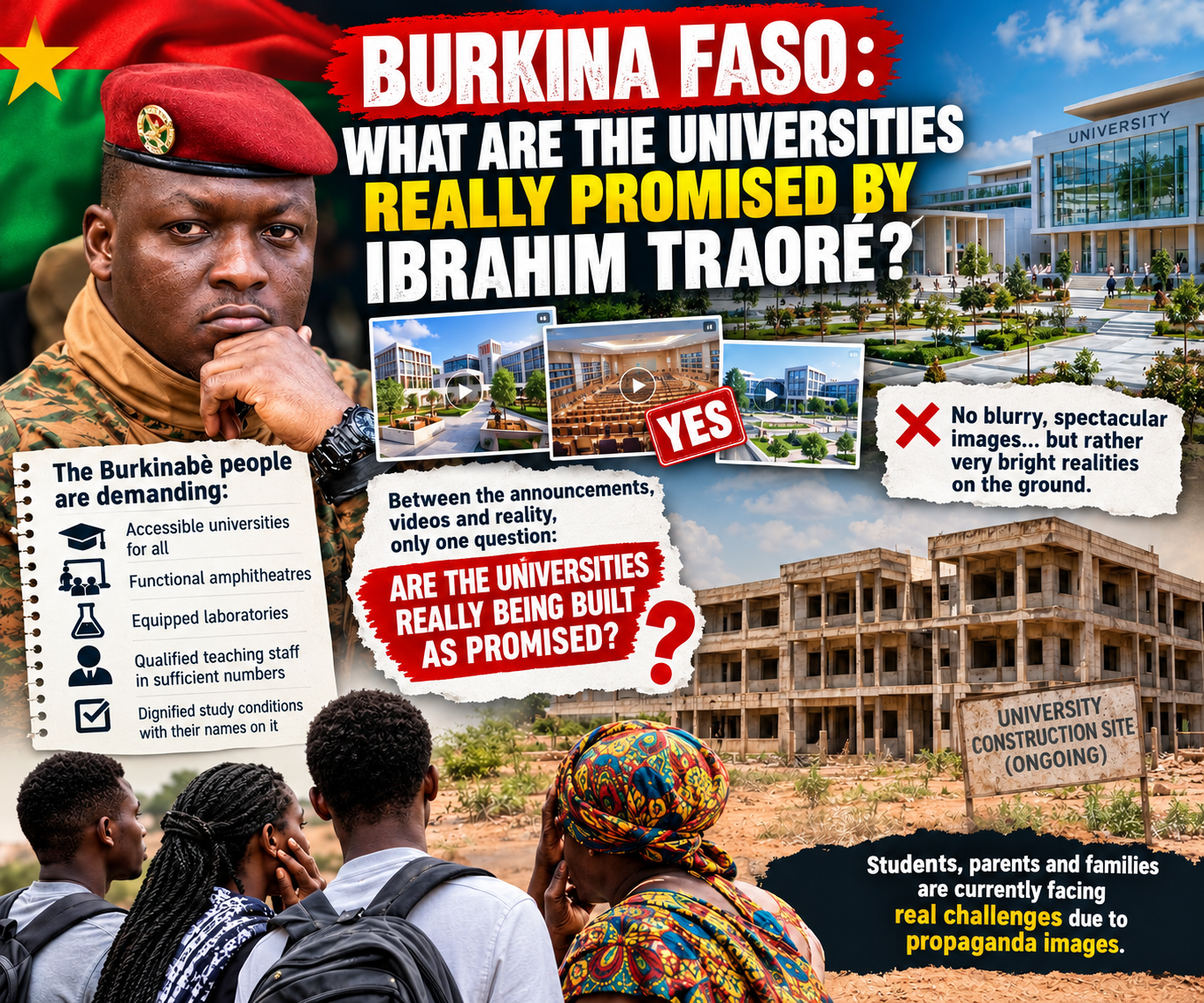
The government of Burkina Faso has repeatedly showcased what it describes as groundbreaking university projects, but students, parents and education stakeholders are demanding tangible evidence of progress beyond digital presentations.
Behind the social media spotlight: what universities actually exist?
While viral videos and images of modern university complexes circulate widely, the core question remains unanswered for many: which of these institutions have been completed, which are still under construction, and which are merely conceptual or digitally altered?
For families investing in higher education, the distinction between a completed facility and a digitally enhanced image is critical. Parents seek functional lecture halls, fully equipped laboratories and sufficient teaching staff not just visually striking renderings.
Digital manipulation and its impact on public perception
The rise of artificial intelligence-generated content has complicated public discourse. Multiple fact-checking investigations have exposed misleading videos falsely attributed to Burkina Faso’s educational projects. One widely shared video, claimed to depict a university under construction, was later traced to an unrelated project in Algeria. Another animation of buildings was revealed as an AI fabrication.
These incidents highlight a growing challenge: in an era where visual content can be manufactured, how can citizens distinguish authentic progress from digital illusions especially when such content shapes national narratives?
While these examples concern property developments, they raise legitimate concerns about the authenticity of higher education imagery. Independent verification of university-related videos including source tracing and on-site inspections is essential to separate fact from fiction.
Promises vs. delivery: the timeline from announcement to reality
Announcing a university is not the same as building one. Between the ceremonial groundbreaking and the day students walk through the doors, complex phases of planning, funding, construction and equipment must be completed. Delays, budget overruns and incomplete facilities are common in large-scale educational projects worldwide and Burkina Faso is no exception.
For instance, an official statement in September 2024 announced the completion of a 1,200-seat lecture hall, four smaller lecture halls and six laboratories at Nazi Boni University in Bobo-Dioulasso. While this represents a positive step, its impact depends on operational readiness: Are the laboratories equipped? Is the seating capacity sufficient? Are teaching staff and administrative services in place?
Key questions that demand answers
How many announced universities have been fully constructed?
How many are currently accepting students?
What percentage of promised facilities are fully operational?
Are maintenance and staffing plans in place for long-term sustainability?
The role of independent verification in education policy
Governments have a responsibility not only to announce progress but to demonstrate it. Relying on unverified social media content to showcase achievements risks eroding public trust especially in education, a sector where families commit life savings with the expectation of real change.
Credibility is built through transparency. Providing access to construction sites, publishing detailed project reports and inviting independent journalists and education experts to conduct on-site assessments would go a long way in validating claims.
Real progress or staged reality? A call for accountability
The future of Burkina Faso’s youth depends on more than inspiring visuals. It hinges on functional institutions, qualified educators and equitable access to quality education. When universities are announced, families deserve to know: Where is the campus? When can my child enroll? What will they learn?
Until concrete answers and verifiable proof are provided, the promise of a higher education revolution in Burkina Faso remains a work in progress one that must be measured not by the number of likes on a video, but by the number of students sitting in real classrooms.
By Nicolas Biyong — Journalist