Over the past two decades, the landscape of major public contracts in Senegal has undergone a seismic shift. While French conglomerates once held dominant positions across sectors such as infrastructure, energy, and banking, their influence has dwindled dramatically—now accounting for only about 5% of public tenders. In stark contrast, Chinese enterprises have surged ahead, capturing over 30% of these high-value projects, according to industry analyses.
Ports, stadiums, and industrial zones: the rise of new players
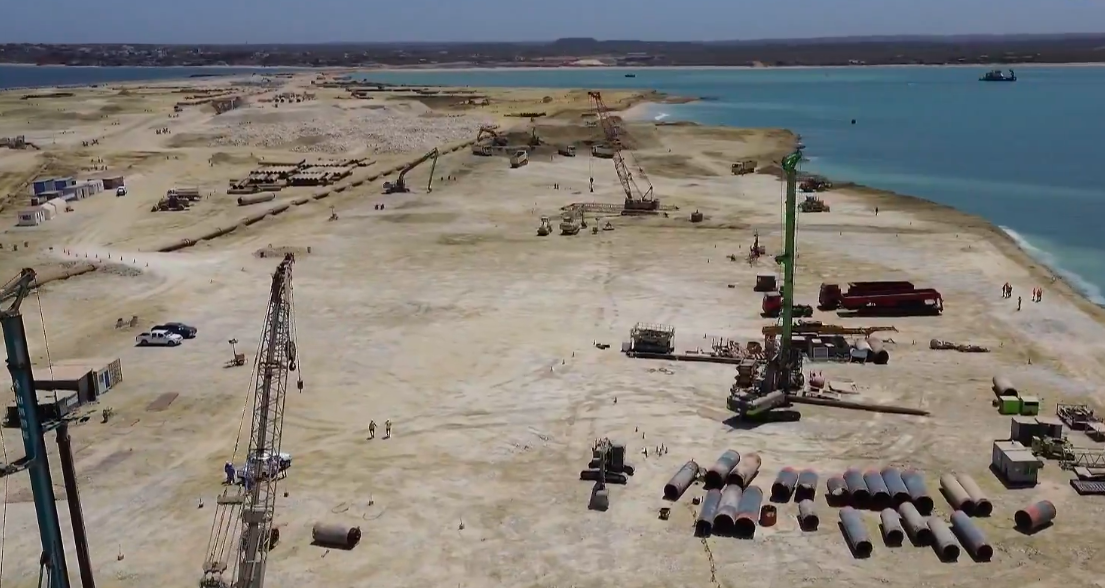
The transformation is evident in flagship projects across the country. In Ndayane, south of Dakar, the construction of Senegal’s first deep-water port—a $2 billion-plus venture designed to accommodate massive container ships—is being led by the Emirati firm DP World. However, the construction consortium is dominated by Chinese contractors. “We evaluated bids from firms worldwide, including several prominent French companies,” explains David Gruar, DP World’s site director. “Ultimately, the Chinese-led bid emerged as the most competitive, offering superior value.”
A few kilometers away, the Diamniadio New City project—a satellite urban development meant to ease congestion in Dakar—highlights the growing presence of Turkish, Chinese, and Tunisian firms. These companies have secured contracts for the stadium, railway station, hotels, and residential buildings, as well as the industrial platform designed to attract foreign investors. Bohoum Sow, secretary-general of the Senegalese Association of Industrial Platforms (APROSI), notes with candor: “I don’t recall any French firm operating on this platform.”
Why Chinese firms are winning Senegal’s infrastructure bids
Experts attribute the success of Chinese companies to their ability to align with Senegal’s development priorities. Unlike traditional contractors, Chinese firms often provide integrated solutions that include financing, technology transfer, and workforce training—key factors for Senegalese authorities seeking rapid, large-scale infrastructure delivery.
One illustrative case is a carton packaging plant where Chinese technicians have trained local employees in modern production techniques. “This is exactly the kind of industry Senegal needs,” says Sow. “They’re not just building infrastructure—they’re creating entirely new sectors and empowering local workers.”
This adaptability reflects China’s broader strategy in Africa, where it has positioned itself as a reliable partner for large-scale development. Over the past 20 years, Beijing has become a major investor across the continent, leveraging infrastructure projects as diplomatic tools to deepen economic and political ties. As a result, Senegal’s skyline now features new Chinese-built stadiums, highways, and industrial parks—symbols of a strategic reorientation.
Can French firms reclaim their share?
Despite the decline, French companies are not entirely sidelined. Some have adapted by forming local partnerships, transferring technology, and adopting flexible pricing models. Take the example of the Ragni Group, a family-owned business from southern France that secured a 70-million-euro contract to install 36,000 solar-powered streetlights across Senegal. To win the tender, Ragni established a local subsidiary led by a Senegalese manager, emphasizing job creation and community integration.
“We focused on flexibility, quality, and cost,” says Birama Diop, director of Ragni Senegal. “That combination—and the creation of local jobs—made the difference.”
Caroline Richard, regional head of Proparco (the private sector financing arm of the French Development Agency), argues that French firms still have a role to play—provided they align with Africa’s evolving demands. “Senegal needs high-quality infrastructure built with local involvement,” she notes. “French firms excel in such environments when they adapt their models and prove their competitiveness.”
The new reality is clear: Senegal’s infrastructure future is being shaped by a diverse coalition of Chinese, Turkish, Emirati, and Tunisian firms. For French companies, the path forward lies in innovation, localization, and strategic partnerships—proving that even in a competitive market, their expertise remains valuable when delivered the right way.