In the face of escalating terrorist violence across the Sahel, Abidjan has underscored the urgent need for collective action. The recent surge in attacks has exposed the vulnerabilities of coastal nations, compelling Ivory Coast to extend a strategic hand to its neighbors in Mali and Burkina Faso.
Beyond ideology: the imperative of survival
West Africa stands at a critical juncture where ideological posturing must yield to pragmatic security measures. The relentless advance of armed groups has transformed the regional threat landscape, pushing once-stable nations toward unprecedented collaboration. Ivory Coast, recognizing the shared peril, has initiated a bold initiative to foster trilateral cooperation.
Abidjan’s strategic proposal
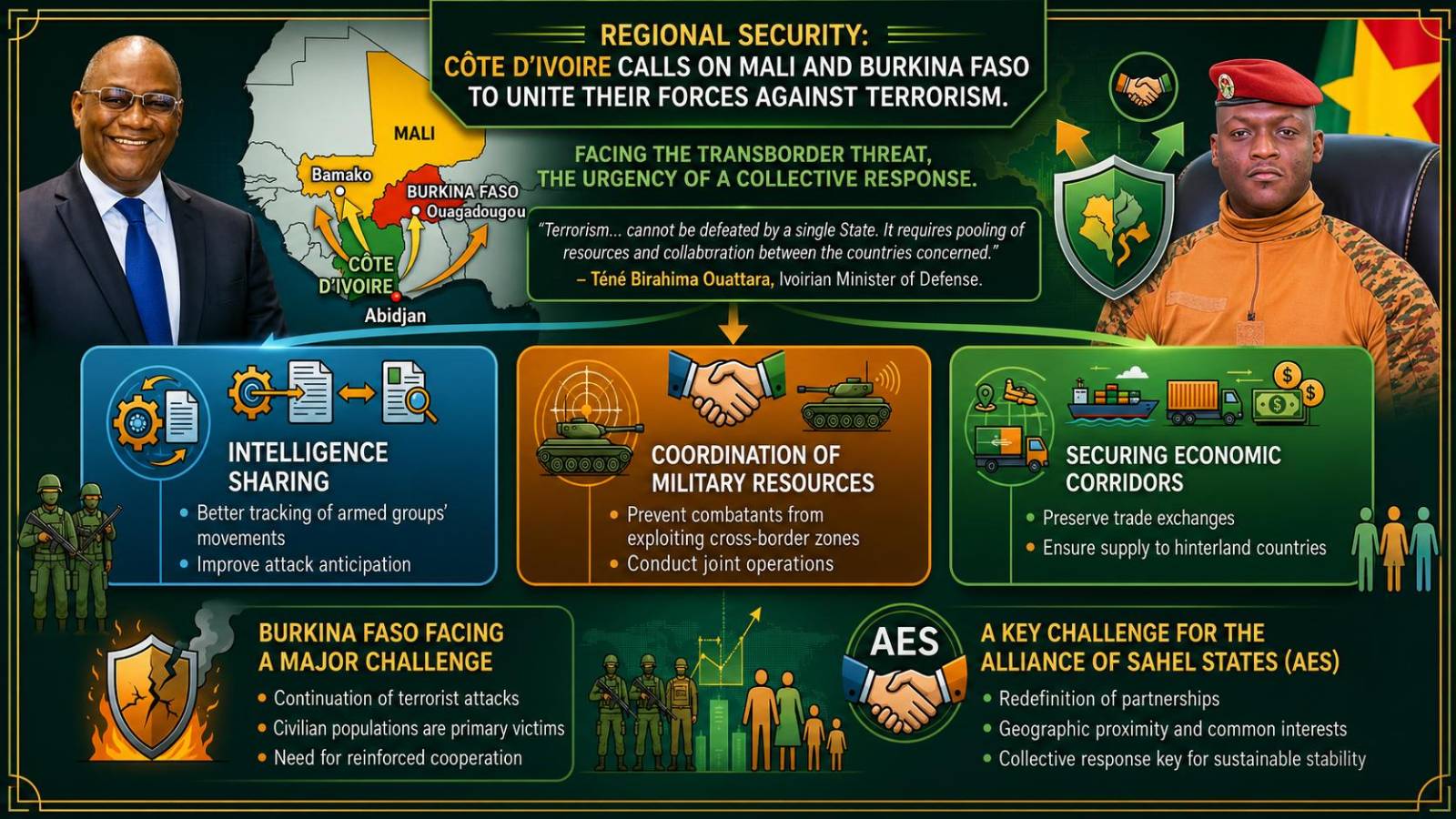
The Ivorian Minister of Defense, Téné Birahima Ouattara, articulated the necessity of this approach in unequivocal terms:
« Terrorism today operates across borders, demanding a unified response. No single nation can confront this challenge alone; success hinges on shared intelligence and coordinated action. »
The proposed framework rests on three pillars designed to strengthen regional resilience:
- Intelligence fusion: Monitoring jihadist movements along vulnerable border zones to preempt attacks.
- Joint military operations: Synchronizing cross-border initiatives to deny insurgents safe havens.
- Economic corridor security: Protecting trade routes vital to landlocked nations’ economic survival.
Burkina Faso at a crossroads
Despite robust national mobilization efforts, Burkina Faso continues to grapple with the terror threat. The human cost—displaced communities, shattered infrastructure, and eroded stability—has reached alarming levels. For Captain Ibrahim Traoré, leader of Burkina Faso’s transitional government, the path forward demands a decisive break from isolationist tendencies.
Analysts emphasize that the current crisis leaves little room for political posturing. The survival of Burkina Faso’s citizens now hinges on embracing regional solidarity, particularly with Ivory Coast, whose logistical strengths and geographic position make it a natural ally.
A test for the Sahel Alliance
The Ivorian initiative presents a defining moment for the Alliance des États du Sahel (AES). While Mali and Burkina Faso have recently recalibrated their international partnerships, geography remains an immutable reality. Ivory Coast’s offer of collaboration is not a gesture of charity but a strategic necessity—one that underscores the futility of unilateral action against a mobile, asymmetric enemy.
For Captain Traoré, accepting this partnership would signal not weakness but political maturity. The alternative—continued fragmentation—risks ceding ground to insurgents and prolonging the suffering of millions. In the Sahel’s existential struggle, unity is not an option; it is the only viable path to reclaiming peace.