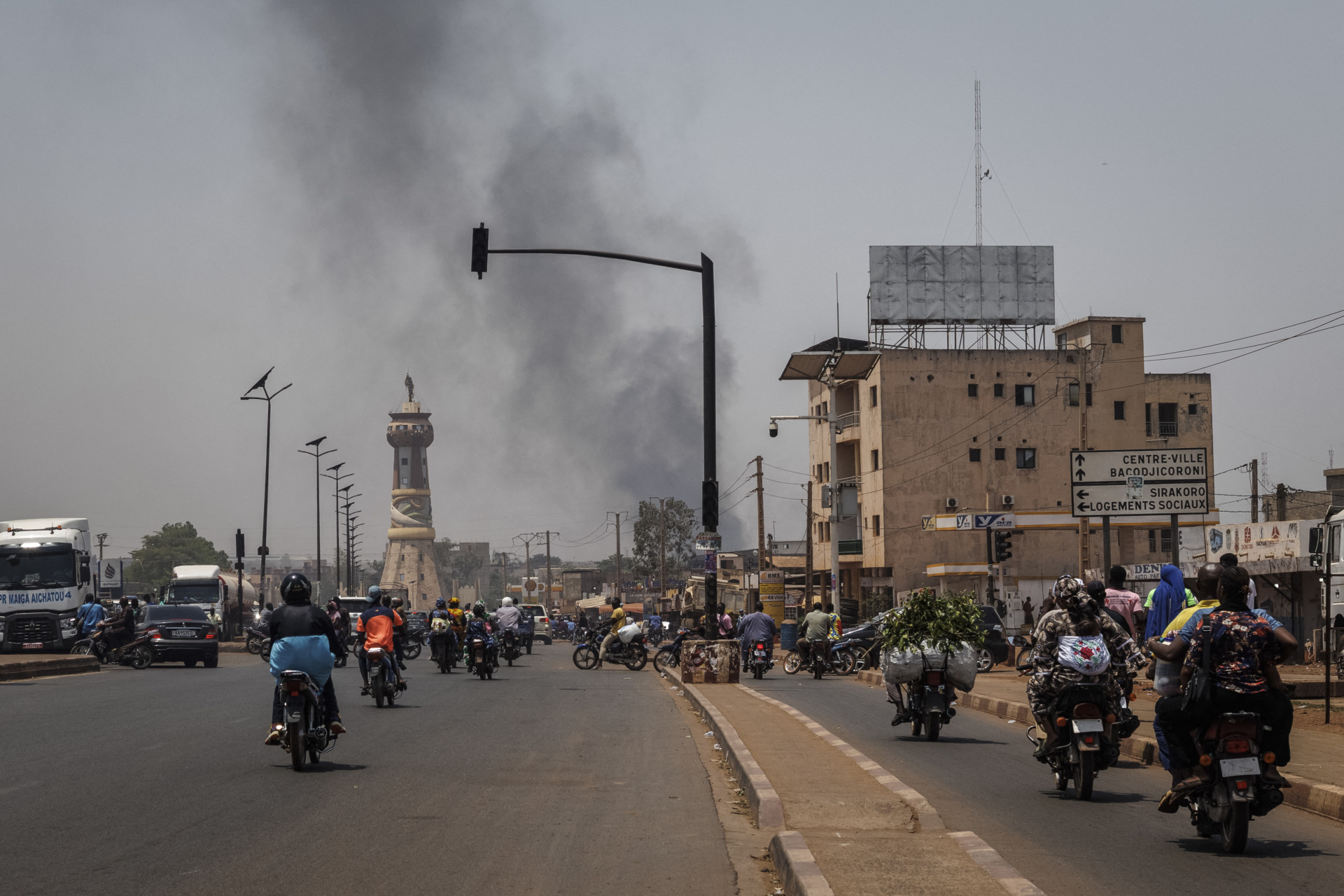
In the early hours of April 25, a barrage of explosions and gunfire shattered the calm around Kati, a strategic military town just 15 kilometers northwest of Bamako, Mali’s capital. Within a day, coordinated assaults by the jihadist coalition JNIM (Group for the Support of Islam and Muslims) and the Tuareg separatist FLA (Azawad Liberation Front) erupted across multiple regions. By the following day, the Malian junta had announced the death of Defense Minister Sadio Camara, who was killed in an attack on his residence. Subsequent reports suggested that intelligence chief Modibo Koné may also have been wounded or killed in the same wave of violence, starkly contrasting with the junta’s initial claims of control over the situation.
These coordinated offensives represent the most significant challenge to junta leader Assimi Goïta’s authority since he seized power in 2020. The assaults occurred at a time when the military regime’s grip on the country was already weakening. JNIM’s months-long blockade, initiated in September 2025, has crippled Mali’s landlocked economy by cutting off critical fuel and food supplies from Senegal and Côte d’Ivoire. The blockade’s impact has been severe, forcing nationwide school closures and economic disruptions. Despite the junta’s attempts to negotiate a temporary truce by releasing over 100 JNIM prisoners, the blockade persists, illustrating the militants’ ability to exert pressure far beyond traditional battlefield engagements.
The recent attacks serve as a critical test for the junta’s strategy, which relies on Russian-backed security support and the suppression of civil liberties to achieve stability—a stark departure from the democratic governance and Western security assistance that previously dominated. The resurgence of militant violence raises questions about the effectiveness of this approach, particularly as neighboring juntas in Burkina Faso and Niger, which also overthrew Western-backed governments, watch closely.
Historical parallels and shifting alliances
In 2012, a similar alliance between jihadist and separatist factions overwhelmed Malian forces, seizing control of the country’s northern regions. Tuareg fighters returning from Libya with weapons and combat experience joined forces with al-Qaeda in the Islamic Maghreb (AQIM) and the Malian jihadist movement Ansar Dine. Their short-lived coalition fractured violently, with jihadist factions turning on their Tuareg allies once the Malian military was expelled from the north.
The recent offensive marks the first major coordinated attack between JNIM and the FLA in over a decade. While their objectives align with past alliances, this collaboration appears tactical rather than strategic. Long-term tensions between the groups make permanent integration unlikely. For now, both factions are focused on exposing the Malian state’s inability to protect its sovereignty. For JNIM, this strategy aims to weaken the junta’s resources and resolve until the regime collapses from within.
General Camara, the late defense minister, played a pivotal role in Mali’s partnership with Moscow and was instrumental in deploying the Wagner Group in late 2021. This move contributed to the expulsion of French military forces in 2022 and the withdrawal of the UN peacekeeping mission in 2023. Following the death of Wagner leader Yevgeny Prigozhin in August 2023, the group was rebranded as Africa Corps under the direct control of the Russian Ministry of Defense. However, this rebranding came with a shift in mandate, moving from frontline combat operations to a training and advisory role focused on preserving Russian influence.
This change has significantly reduced operational effectiveness. Unlike Wagner, which positioned itself as a combat force capable of reversing Mali’s security decline, Africa Corps now operates with limited engagement in active battles. Data from the Armed Conflict Location and Event Data (ACLED) project indicates a sharp decline in battles involving Russian fighters, dropping from 537 in 2024 to 402 in 2025, with only 24 incidents per month recorded in early 2026. The ongoing conflict in Ukraine has further strained Russia’s capacity to sustain even this reduced level of involvement in Mali.
Strategic setbacks in Kidal
The distinction between Wagner’s combat-focused approach and Africa Corps’ advisory role is critical to understanding the events in Kidal. In November 2023, Malian forces, supported by Wagner, captured the city after more than a decade of jihadist control—a victory that appeared to validate the junta’s partnership with Moscow. However, in the aftermath of the April 25 attacks, Africa Corps withdrew from Kidal under escort, surrendering the city without resistance.
The fall of Kidal encapsulates the broader failures of the Alliance of Sahel States (AES) model. The AES juntas—Mali, Burkina Faso, and Niger—expelled Western partners and consolidated power under the premise that these partnerships had failed to provide security. They withdrew from ECOWAS and formed their own defense alliance. Yet, the security environment has deteriorated measurably under their rule, and the recent attacks have exposed the growing risks of this approach.
Since 2012, Sahelian militaries have cited insecurity as justification for at least five unconstitutional seizures of power. Three of these coups removed democratically elected presidents—Amadou Toumani Touré in Mali (2012), Ibrahim Boubacar Keïta in Mali (2020), and Roch Marc Christian Kaboré in Burkina Faso (2022). Another coup removed Burkina Faso’s transitional government in 2022, while a fifth ousted interim leader Paul-Henri Sandaogo Damiba in October 2022 after he failed to improve security. Assimi Goïta now faces a similar predicament, with his grip on power more uncertain than ever.
In May 2025, the junta dissolved all political parties and granted Goïta a renewable five-year presidential term, extending his rule until at least 2030. A failed coup attempt in August 2025 revealed fractures within the military, as soldiers and generals were arrested for plotting against the regime. The recent offensive may deepen these divisions, with officers likely blaming intelligence failures for the coordinated attacks that breached the regime’s defenses.
As dissent within the military grows, the likelihood of a palace coup or junior officer mutiny has increased. The Russian partnership was initially seen as an insurance policy for the junta, but the events of April 25 have forced Mali’s leaders to reconsider its value.
U.S. leverage in a shifting landscape
For nearly a decade, Mali served as the epicenter of U.S. counterterrorism efforts in the Sahel. Coups in 2012 and 2020 led to the suspension of most foreign aid under Section 7008 of the U.S. congressional appropriations bill, which prohibits funding for governments that seize power through military coups. However, recent developments suggest a potential shift in U.S. policy. In February 2026, the Treasury Department lifted sanctions on three senior Malian officials, including the late Defense Minister Camara, who had previously facilitated Wagner’s activities in Mali. This move followed a visit by a senior State Department official to Bamako, signaling efforts to re-engage with the junta.
The recent militant offensive paradoxically increases U.S. leverage in Mali. The junta’s Russian ally has been publicly embarrassed by the attacks, and the central premise of the junta’s security strategy has been exposed as flawed. Reports indicate that Washington had been exploring a minerals-for-security deal with Bamako even before the April 25 attacks, possibly inspired by a similar agreement signed with the Democratic Republic of the Congo (DRC) in late 2025. This deal offered economic and security cooperation in exchange for preferential access to critical minerals such as lithium and gold. The DRC arrangement also involved private security actors, including Erik Prince’s Vectus Global, which deployed personnel and drones to support Congolese forces. The United States may be considering a similar model to bring Sahelian juntas back into its sphere of influence.
The recent offensive in Mali underscores the failure of the junta’s approach. JNIM has demonstrated the ability to expand its reach into Bamako at will, even without the capability to seize and hold the capital. The group’s operational toolkit has expanded to include drone warfare, economic sabotage, and a multinational network that transcends Sahelian borders. Meanwhile, the Malian state’s resources and legitimacy have dwindled, and no credible regional security framework exists, particularly in light of the AES’s withdrawal from ECOWAS.
Regional implications and Russia’s waning influence
Mali served as Russia’s foothold in the Sahel, and the reputational damage from the April 25 attacks will not go unnoticed by other African governments seeking security guarantees from Moscow. The Alliance of Sahel States has marketed its approach as a more effective alternative to Western-led security arrangements. Other members of the alliance are closely monitoring the situation as the credibility of the junta model is put to the test.
Beyond the Sahel, Africa Corps has been pushing for influence in the Central African Republic, where President Faustin-Archange Touadéra has resisted transitioning from Wagner to Africa Corps. Russian military instructors from Africa Corps have also arrived in Madagascar following the 2025 coup. However, the events in Mali may prompt these and other governments to reconsider their reliance on Russian security partnerships.
Russia’s credibility was already in question before the weekend’s events. Its inability to prevent the collapse of the Assad regime in Syria and the U.S. operation to apprehend Venezuelan leader Nicolás Maduro in January highlighted the limits of Moscow’s capabilities. With Africa Corps’ humiliating withdrawal from Kidal, regimes that have courted Russian security cooperation can now assess the true value of such partnerships when their allies face sustained pressure.