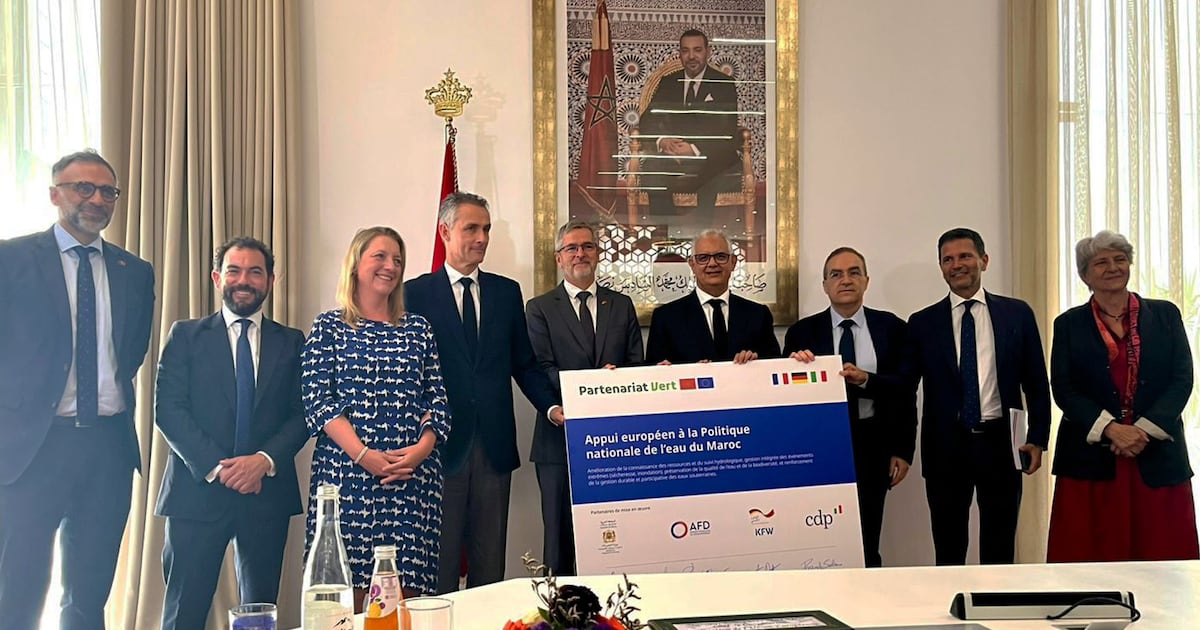
The European Union, alongside key European cooperation agencies, formalized a €348 million funding package—equivalent to nearly 3.7 billion Moroccan dirhams—dedicated to advancing Morocco’s water infrastructure initiatives. The agreement was signed in Rabat at the Ministry of Equipment and Water, with Minister Nizar Baraka and ambassadors from the EU, France, Germany, and Italy in attendance.
This three-year commitment builds on a prior agreement established in November 2024, during a high-level meeting in Rabat between King Mohammed VI and French President Emmanuel Macron. The funding aims to bolster both potable water access and agricultural irrigation, particularly in rural regions grappling with water scarcity.
Photo caption: European and Moroccan officials finalize a landmark water funding agreement in Rabat.
Key European partners contributing to this initiative include the French Development Agency (AFD), Germany’s KfW development bank, and Italy’s Cassa Depositi e Prestiti (CDP). The AFD, designated as the project’s lead agency, has played a pivotal role in accelerating the program’s implementation, as noted by French sources. Notably, France has already contributed €1 billion to Morocco’s water sector, a figure highlighted by new French Ambassador Philippe Lalliot during his inaugural official engagement in the country.
EU Ambassador to Morocco, Dimiter Tzantchev, emphasized the bloc’s prioritization of water security amid climate change pressures. “The EU places water at the heart of its cooperation with Morocco, especially as climate shifts intensify the urgency of sustainable solutions,” he stated. The funding will support critical projects, including desalination plants, dam expansions, and rural water networks, directly addressing Morocco’s pressing water security challenges.
During the signing ceremony, Minister Baraka outlined Morocco’s National Water Strategy, a visionary plan spearheaded by King Mohammed VI. “Our strategy relies on 26 operational dams irrigating over 1.5 million hectares, with a near-term goal of sourcing 60% of potable water from desalination,” he explained. “Water mastery is the foundation of national resilience,” he added, underscoring the stakes for Morocco’s economic and social stability.
Baraka further assured that the Ministry would prioritize efficient governance to ensure the program’s success, expressing gratitude to the ambassadors for their steadfast support. German Ambassador’s remarks echoed this sentiment, praising the robust Morocco-Germany partnership and the strategic significance of water cooperation through KfW’s involvement. His tenure in Rabat is nearing its conclusion.
This EU-backed initiative reinforces Morocco’s broader efforts to mitigate water stress, accelerate infrastructure development, and safeguard its agricultural and rural populations. From desalination to irrigation networks, the collaboration underscores a shared commitment to securing Morocco’s water future against the backdrop of climate variability.