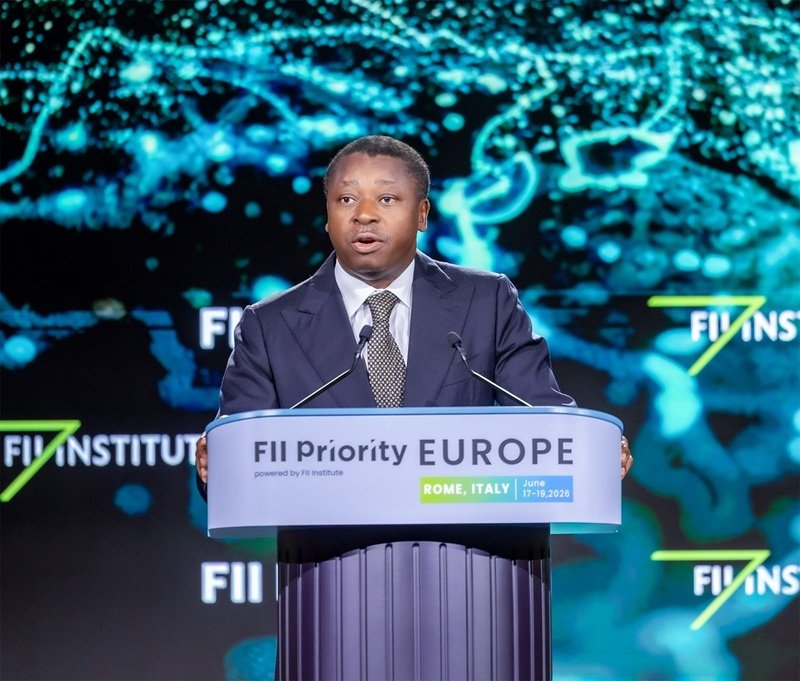
Since June 18, 2026, the President of the Council, Faure Essozimna Gnassingbé, has been participating in the FII PRIORITY Europe summit. This prestigious gathering focuses on the financing of industrial renewal, the strengthening of supply chain resilience, and the evolving landscape of labor in the age of artificial intelligence.
Speaking on this global stage, the Togolese leader advocated for a fundamental restructuring of the relationship between Europe and Africa. He emphasized the need for a partnership built on shared strategic interests, productive investment, and a more sophisticated management of economic interdependencies.
Moving beyond traditional cooperation frameworks
During his address, the President of the Council noted that Europe and Africa now face comparable challenges within a global environment defined by geopolitical friction and intense economic rivalry.
He argued that the conventional models of aid and traditional cooperation are no longer sufficient to address the complexities of the modern world.

“The conversation must shift away from standard aid or classic cooperation. Instead, we must forge a more balanced strategic bond between Europe and Africa,” he stated.
According to the Togolese leader, both continents need to establish partnerships that effectively tackle emerging issues regarding economic, energy, and technological sovereignty.
Strategic autonomy through balanced interdependence
Faure Gnassingbé shared his perspective on strategic autonomy, describing it not as a move toward isolationism, but as a more effective organization of economic ties between nations.
He pointed out that recent global crises have highlighted how vital interdependencies are, provided they are secure, equitable, and predictable.
The President of the Council believes that Europe and Africa possess natural complementarities that can drive the development of a new cooperative model.
A mutually beneficial partnership for both continents
The Togolese head of government noted that while Europe is looking for dependable partners to secure its resources and boost competitiveness, Africa requires capital, technology, and infrastructure to speed up its economic evolution.
“These requirements are not contradictory; they can actually reinforce one another,” he asserted.
For Faure Gnassingbé, the Euro-African partnership should be reimagined as a convergence of strategic goals that serve the interests of both regions.
Togo’s ambition as a West African logistics gateway
Discussing Togo’s domestic strategy, the President of the Council reiterated the nation’s goal to establish itself as a premier logistics, industrial, and commercial hub in West Africa.
This roadmap is centered on several key pillars:
- modernizing the Port of Lomé;
- expanding regional transport corridors;
- improving trade facilitation;
- digitizing administrative workflows.
He emphasized that these infrastructure improvements do more than just serve Togo; they contribute to the economic stability of the entire sub-region.
An Africa focused on local production and value addition
Faure Gnassingbé stressed Africa’s determination to move past its historical role as a simple exporter of raw materials.
The continent, he remarked, aims to transform into a center for production, processing, and innovation, capable of generating significant value internally.
Furthermore, he suggested that a more industrialized and integrated Africa would present a major opportunity for Europe and the wider international investment community.
Engaging with global investors in the international arena
Beyond the high-level policy discussions, Togo’s participation in the FII PRIORITY Europe summit serves as a platform to showcase the country’s logistical, industrial, and financial advantages to global economic leaders.
For the authorities in Lomé, this international engagement is part of a broader effort to attract more investment, establish transformative partnerships, and solidify Togo’s role as a regional economic powerhouse.
The summit brought together numerous influential figures, including Yasir ben Othman Al-Rumayyan, Chairman of the Future Investment Initiative Institute, and Richard Attias, the founder and Chairman of the institution’s Executive Committee, alongside various political leaders and heads of international financial organizations.