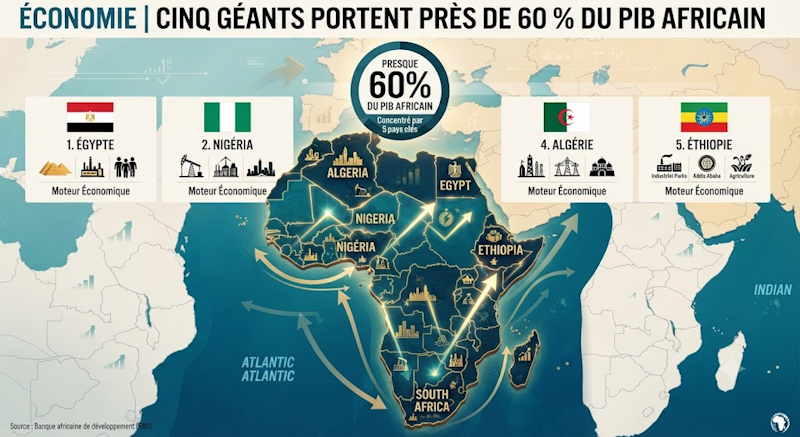
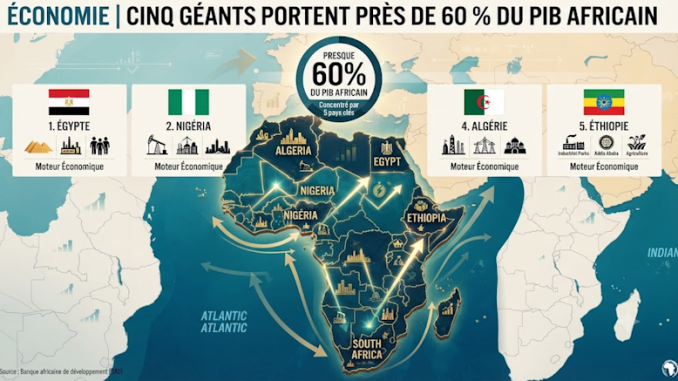
New figures from the African Development Bank reveal a striking reality: just five nations account for nearly 60% of Africa’s total gross domestic product. These economic powerhouses—Egypt, Nigeria, South Africa, Algeria, and Ethiopia—are the continent’s driving forces, shaping its financial future.
Their dominance stems from a combination of key factors: vast natural resources, rapidly expanding domestic markets, robust industrial bases, and strategic investments in critical infrastructure. Each of these countries contributes uniquely to the continent’s economic engine, reinforcing Africa’s position on the global stage.
What sets these economies apart?
Egypt and Nigeria stand out for their massive populations and steadily diversifying economic portfolios. South Africa remains the continent’s industrial and financial leader, anchoring regional trade and investment flows. Algeria leverages its vast energy reserves and state-backed development initiatives to fuel growth, while Ethiopia has emerged as a manufacturing hotspot, rapidly industrializing and rolling out large-scale infrastructure projects.
The other side of the coin: economic disparities
While these five nations propel the continent forward, their outsized influence also highlights stark economic imbalances. Many African countries continue to grapple with limited industrialization, weak financial access, fragile job markets, and over-reliance on primary sectors. The challenge now is to translate the success of these economic giants into shared prosperity across the entire continent.
Economists warn that without deliberate efforts to distribute growth more evenly, the gap between Africa’s leading economies and its smaller neighbors could widen, leaving millions behind in the race for development.