France’s new ambassador to Morocco signals strategic shift in relations
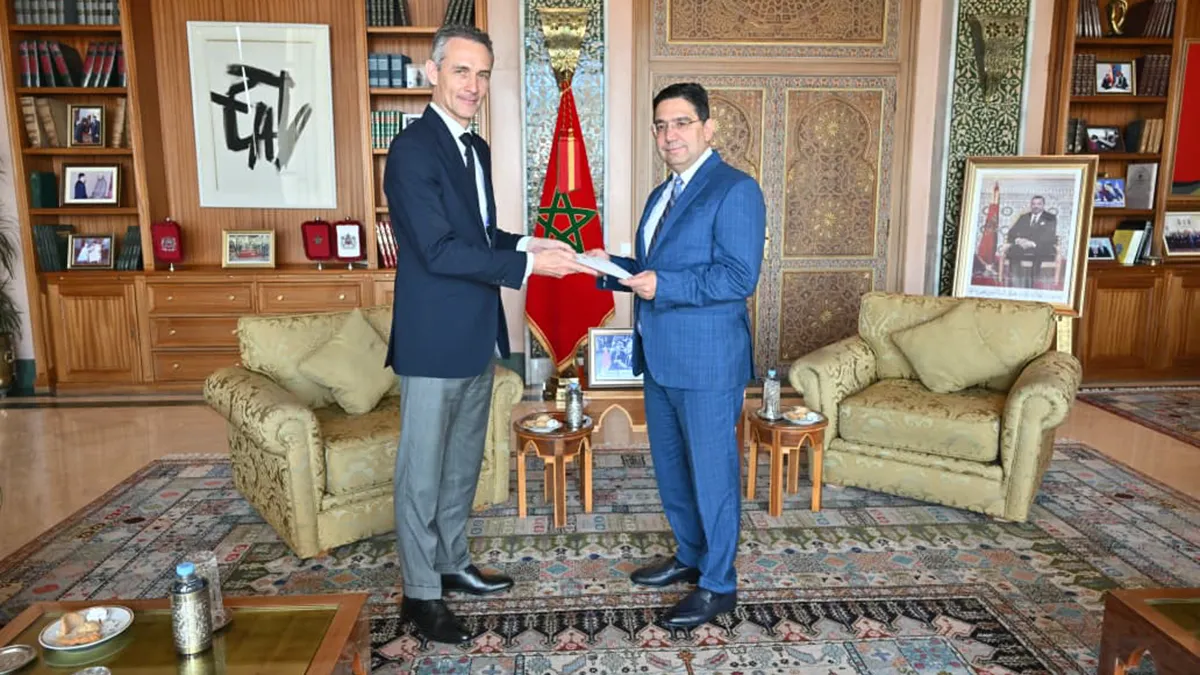
Philippe Lalliot formally presented his credentials to Moroccan Foreign Minister Nasser Bourita, marking a new chapter in bilateral relations. His appointment comes as both nations seek to strengthen ties following recent diplomatic breakthroughs and prepare for Morocco’s role in the 2030 World Cup.
- The Sahara factor and strategic realignment
- Economic investments and World Cup preparations
- Challenges of new bilateral framework
The arrival of a new ambassador often passes unnoticed beyond official circles, but Philippe Lalliot’s posting to Rabat represents an exception to this rule. After his formal appointment in mid-May, the French diplomat yesterday completed the crucial credential presentation process to Moroccan Foreign Minister Nasser Bourita, marking the official start of his mission.
This diplomatic milestone initiates a comprehensive bilateral agenda designed not merely to restore frayed relations but to fundamentally reshape power dynamics across the Mediterranean and African spheres.
Lalliot takes up his post following the most challenging period in recent Franco-Moroccan relations. This diplomatic winter had been characterized by France’s drastic reduction in visa issuance to Moroccan citizens—a measure that, combined with what Rabat perceived as Paris’s detached stance on Morocco’s national priorities—effectively froze high-level dialogue between the two nations.
The years of estrangement manifested through the absence of state visits and a noticeable decline in France’s influence over Morocco’s external agenda. The historical partnership that had defined relations for decades gave way to a cycle of prolonged diplomatic distance.
The Sahara factor and strategic realignment
The critical turning point emerged throughout 2024, when months of quiet diplomacy culminated in a historic shift in Emmanuel Macron’s position. In an official letter addressed to King Mohammed VI, the French president publicly endorsed Morocco’s autonomy plan for Western Sahara, declaring it the only viable foundation for resolving the regional conflict.
For Morocco, this diplomatic victory carried geopolitical significance far beyond traditional alliance support. The endorsement from a permanent UN Security Council member with substantial European influence represented a strategic repositioning that fundamentally altered the regional balance of power.
Following this announcement, diplomatic paralysis gave way to renewed momentum. Ministerial exchanges resumed, joint business missions reconnected, and previously frozen economic projects began moving forward. The culmination of this process came with President Macron’s state visit, which symbolically ended the period of estrangement. During this historic trip, Macron emphasized adapting the relationship to Africa’s evolving realities while Bourita framed the new understanding around mutual trust and shared strategic interests.
Beneath this newfound harmony lay a pragmatic calculation. During the years of tension with Paris, Morocco had not paused its foreign policy but instead diversified its alliances, strengthening ties with the United States, Gulf monarchies, and multiple African governments—thereby expanding its international maneuvering space.
Faced with a rapidly shifting regional landscape, the Élysée Palace recognized that maintaining distance from Rabat carried increasing political and economic costs that became increasingly difficult to justify.
Economic investments and World Cup preparations
Ambassador Lalliot assumes his post under favorable conditions but inherits a demanding agenda. The economic dimension will take priority: French companies remain the largest foreign investors in Morocco’s business sector, maintaining dominant positions in critical industries including automotive manufacturing, railway development, banking, energy transition, and large-scale public works.
This economic relationship is further strengthened by Morocco’s role as a gateway for French businesses seeking to expand into Sub-Saharan African markets.
The handover from Christophe Lecourtier did not signal a break with Morocco—his subsequent appointment as head of the French Development Agency (AFD) in Morocco underscores the priority Paris places on economic cooperation in this renewed partnership.
The AFD plays a central financial role as Rabat accelerates its public investment and infrastructure development plans ahead of the 2030 FIFA World Cup—an ambitious project shared with Spain and Portugal that has proven highly attractive to French companies and engineering firms.
Challenges of new bilateral framework
While institutional normalcy has returned to diplomatic channels, a deeper reconfiguration of power balances is underway. France seeks to reposition itself across Africa after suffering significant setbacks in its traditional spheres of influence, while Morocco consolidates an ambitious foreign policy centered on its Atlantic and Mediterranean reach.
Regional security cooperation, migration management, Sahel stability, and trade exchanges will continue to shape the daily agenda between both nations. These domains offer clear areas of convergence but are not without potential friction points.
The decisive test for Philippe Lalliot’s tenure will not be maintaining current harmony but proving the alliance’s resilience when inevitable strategic divergences arise. Past crises between Paris and Rabat have demonstrated that commercial interests alone cannot prevent ruptures—divisions emerge when one party believes the other has ceased to understand or respect its fundamental priorities.