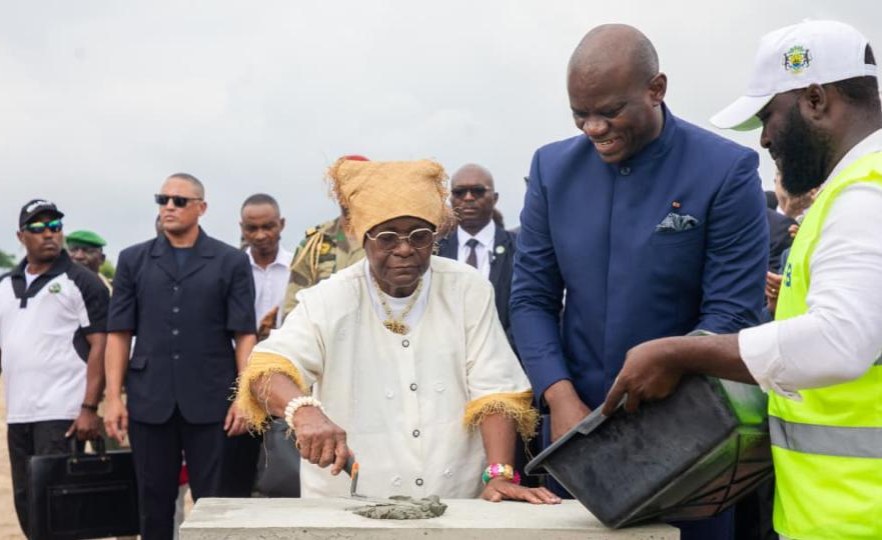
The Gabonese Republic is embarking on a historic journey toward post-oil industrial self-sufficiency. Under the leadership of President General Brice Clotaire Oligui Nguema, the groundbreaking ceremony for the Kobé-Kobé deep-water port has officially marked the beginning of a transformative infrastructure endeavor. This integrated megaproject, anchored to one of the planet’s richest iron ore deposits and complemented by cutting-edge rail and energy systems, aims to redefine the nation’s economic growth trajectory by the year 2030.
Gabon’s coastline is preparing to welcome a state-of-the-art maritime gateway. Located in the Estuaire Province, the future deep-water terminal will feature an impressive draft depth of 14 to 16 meters. This technical capability will enable the port to accommodate ultra-large commercial vessels, significantly boosting the country’s competitive edge against regional rivals in the Gulf of Guinea, including Cameroon’s Kribi and Congo’s Pointe-Noire.
The true innovation of Kobé-Kobé lies in its integrated vision. This facility will not operate in isolation but will serve as the maritime endpoint of a comprehensive national value chain. The development encompasses three critical components:
- Belinga iron ore extraction — situated in Ogooué-Ivindo Province, this geological marvel holds one of the world’s largest untapped high-grade iron ore reserves;
- A pioneering railway corridor — connecting the Belinga mining heartland directly to the Estuaire port complex;
- The Booué hydroelectric dam — designed to ensure energy autonomy for mining and processing operations.
This synchronized strategy seeks to break away from Gabon’s longstanding extractive economy model by prioritizing local metallurgical processing before any export. The project entered a decisive phase in April 2026 with the signing of a strategic partnership agreement between the Gabonese government and Africa Global Logistics (AGL), a global logistics leader.
Beyond infrastructure, Kobé-Kobé is positioned as a transformative force for social inclusion. Economic impact forecasts anticipate the creation of up to 160,000 direct and indirect jobs during construction and operational phases.
For Gabon’s youth, this initiative represents a gateway to technical careers in civil engineering, port operations, energy engineering, railway maintenance, and metallurgy. The administration aims to catalyze private sector growth by integrating local small and medium-sized enterprises (SMEs) into subcontracting and service supply chains.
The launch of Kobé-Kobé also carries profound political and geopolitical significance. Conceived during the constitutional presidency of Brice Clotaire Oligui Nguema, the project embodies a doctrine of reclaiming national economic sovereignty through the revitalization of critical infrastructure. Libreville is proactively preparing for the gradual decline of oil reserves—still the backbone of state revenue—by pivoting toward sustainable mining industries. If execution timelines are met by the involved consortiums, Kobé-Kobé will emerge by 2030 as the driving force behind Gabon’s industrial emergence.