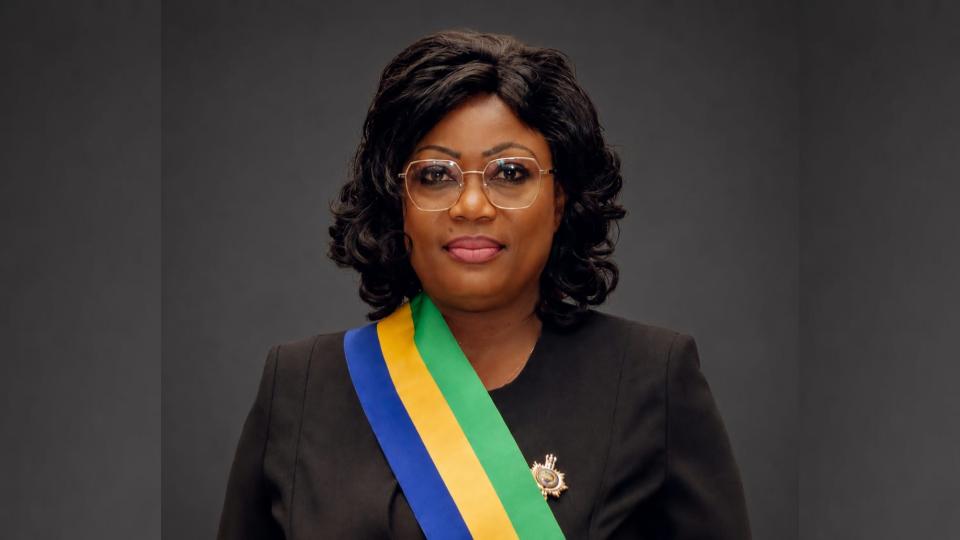
The escalating verbal attacks against President Brice Clotaire Oligui Nguema, his wife, and his mother have drawn sharp criticism from Gabonese lawmaker Daisy Léance Akinikoussou. In a forceful statement titled « It’s time to say: enough! », the deputy representing the second constituency of the Plateaux region condemns what she views as an alarming erosion of political discourse, where legitimate criticism has crossed into personal attacks against family members.
For Akinikoussou, the boundaries between vigorous political opposition and targeted harassment of relatives must be firmly re-established. As secretary-general of the National Network of Women Deputies (RENAFED), she argues that attacking the mother of a public official represents a fundamental violation of human dignity—a line that should never be crossed, regardless of political convictions.
When criticism crosses into personal attacks
The controversy stems from recent inflammatory remarks attributed to activist Landry Mbeng, widely known online as Lanlaire. The lawmaker condemns these statements as a dangerous precedent, where the mother of a president becomes fair game simply because of her familial ties. « A mother remains a mother, » Akinikoussou asserts, « no matter the position held by her child. »
She draws a clear distinction between legitimate political opposition and personal attacks, emphasizing that while the President’s governance may be contested, his mother’s dignity must be protected. « Defending the President’s mother today is not about defending a regime—it’s about defending a principle: the right of every individual to be free from harassment due to their family connections. »
Protecting women’s dignity in political discourse
Beyond the immediate controversy, Akinikoussou frames the issue through the lens of women’s rights and respect. She warns against a double standard where advocates for women’s dignity tolerate attacks on women they disagree with politically. « The fight for women’s rights cannot be selective, » she states. « We must defend all women—regardless of their opinions, alliances, or family ties. »
Her stance seeks to shift the debate from partisan conflict to a broader discussion about the normalization of online harassment and insults. In her view, the current climate risks normalizing disrespect as a tool of political engagement, with consequences far beyond any single controversy.
The dangerous precedent of targeting families
Akinikoussou cautions that tolerating such attacks sets a perilous precedent. « Today, it’s the President’s mother. Tomorrow, it could be the mother of an opponent, a journalist, a grassroots activist, or an ordinary citizen, » she warns. Her concern is not about shielding public figures from criticism but ensuring that political debate remains focused on governance, policies, and actions—not personal vendettas.
She acknowledges the importance of holding leaders accountable but insists that criticism must remain within ethical boundaries. « One can be a determined political adversary without becoming an adversary of human dignity, » she declares. « The two are not mutually exclusive. »
Restoring the boundaries of democratic debate
Her intervention comes at a time when Gabonese civil society voices are increasingly alarmed by the toxic nature of online political discourse. While political disagreements are inevitable in a democracy, Akinikoussou argues that the current climate risks eroding the very foundations of respectful debate. Her message is unambiguous: « Enough is enough. »
In her view, a healthy democracy thrives on rigorous scrutiny of leaders—not on the degradation of their families. The challenge now is to reclaim the discourse, ensuring that political opposition never descends into personal destruction.