Guinea’s media regulator takes decisive action against perceived editorial bias
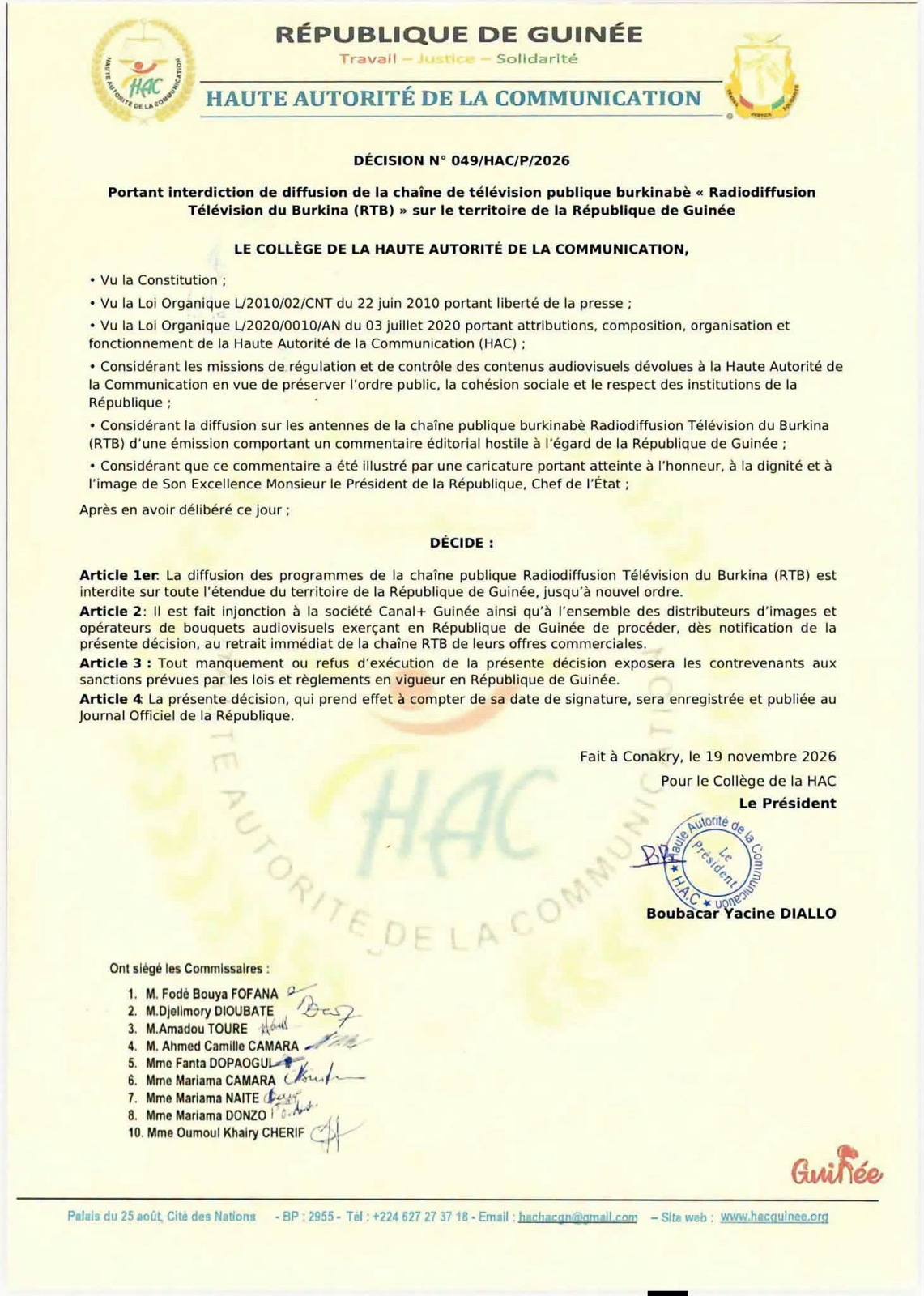
Guinea’s High Authority for Communication (HAC) has imposed an indefinite suspension on all transmissions of Burkina Faso’s public broadcaster, the Radiodiffusion Télévision du Burkina (RTB), across the national territory. The decision follows mounting concerns over the RTB’s apparent deviation from its core mandate as a public service media organization.
The suspension raises critical questions about the role of state-owned broadcasters in West Africa, particularly when their editorial content appears to prioritize political allegiance over journalistic integrity and public service obligations.
RTB’s alleged politicization under Burkina Faso’s current regime
Under the leadership of Burkina Faso’s transitional authorities, the RTB has faced criticism for its perceived alignment with the ruling government’s political narrative. Reports indicate that the broadcaster has increasingly used its platforms to amplify government positions, marginalize dissenting voices, and present one-sided coverage of national and regional events.
The HAC’s decision reflects growing dissatisfaction across the region with state media organizations that appear to function as mouthpieces for political agendas rather than serving the public interest. This raises concerns about the erosion of journalistic standards and the misuse of public resources designated for media services that should remain impartial and independent.
Journalism versus political communication: where do public broadcasters draw the line?
A public broadcaster’s primary responsibility is to inform citizens with accuracy, balance, and fairness. This includes presenting multiple perspectives, fact-checking claims, and allowing space for critical debate. When a state-owned media outlet prioritizes political messaging, it undermines public trust and confuses citizens about the difference between journalism and propaganda.
The HAC’s suspension of RTB broadcasts underscores the expectation that public media should uphold the highest ethical standards. Journalists and editorial teams working within state-funded institutions must deliver content that serves the nation not a particular political faction especially in politically sensitive environments.
The broader implications for West African media sovereignty
This development is not an isolated incident but part of a larger pattern affecting public broadcasters in West Africa. When state media become instruments of political influence, they risk eroding the very foundation of democratic discourse. Citizens rely on public broadcasters for credible, diverse, and trustworthy information to participate meaningfully in governance and societal development.
The HAC’s decision sends a clear message: public broadcasting must not be exploited as a tool for political manipulation. It underscores the necessity of maintaining editorial independence within state-funded media to preserve the integrity of journalism across the region.
What happens next? Accountability and the path forward
As the suspension remains in effect, the RTB faces an opportunity to review its editorial practices and realign its content with the ethical expectations of public service broadcasting. The HAC has not ruled out lifting the ban if the RTB demonstrates commitment to restoring its credibility through balanced, impartial, and fact-based reporting.
Meanwhile, the decision highlights the growing importance of regulatory bodies in safeguarding the independence of public media. In West Africa, where political interference in state broadcasters remains a persistent challenge, strong oversight mechanisms are essential to ensure that media serve the public not political agendas.
The case of the RTB suspension serves as a pivotal moment for public broadcasting in the region. It challenges state broadcasters to reflect on whether their mandate is to serve citizens or to amplify the narratives of those in power.
By Jeanne Ntouba — Journalist