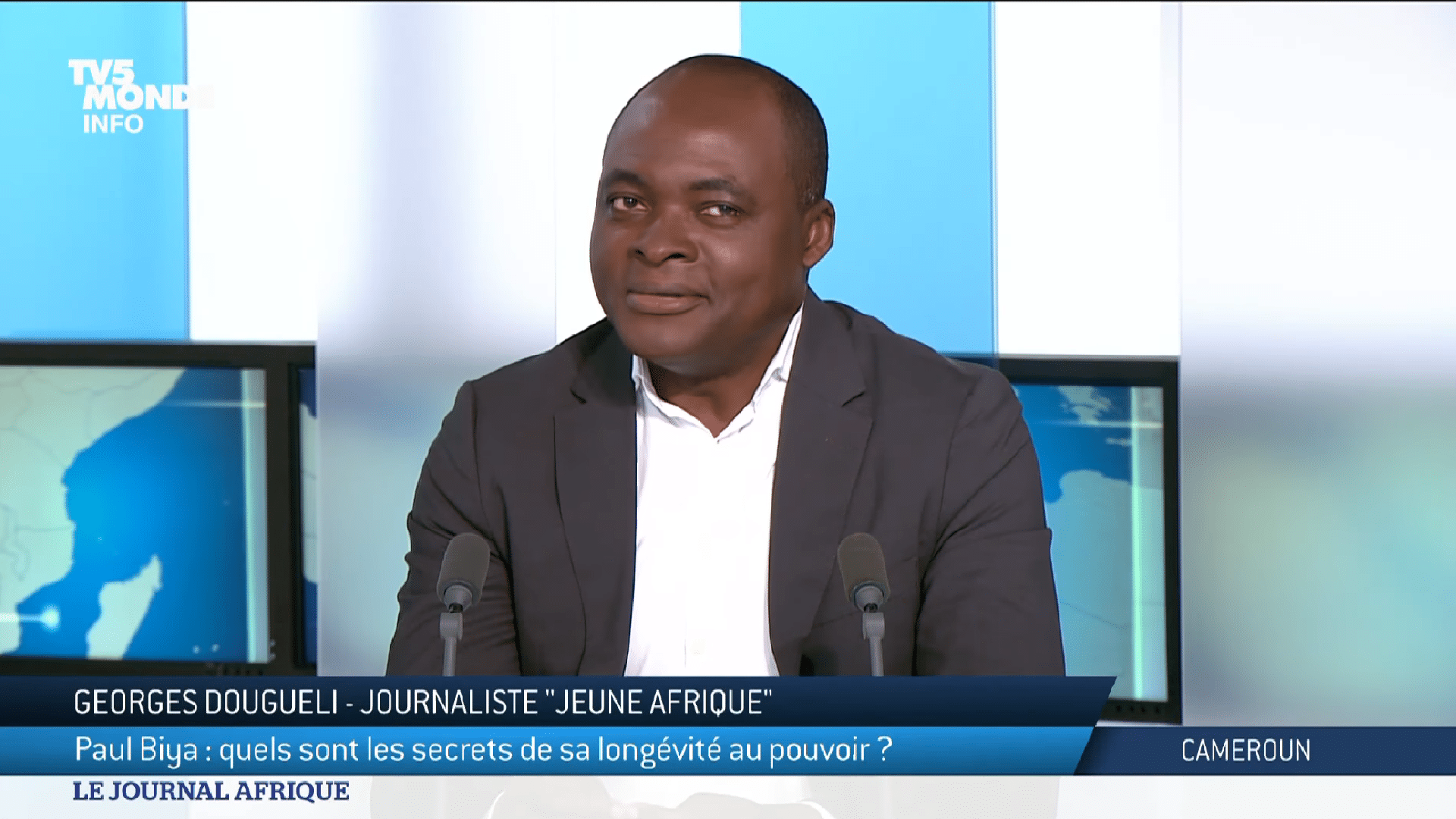
Journalist counters Owona Nguini’s claims about President Biya’s health
In a fresh opinion piece, the seasoned journalist addresses the vice-rector of the University of Yaoundé II, challenging his remarks on presidential speculation.
In a freshly published opinion piece, the journalist fires back at the University of Yaoundé II’s vice-rector, asserting that presidential speculation is part and parcel of legitimate journalism.
Here’s the full response:
TO WHOM IS MR. OWONA NGUINI ADDRESSING HIS CRITICISM?
“Dougueli speculates on President Biya’s death.” Of all the statements made by Mr. Owona Nguini during his June 26 television appearance, this one flooded my inbox. What am I supposed to say to that? Honestly, sir, speculating about a head of state’s death is what we journalists do. Nothing is off-limits for us. Some newsrooms even draft obituaries for key figures before they pass away.
Take former French President Mitterrand, who famously called journalists “dogs.” Every astute politician knows this scrutiny. President Biya is no stranger to it—and perhaps that’s why the security sphere’s zealots might want to hand me over to him. Let me make one thing clear: you cannot chronicle the life of a nation without questioning the health of its leaders. So I must ask—who exactly is this tirade aimed at? Perhaps it’s time to sketch a quick profile of the audience this television pundit is courting.
1. IS HE TARGETING THE ‘EKANG’ SUPREMACISTS?
This falls squarely within the political arena where this demagogue peddles dangerously inflammatory ideas. When he repeatedly declares, “I am a lord,” some dismiss it as mere childish megalomania. But they overlook the deep influence of Laburthe Tolra on his ideology.
It was Owona Nguini who hijacked and popularized the “Ekang” concept, rooted in Mvett mythology. According to French anthropologist Laburthe Tolra, the Ekangs—“Lords of the Forest”—are said to have migrated from the Nile’s banks to settle in the equatorial forest. Owona Nguini, taking this theory at face value, believes this group, which expanded into Gabon, Equatorial Guinea, and Congo, is destined to govern these lands.
In Gabon, where the Fang people (40% of the population) are steeped in Mvett culture—thanks in part to Tsira Ndong Ntoutoume’s work—the dangers of this supremacist “Ekang” ideology became evident during the 2009 presidential election, marked by the “Not the Fangs” movement. The concept never crossed Cameroon’s southern border. So what does this have to do with Fecafoot? The answer lies in Owona Nguini’s worldview, much like Carl Schmitt’s: politics is about defining the enemy. Yesterday, it was the “Ntaalibams” of “Uncle Maurika.” Today, the target is the so-called “Eglisiens,” fanatics supposedly “destined to cause trouble.” How? For whom? Why? That’s for this self-styled intellectual agitator to explain. One thing is certain: in the turbulent times ahead, this man—whose tact resembles an elephant in a China shop—will likely be the one stirring real trouble.
2. IS HE SPEAKING TO THE RULING ELITE AGAINST THE MASSES?
Can anyone seriously believe that Samuel Eto’o’s supporters, after enduring relentless harassment since 2021, are all “mindless drones” or paid thugs? By attacking the “illiterate” leader of Fecafoot, labeling his followers “sheep,” “uncultured fanatics,” and a “cyber mob,” this provocateur is rallying the educated elite against the perceived threat from below.
He’s painting a false dichotomy: “brains” versus “muscle.” To drive his point home, Owona Nguini—and his faction—are trying to vilify Eto’o, reducing him to a “cancer” that must be excised. They insult and degrade him until he’s symbolically “dead,” perhaps hoping to rehabilitate their own tarnished image, marred by poor governance, endemic corruption, and political crimes.
It’s a call to strip the masses of their sovereignty, to reinstate a monarchy’s absolute authority through the misuse of “high instructions,” falsely elevated as the pinnacle of legal norms.
I leave it to constitutionalists, political scientists, psychosociologists, and even psychoanalysts to dissect Owona Nguini’s remarks.
Be the first to comment


Comments