The political landscape in parts of Africa, particularly within the Alliance of Sahel States (AES), has recently been shaped by highly symbolic displays. During numerous sovereignist demonstrations, Russian flags and pro-Moscow slogans have become ubiquitous in public spaces. For a vocal segment of activists, Russia is now framed as the indispensable savior in contrast to Western powers of the past.
However, this growing fascination raises fundamental questions, especially when it stems from movements advocating total independence. Today, one of the leading figures of contemporary Pan-Africanism, Kemi Seba, appears to be undergoing a major doctrinal shift from inside his prison cell in South Africa, challenging this very dynamic.
Sovereignism versus the trap of substitution
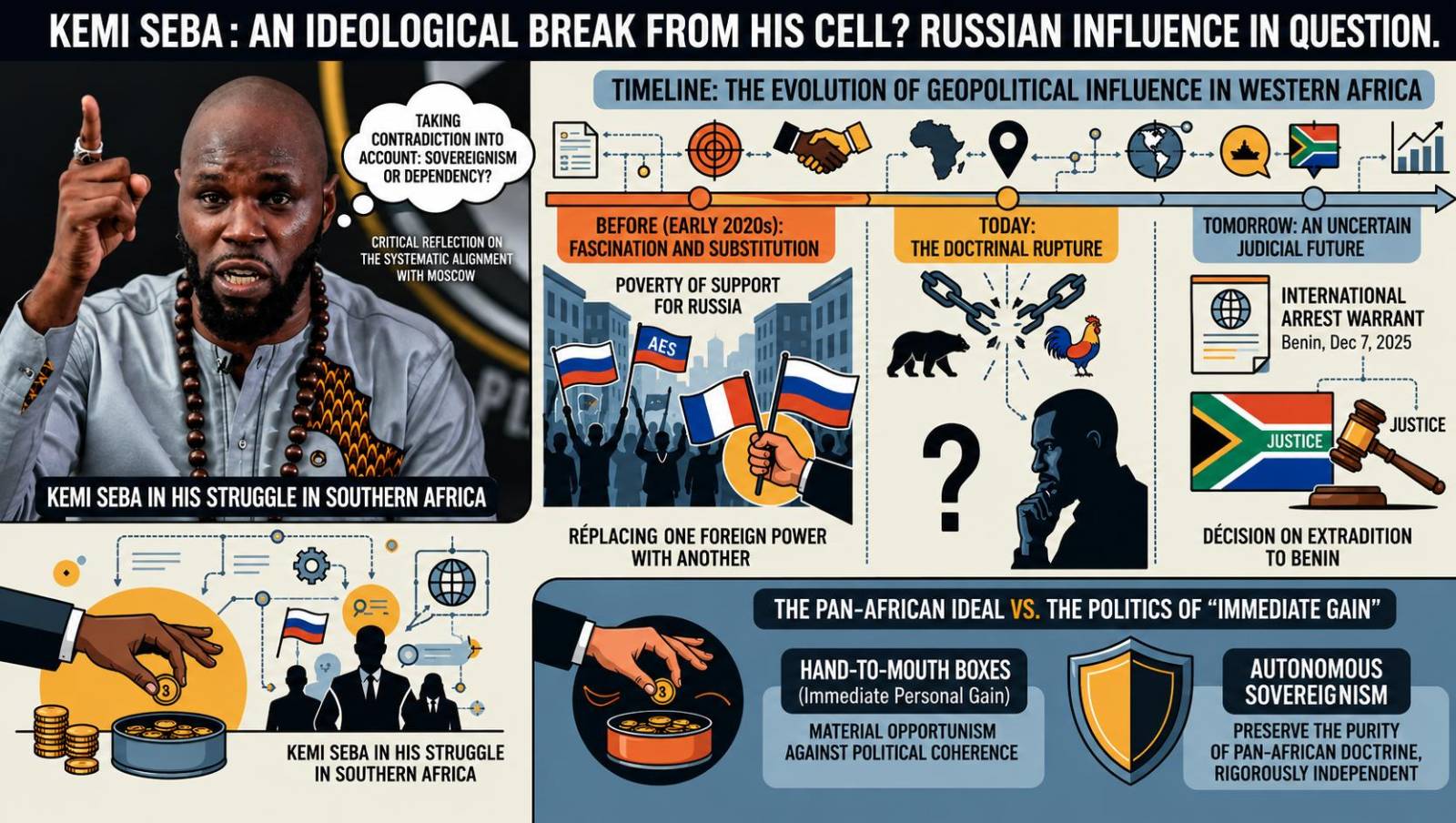
While seeking new international partnerships is a legitimate diplomatic endeavor for any state or political movement, replacing one foreign influence with another is widely seen as a profound ideological inconsistency. Swapping France’s historical dominance for Russia’s does not, in itself, signify true emancipation but merely shifts the center of dependency.
Observers suggest that Kemi Seba has recognized this contradiction. The Pan-African ideologue now critically examines the limitations of an uncritical alignment with Moscow, refusing to endorse any new form of protectorate, even one framed as anti-Western.
Pan-African ideals versus the politics of immediate gain
This distancing highlights a rift within sovereignist movements. While some pro-Russian enthusiasm stems from a genuine desire for geopolitical rupture, other dynamics appear driven by more material than ideological interests.
Kemi Seba firmly rejects such opportunism, often encapsulated by the metaphor of ‘filling the stew pot’—a reference to prioritizing short-term personal gain over long-term political coherence. By avoiding this mercenary logic, the activist seeks to uphold the doctrinal purity of a Pan-Africanism that demands absolute autonomy.
A suspended political and judicial future in Pretoria
This doctrinal introspection unfolds against the backdrop of a deeply precarious personal situation for the activist. Facing an international arrest warrant issued by the Beninese government following the December 7, 2025 coup attempt, Kemi Seba is currently imprisoned in South Africa.
The militant’s future no longer hinges solely on ideological battles but on judicial proceedings. The South African courts will soon rule on Cotonou’s extradition request. Will this enforced incarceration mark a definitive rupture or merely a reconfiguration of Pan-African discourse? The coming weeks will be decisive not only for Kemi Seba’s political fate but also for the trajectory of the movements he influences.