The Sahel’s shifting security landscape
Recent military developments in northern Mali have exposed a sophisticated transnational supply network linking southern Libya to the region, with the Nigerien border serving as a critical transit point.
Libya’s southern territories as a rebel stronghold
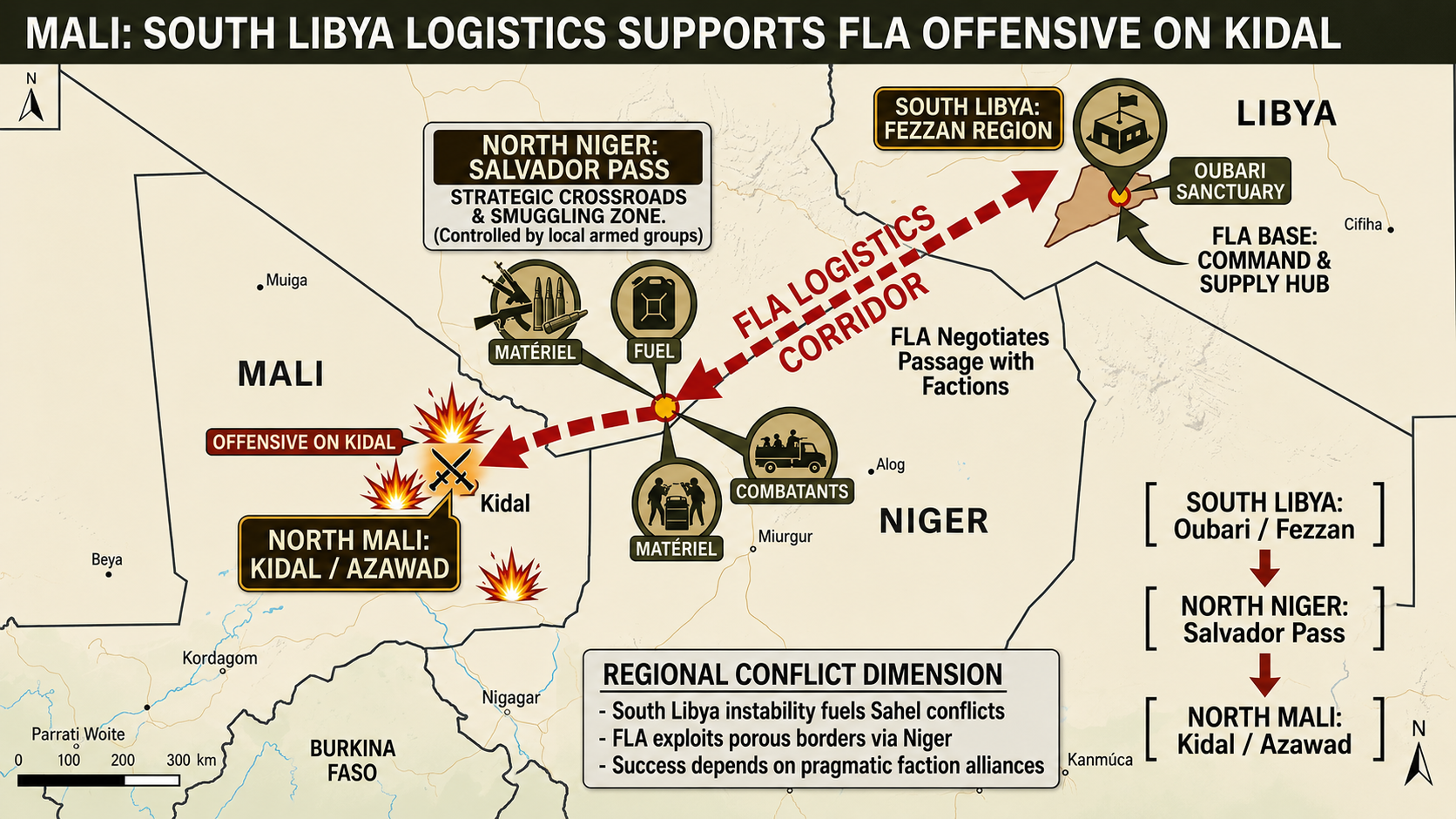
Observations from the field indicate that the Front de Libération de l’Azawad (FLA) has established a logistical pipeline from southern Libya into northern Mali, routing through Niger to support its latest offensive. The Fezzan and Oubari have emerged as key operational hubs, where rebel factions have consolidated command centers, storage facilities, and staging areas.
Intelligence gathered on the ground reveals that these zones are not merely temporary shelters but actively managed bases from which the FLA coordinates its movements. The timing of these preparations aligns with the April 25 campaign aimed at retaking Kidal, suggesting a deliberate strategy to exploit regional instability.
The Salvador Pass: a gateway for arms and fighters
A pivotal element of this cross-border infrastructure is the so-called “Salvador Pass,” a desert transit route in northern Niger. Historically notorious for smuggling activities, this corridor now functions as a lifeline for armed groups operating in the Sahel.
The pass facilitates the movement of three essential components:
- Military hardware: including weapons, ammunition, and equipment transported in convoys of armed pickup trucks;
- Strategic supplies: notably fuel, which is critical for sustaining desert operations;
- Manpower: fighters who move forward to engage in combat before retreating to Libyan territory.
Transit routes and regional alliances
The FLA’s ability to utilize this corridor hinges on negotiations with local armed factions controlling northern Niger. Unlike a straightforward military campaign, this offensive required securing passage agreements with these groups, highlighting the interdependence of Sahelian armed actors.
This logistical reality underscores a broader truth: modern conflicts in the Sahel are increasingly defined by pragmatic alliances between armed entities spanning national borders. The success of any operation now depends on the willingness of these factions to cooperate—even temporarily.
Implications for Mali’s northern conflict
As fighting intensifies around Kidal, the evidence points to a regionalized conflict where Libyan instability continues to fuel violence across the Sahel. The FLA’s offensive is not an isolated event but part of a wider pattern in which porous borders and shifting alliances enable armed groups to sustain long-term campaigns.
The situation demands urgent attention to the role of southern Libya as a rear base for rebel movements, as well as the vulnerabilities of transit zones in Niger. Addressing these dynamics will be essential to stabilizing northern Mali and the broader Sahel region.