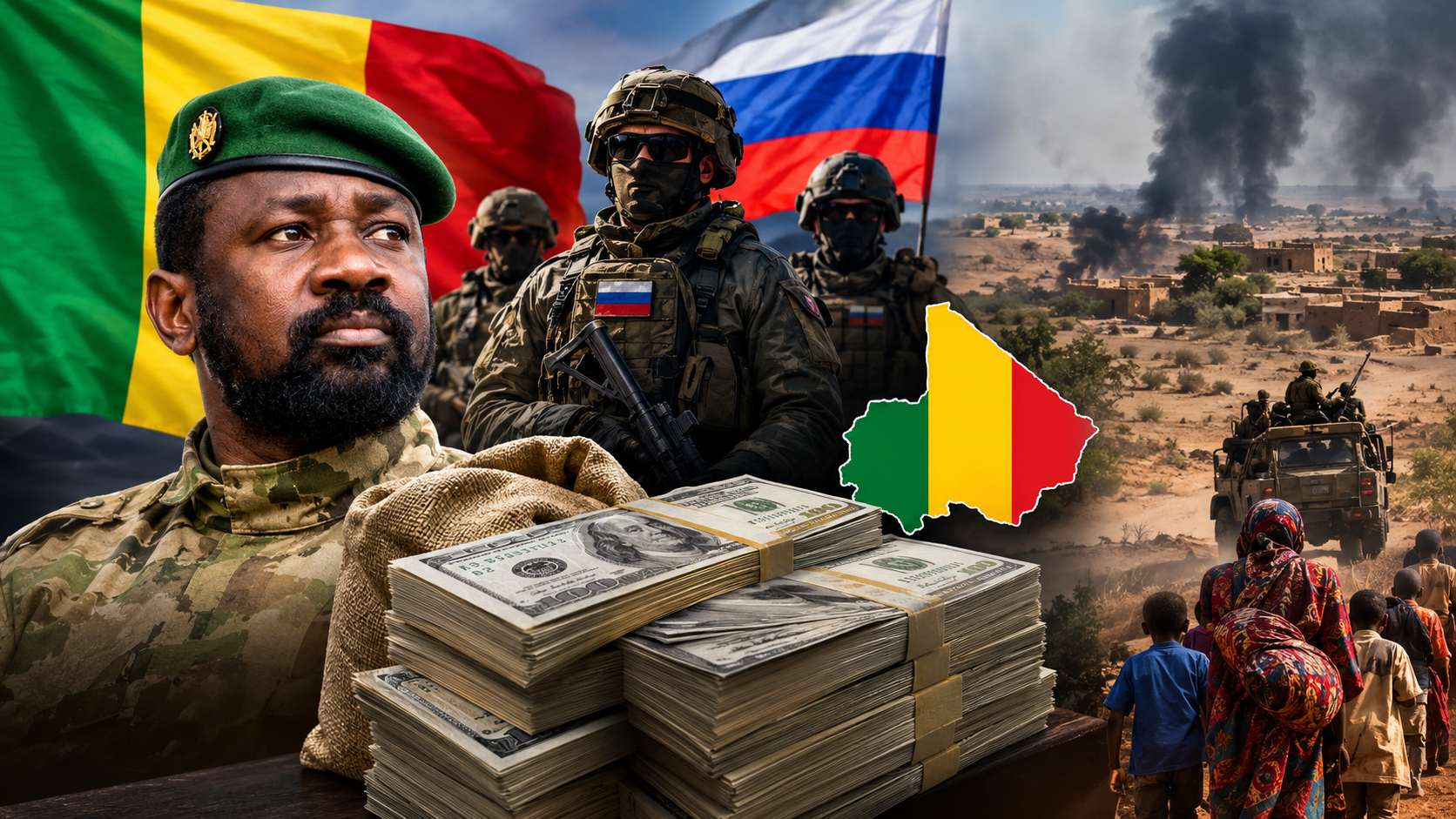
The Government of Mali has poured nearly $1 billion into its military partnership with Russian forces, a financial commitment now under intense scrutiny for its real-world impact. This investment, which funds the deployment of Russian paramilitary units first associated with Wagner Group and now rebranded under Africa Corps has raised critical questions about efficacy, accountability, and the true cost of sovereignty.
What one billion dollars is supposed to deliver
The scale of spending approximately $10,000 per fighter per month positions this alliance as one of Bamako’s most consequential security decisions in recent years. Transition authorities broke from long-standing Western partnerships, citing the need to reclaim national sovereignty and restore state control over embattled regions. Yet the true measure of success lies not in geopolitical alignment, but in measurable improvements: fewer attacks, safer roads, protected communities, and sustainable governance in reconquered areas.
A paradox of stated intent versus on-the-ground reality
Announced as a decisive shift in Mali’s security posture, the Russian partnership was framed as a break from dependency and a step toward self-reliance. However, the persistence of armed assaults, continued vulnerability at key installations, and the ongoing displacement of civilians paint a conflicting picture. If the billion-dollar investment fails to translate into enhanced protection for the population, the legitimacy of this strategic pivot must be reassessed.
Infrastructure and development sacrificed for military expenditure
The $1 billion constitutes public funds that could have supported schools, hospitals, and rural infrastructure in conflict-affected zones.
While no single counterterrorism effort guarantees immediate victory, the size of this investment demands clear, evidence-based outcomes.
Without measurable improvements in civilian safety, the cost-benefit ratio of this partnership remains unacceptably opaque.
From Wagner to Africa Corps: change in name, but not in expectation
The rebranding of Russian forces in Africa reflects an organizational shift, not necessarily a strategic one. For Mali, the critical test is whether this evolution has led to more effective collaboration with Malian troops, improved intelligence sharing, better protection of towns and villages, and a lasting reduction in jihadist activity.
External combat support can enhance operational capacity, but it cannot replace the need for a well-equipped, professionally trained, and nationally accountable military capable of holding territory. When national security hinges indefinitely on foreign fighters, the very sovereignty championed by the authorities comes into question.
The cost of sovereignty without transparency
Sovereignty, as the Government asserts, is not merely the freedom to choose allies it is the ability to govern with full knowledge of costs, risks, and results. Citizens deserve clarity on how funds are used: what missions are assigned to Russian forces, what milestones have been reached, and how civilian protection has improved. Secrecy in such matters risks turning strategic choice into political liability.
This accountability is not a critique of Russia or a nostalgic appeal for former partners. It is a public duty. A security partnership of this magnitude cannot be shielded from evaluation simply because it aligns with official discourse.
The ultimate judge: daily life for the Malian people
In towns such as Mopti, Gao, and Timbuktu, families, farmers, and traders bear the weight of insecurity every day. They do not measure success in press conferences or alliance announcements, but in the freedom to move, farm, trade, and return home safely. Until these conditions improve, no amount of strategic rhetoric can justify the billion-dollar expenditure.
The only meaningful benchmark for this partnership is the lived experience of Malians. If attacks continue unabated, if routes remain hazardous, and if displaced communities cannot safely resettle, then the investment has not delivered what it promised and the Government must explain why.
Accounting for every dollar and every life protected
To assess this partnership fairly, full transparency is required: verifiable payment records, confirmed troop numbers, contract durations, operation logs, and before-and-after security data. Only then can the claim of a $1 billion investment be evaluated against a backdrop of concrete evidence.
Ultimately, this issue transcends the presence of Russian forces. It speaks to the ability of Malian leadership to convert a foreign policy decision into tangible improvements for its people. Diverging from former allies is not a victory in itself. Proving that the new path secures the nation that is the true test of sovereignty.
By Jeanne Ntouba — Journalist