From guns to gold: how Russian security firms are reshaping African alliances
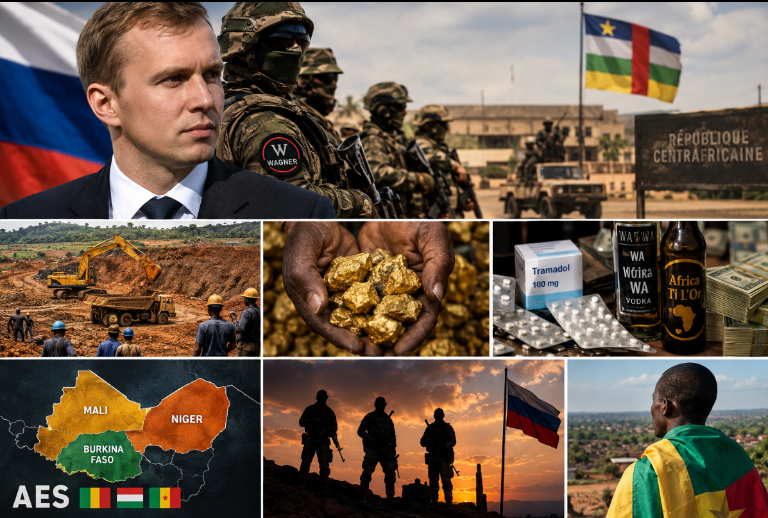
In Central Africa, the Wagner Group’s operations continue to cast a long shadow—this time through Pavel Prigojine, son of the late founder Evgueni Prigojine. Reports indicate that the younger Prigojine has expanded what was once a $400 million annual empire, blending military security with deep economic interests across the Sahel region and the African continent.
For African nations grappling with insurgencies and shifting geopolitical sands, these partnerships appear to offer a lifeline. But beneath the surface, a troubling pattern is emerging: Russia’s security presence is increasingly intertwined with access to gold and other strategic minerals. In the Central African Republic (CAR), Wagner-linked entities now control or influence mining operations worth over $250 million annually, raising serious questions about transparency and state sovereignty.
Bangui’s bargain: security for economic control
In Bangui, the Wagner Group has been a key enabler of President Touadéra’s regime, offering protection against armed groups in exchange for unchecked access to lucrative sectors. Despite the death of Evgueni Prigojine in 2023, the network has not only survived—it has reorganized under new leadership, with Pavel Prigojine reportedly retaining control over significant assets.
Military presence remains strong, with approximately 500 Wagner-aligned fighters still deployed in CAR. Their role extends beyond battlefield operations: logistic hubs, transport networks, and local businesses have fallen under their operational influence. This dual role—shield and exploiter—creates a dependency that transcends traditional military support.
Gold as collateral: the hidden cost of security
Gold extraction in CAR, allegedly tied to Wagner-linked enterprises, has reached an estimated $250 million in annual output. Yet revenue streams are opaque, and public benefit remains uncertain. While the state touts mining as an engine for development, local communities see little of the proceeds. Instead, significant volumes are exported under unclear contractual terms, often bypassing official channels.
This model is not unique to CAR. In Mali, Burkina Faso, and Niger—nations now forming the Alliance of Sahel States (AES)—Russia’s growing military footprint is raising the same concerns. The promise of rapid security assistance is compelling, especially amid jihadist threats and strained relations with Western partners. But when security firms become economic operators, the line between protector and profiteer blurs.
What the Sahel can learn from Central Africa
The CAR experience serves as a cautionary tale. While Wagner’s methods have brought temporary stability to Bangui, long-term consequences include weakened state institutions and loss of control over national resources. The model relies on a dangerous trade-off: security today, economic surrender tomorrow.
In the Sahel, governments are not blind to the risks. Mali has already seen controversy over Russian military operations and civilian casualties. Burkina Faso and Niger are navigating sensitive negotiations, weighing the benefits of Russian support against the potential erosion of national autonomy. One critical question looms: Can these nations secure their borders without surrendering control of their gold, uranium, and other minerals?
The Kremlin’s evolving role: control vs. chaos
Since the 2023 rebellion led by Evgueni Prigojine, Russia has attempted to formalize its African operations under the Africa Corps, a state-aligned force. This shift was meant to bring Wagner’s activities under government oversight. Yet in CAR, local networks appear resilient, operating with surprising autonomy.
This partial independence suggests a dual strategy: Moscow seeks to project influence through official channels, while Wagner-linked figures maintain private economic interests. For African partners, this creates a paradox. They may gain military support from a recognized state actor, only to find that the benefits are redirected toward unaccountable networks.Sovereignty at stake: who controls the gold?
The core issue is not whether African nations need security partners—but how those partnerships are structured. Transparent contracts, independent audits of mining revenues, and strict limits on foreign influence over local economies are essential. Without these safeguards, gold does not fund schools or hospitals; it funds private empires.
For the Sahel, the lesson is clear. Security partnerships must be evaluated not just by their short-term military impact, but by their long-term effects on national sovereignty. When gold becomes the currency of protection, the true price is paid in lost autonomy.
In the end, the question is not just who protects a government—but who profits from its resources, who answers for the consequences, and whether the nation truly remains the master of its own future.