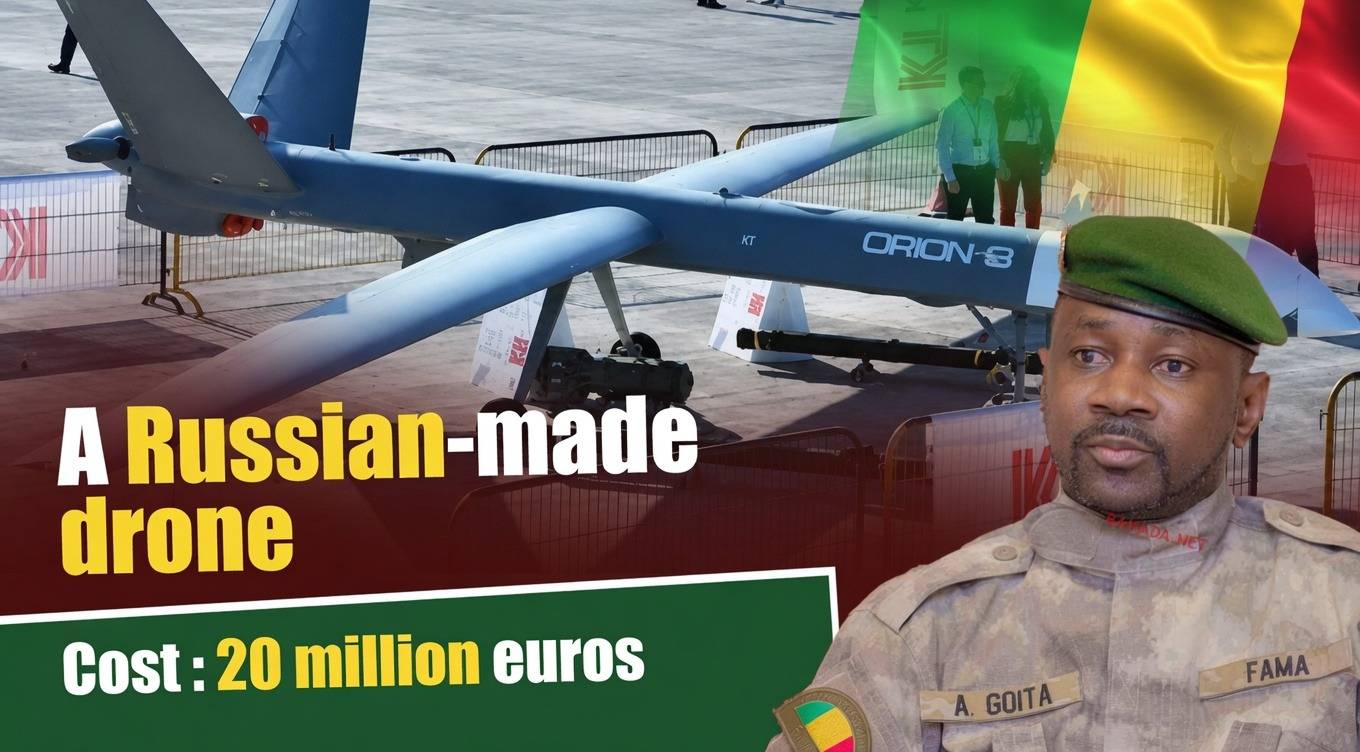
The Malian military has recently taken delivery of a high-profile Russian-made drone, the Orion, as part of its efforts to bolster aerial capabilities. While authorities hail this as a significant step toward reclaiming territory, military experts are raising serious concerns about the drone’s suitability for the country’s asymmetric warfare challenges and its staggering financial burden.
Mali’s partnership with Moscow delivers a new aerial asset
The Malian Armed Forces (FAMa) now operate a new Orion drone, a Medium Altitude Long Endurance (MALE) aircraft designed for prolonged surveillance and precision strikes. This acquisition follows a series of military equipment deliveries from Russia, reinforcing Bamako’s strategic pivot toward Moscow. Proponents argue that the Orion enhances Mali’s ability to monitor vast desert expanses, marking a shift away from traditional Western military partnerships.
Why the Orion may struggle in Mali’s asymmetric conflict
The Malian military faces adversaries that are mobile, dispersed, and highly adaptable—hallmarks of asymmetric warfare. However, the Orion’s most glaring weakness in this context is its acoustic signature. The drone’s loud noise makes it detectable long before it reaches its target, giving terrorist groups ample warning to scatter or conceal themselves in the terrain.
Additionally, the assumption of air superiority is risky. Armed groups in northern and central Mali have demonstrated the ability to acquire and deploy anti-aircraft systems capable of targeting low- to medium-altitude aircraft. A bulky, easily detectable drone like the Orion could quickly become a prime target for portable surface-to-air missiles or concentrated fire.
A 20-million-euro gamble: is the Orion a smart investment?
The financial implications of this acquisition have sparked intense debate. Priced at nearly 20 million euros (over 13 billion West African CFA francs), the Orion represents a massive outlay for Mali, a nation grappling with severe budget constraints and pressing social needs. Critics argue that this single purchase could have funded an entire fleet of smaller, more discreet, and cost-effective tactical drones. By prioritizing a high-profile but potentially impractical asset, Bamako may have prioritized political symbolism over tactical efficiency.
One drone, one challenge: covering Mali’s vast and vulnerable terrain
Mali’s sprawling landscape—from the arid expanses of Taoudénit to the dense forests of Kayes—poses a monumental challenge for counterterrorism efforts. Yet, the Orion’s limitations become glaringly apparent: a single drone cannot cover the entire country. Even with its extended endurance, the aircraft cannot maintain a constant aerial presence across all regions. When it lands for maintenance or refueling, critical areas fall back into a dangerous void, leaving the skies open for militant movements to operate unchecked.
The hidden costs: logistics, maintenance, and long-term sustainability
The price tag of 20 million euros is merely the beginning. Operating the Orion demands a heavy and expensive logistical infrastructure. Ground control stations, climate-controlled shelters to protect sensitive electronics, and specially reinforced runways are just the start. Ongoing expenses include high-cost fuel, imported spare parts from Russia, and guided munitions to keep the drone operational. Without a continuous financial commitment to sustain these needs, the Orion risks becoming an expensive, immobile relic, stranded in a hangar.
As Mali’s military continues to expand its capabilities, the Orion acquisition underscores the tension between high-profile investments and pragmatic security needs. In a conflict defined by mobility and surprise, a single, expensive, and easily detectable drone may not be the answer. Instead, a diversified, agile, and sustainable approach—prioritizing smaller, stealthier, and more affordable assets—could offer a more effective path forward for securing the nation.