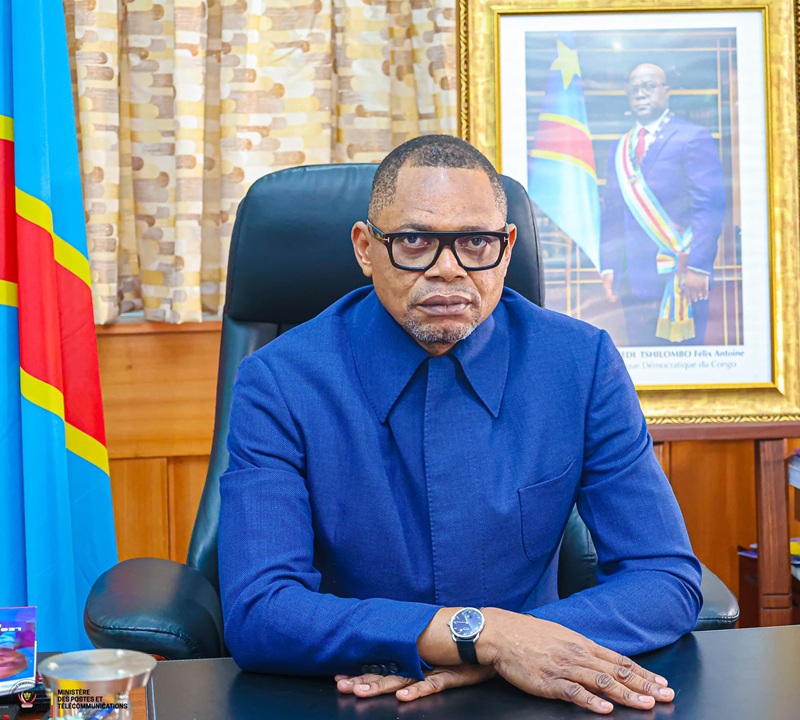
Exactly one year after Me José Mpanda Kabangu took office as Minister of Posts and Telecommunications, his leadership has reshaped the sector in the Democratic Republic of the Congo. Appointed on August 8, 2025, he has spearheaded transformative initiatives that reposition the country on the global stage while upgrading domestic infrastructure and services.
The minister’s first priority was to diagnose systemic challenges in collaboration with telecommunications operators and administrative bodies. Among the key objectives were: ending the country’s international isolation in critical postal and telecom institutions, improving working conditions for civil servants, and fostering a stable business environment to enhance service delivery nationwide.
Regaining global standing in postal and telecom governance
Within just five weeks of assuming office, the DRC regained its full voting rights and speaking privileges at the Universal Postal Union (UPU), an institution it had been barred from for over 34 years due to unpaid contributions. This breakthrough was achieved through direct advocacy with the President and government, culminating in the settlement of long-standing arrears.
In a historic move, Me José Mpanda secured the return of the African Telecommunications Union (ATU) headquarters from Nairobi, Kenya, to Kinshasa. The decision was formally ratified during the 7th Plenipotentiary Conference held in Abuja, Nigeria, on July 23, 2026. The Zambian Secretary-General of the ATU, Kezias Kazuba Mwale, will officially take office in the Congolese capital starting January 2027. This relocation—long overdue since 1992—was made possible after the minister cleared arrears and penalties totaling more than $1.4 million USD. The move grants the DRC an automatic seat on the ATU’s governing council, a first in 34 years and a milestone achieved despite the ministry having been led by 17 ministers during that period.
With sights set on further elevation, Me José Mpanda is now preparing the DRC’s candidacy for a seat on the International Telecommunication Union (ITU) Council for the 2027–2030 term. The formal bid will be submitted during the upcoming Plenipotentiary Conference in Doha, Qatar, this November. The ITU, a UN specialized agency, sets global standards for spectrum management, broadband infrastructure, satellite networks, and digital inclusion policies. By securing a seat, the minister aims to align the DRC with its ambition of becoming a regional technology hub by 2030—a vision championed by President Félix-Antoine Tshisekedi.
Strengthening domestic institutions and operator partnerships
On the national front, Me José Mpanda has revitalized the administration under his purview. Within 144 days of taking office, he supplied the General Secretariat of Posts, Telecommunications, and New Information and Communication Technologies (SG PTNTIC) with a fleet of ten brand-new vehicles, including three large buses and official jeeps for senior staff. This unprecedented gesture was hailed by long-serving civil servants—many with 30 to 40 years of service—as a turning point in the ministry’s history.
In parallel, he implemented sweeping reforms to improve working conditions: updating the salary grid, rehabilitating office buildings, and adopting a new organizational framework. Merit-based promotions were also introduced across all levels of the administration, ensuring fairness and transparency.
To stabilize the operating environment for telecom operators—Airtel, Vodacom, Orange, and Africell—he resolved long-standing legal and judicial uncertainties by converting their licenses into compliant titles. Additionally, he halved the decade-long moratorium on Congolese ownership in telecom companies, enabling local investors to meet the 25% capital participation threshold (with a 5% allocation for employees) under the Telecommunications Act, Article 40, retroactively.
Laying the groundwork for a digital future by 2030
At the heart of Me José Mpanda’s strategy is a bold infrastructure agenda aimed at closing the digital divide. Inspired by the outcomes of the national postal and telecom stakeholders’ conference held in April 2026, his administration has charted a clear roadmap: deploying at least 54,000 kilometers of fiber-optic cable and erecting 30,000 new towers or antennas to connect all 145 territories, modernize the postal system, broaden tax bases, and accelerate digital transformation.
Implementation is already underway. Through the Digital Transformation Program (PTN), funded by the World Bank and the French Development Agency, 10,000 km of fiber are being laid. Meanwhile, the Universal Service Development Fund (FDSU)—a department under the ministry—is constructing towers using its own resources. The first phase targets Nkamba in Kongo Central, a pilot zone where over 3,000 towers are planned. On August 8, 2026, the FDSU signed agreements with the four mobile operators, each receiving grants to build at least ten antennas in peri-urban and rural areas.
Complementing terrestrial efforts is a sovereign satellite project. Negotiations with China Unicom are advancing, with plans to launch a national satellite to support connectivity, broadband access, and rural inclusion.
Conclusion: from recovery to leadership
In just one year, Me José Mpanda Kabangu has steered the DRC from isolation to influence within the global postal and telecom community. By restoring voting rights in the UPU, relocating the ATU headquarters to Kinshasa, and positioning the country for a seat on the ITU Council, he has reclaimed the DRC’s rightful place in international governance. Nationally, through fleet upgrades, salary reforms, and infrastructure investments, he has redefined the ministry’s operational culture and set the stage for a digitally inclusive future by 2030.