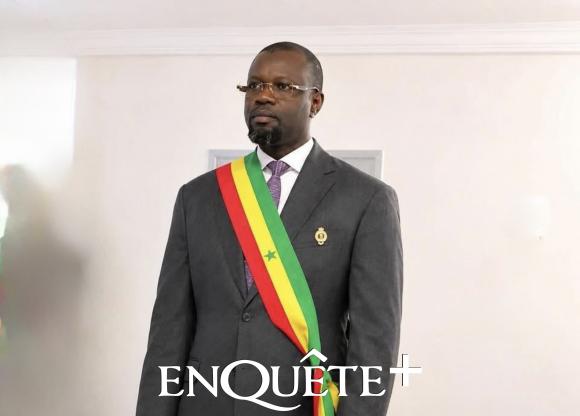
The opposition has escalated its institutional confrontation by filing a legal challenge to contest Ousmane Sonko’s reinstatement as a deputy and subsequent election as President of the National Assembly. In an official statement released yesterday, a coalition of opposition lawmakers announced they had lodged a petition with the Constitutional Council, invoking constitutional provisions to invalidate the actions taken by the National Assembly Bureau.
Legal grounds for the constitutional challenge
At the heart of the opposition’s argument is Article 54 of the Constitution, which they claim was violated when Sonko was reinstated as a deputy despite his prior appointment as Prime Minister. The petitioners assert that holding both executive and legislative positions simultaneously constitutes a clear breach of constitutional separation of powers. They maintain that Sonko’s election to the Assembly presidency—secured with 132 votes out of 133 cast—was the direct result of an unconstitutional maneuver.
The opposition coalition, composed of independent deputies and opposition groups, argues that Sonko’s initial election as a deputy in 2024 was incompatible with his role as Prime Minister. By retaining government functions, they claim, he forfeited his parliamentary mandate under both constitutional and internal Assembly rules. Their legal filing emphasizes that the Constitutional Council holds exclusive authority to rectify such institutional violations, ensuring that parliamentary mandates adhere strictly to constitutional norms.
Procedural irregularities fuel legal dispute
Beyond the constitutional arguments, the opposition has highlighted what they describe as deliberate obstruction to justice. Lawmakers report that repeated requests for essential documents—including the formal reinstatement decree and the May 26 plenary session minutes—were denied by the Assembly’s Secretary-General and First Vice-President. Only after formal summons by legal representatives were these materials obtained, a delay the opposition condemns as an affront to transparency and democratic accountability.
The coalition condemns these refusals as a “serious breach of parliamentary rights”, insisting that such documents are inherently public and should have been immediately accessible. Their petition calls on the Constitutional Council to intervene, describing the situation as a “flagrant violation of institutional integrity” that undermines the Assembly’s credibility.
A political crisis unfolds
The legal battle unfolds against a backdrop of intense political upheaval. Ousmane Sonko, who was dismissed as Prime Minister on May 22, staged a dramatic political comeback by securing the Assembly presidency just days later. His election followed the resignation of former president El Malick Ndiaye, making Sonko the second-highest-ranking official in the country. The vote, however, was boycotted by opposition members, who labeled the process a “constitutional coup”.
The legal uncertainty deepens as conflicting interpretations of the Constitution emerge. Some legal scholars argue that Article 54 does not explicitly address suspension or automatic reinstatement, instead establishing an incompatibility principle with concrete institutional consequences. Others point to Article 123 of the Assembly’s internal regulations, which allows for the replacement of deputies appointed to government roles, potentially justifying Sonko’s return.
Constitutional hurdles ahead
A critical question remains: whether the opposition’s petition is even admissible. Legal experts note that individual deputies typically lack the authority to directly petition the Constitutional Council on such matters; that prerogative generally rests with the President of the Republic. While the presidency has denied involvement in the filing, the Council must first determine whether the opposition’s legal challenge meets procedural requirements before addressing its merits.