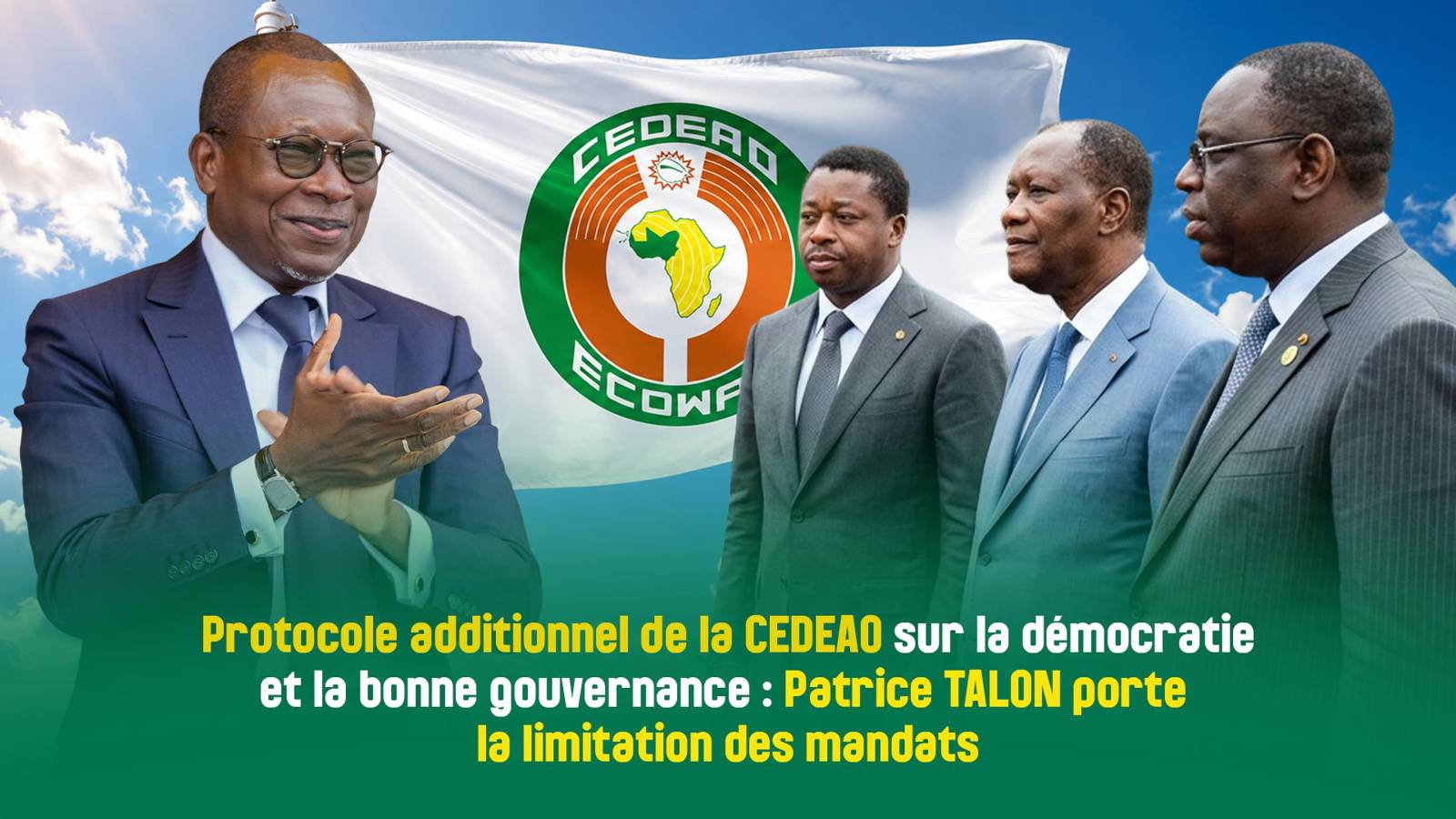
West Africa finds itself at a crossroads where democratic ideals clash with entrenched political traditions. At the heart of this standoff within the Economic Community of West African States (CEDEAO) lies the contentious issue of presidential term limits—a debate that has exposed deep divisions among regional leaders.
Cotonou’s crusade for democratic reform
From the outset of his presidency in 2016, Patrice Talon of the Bénin has waged a determined campaign to embed term limits as the cornerstone of regional governance. His administration argues that the wave of military coups sweeping across the Sahel—particularly in the Mali, Burkina Faso, and Niger—stems directly from leaders’ refusal to relinquish power. Talon’s proposed solution is uncompromising: a blanket prohibition on more than two presidential terms for all CEDEAO members, with no loopholes for constitutional amendments.
The Béninois president contends that such a rule is the only safeguard against constitutional breaches that erode the bloc’s credibility. His stance reflects a broader conviction that institutional integrity must take precedence over political expediency, even if it means challenging long-standing allies.
Resistance from Abidjan, Dakar, and Lomé
Patrice Talon’s reformist zeal, however, has collided with a wall of opposition. Three influential leaders—Faure Gnassingbé of Togo, Alassane Ouattara of Côte d’Ivoire, and the former president of Sénégal—have vehemently rejected the proposed mandate cap. Their resistance underscores a fundamental divide: sovereignty versus supranational oversight.
In Lomé, Gnassingbé’s government frames the proposal as an unacceptable infringement on national autonomy, pointing to Togo’s recent shift to a parliamentary system as justification for extended executive tenure. Meanwhile, Abidjan has dismissed the idea outright, with Ouattara’s contested third term in 2020 serving as a stark counterpoint to Talon’s arguments. In Dakar, the former administration under Macky Sall maintained that CEDEAO’s priorities must lie in combating terrorism and economic integration—not policing presidential mandates. The Sénégal itself has grappled with term-limit disputes, though the 2024 transition has shifted the political landscape.
A principled absence reshapes Bénin’s regional role
Patrice Talon’s refusal to compromise has translated into a deliberate strategy of diplomatic abstention. The Bénin has notably skipped several high-profile CEDEAO summits, a move framed not as disengagement but as a protest against perceived double standards. By sanctioning military juntas while tolerating constitutional overreach by civilian leaders, the bloc, in Talon’s view, undermines its own moral authority.
Critics may see this as isolation, but Porto-Novo defends it as consistency. For the Béninois president, walking away from forums that fail to uphold democratic principles is a necessary stand—one that aligns with his pledge to step down in 2026, a rarity in a region where leaders often cling to power.
Can the lone reformer shift the tide?
Despite the resistance from regional heavyweights, Talon’s position resonates with civil society across West Africa. His advocacy for term limits positions him as a rare voice prioritizing institutional stability over personal ambition. Yet the question remains: can a single leader’s conviction outweigh the entrenched interests of those who benefit from the status quo?
The answer may hinge on whether CEDEAO can reconcile its dual mandate—preserving democratic norms while navigating the pragmatic realities of power retention. For now, the debate rages on, with the Bénin serving as both a beacon and a cautionary tale. The future of West Africa’s democratic experiment may well be decided in this clash of visions.