From rhetoric to reality: the sovereignist gamble of the Sahel alliance
Three years after military takeovers reshaped the political landscape in Mali, Burkina Faso, and Niger, the Alliance of Sahel States (AES) continues to champion a discourse rooted in sovereignty and defiance of traditional regional partnerships. What began as a bold assertion of independence has increasingly exposed the limits of a strategy built on rupture rather than tangible progress.
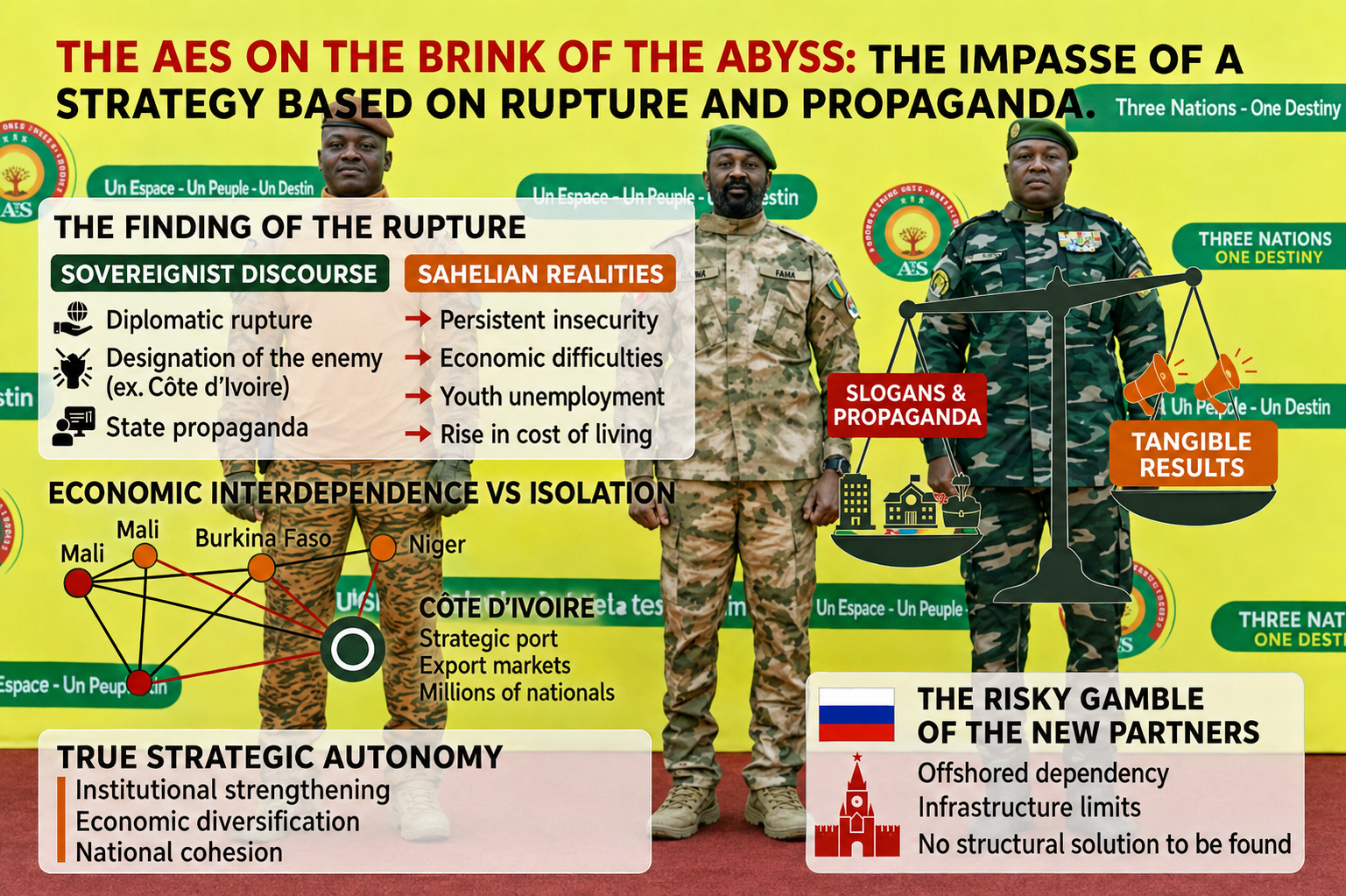
The alliance’s narrative, which emphasizes breaking away from former allies and rejecting external influence, initially resonated with segments of the Sahelian public. Frustrated by persistent insecurity and perceived inefficacy of international cooperation, many welcomed the promise of full control over diplomatic and military choices. Yet sovereignty, as many now observe, cannot be measured solely by the denunciation of agreements or the severing of ties. True sovereignty demands results: security for citizens, economic resilience, job creation, and functional public services.
The reality, however, tells a different story. Despite the bold declarations, the challenges confronting the AES remain daunting. Insecurity persists, economies strain under pressure, and public expectations continue to mount. In such a climate, political communication often fills the void left by unmet promises.
The political cost of shifting blame
When leaders struggle to deliver visible improvements, externalizing blame becomes a convenient tool for rallying support. For the AES, neighboring states and regional organizations have increasingly become targets of criticism, with Côte d’Ivoire frequently singled out as a hostile actor or a conduit for foreign interests.
This approach offers short-term political advantages by uniting populations against a common enemy. Yet its drawbacks are significant. It diverts attention from pressing domestic issues—rising living costs, youth unemployment, educational deficits, and crumbling infrastructure. It also risks stoking unnecessary diplomatic tensions among nations whose economies and societies remain deeply interconnected.
Furthermore, labeling domestic critics as supporters of external adversaries risks stifling democratic debate, narrowing the space for dissent and constructive dialogue.
Côte d’Ivoire’s steady hand amid regional turmoil
While the AES navigates its confrontational stance, Côte d’Ivoire has maintained a diplomatic posture rooted in dialogue and stability. This approach reflects a long-standing tradition of mediation and consensus-building, a legacy shaped by the vision of former leader Félix Houphouët-Boigny.
The Ivorian strategy prioritizes continuity over confrontation, even in the face of provocative rhetoric. This choice is not merely ideological; it is grounded in pragmatism. Côte d’Ivoire serves as a vital economic hub for the Sahel, with its port facilitating trade for landlocked nations like Mali, Burkina Faso, and Niger. Millions of nationals from these countries live, work, or conduct business in Côte d’Ivoire, underscoring the deep human and economic ties that transcend political rhetoric.
A prolonged deterioration in relations would carry heavy consequences, not just for diplomacy but for the daily lives of millions across the region.
The hidden economic toll of diplomatic confrontations
The strategy of confrontation carries an often-overlooked economic burden. Heightened tensions can deter investment, disrupt trade flows, inflate logistical costs, and erode a country’s appeal to international investors. In economies already weakened by insecurity, diplomatic crises compound existing challenges, slowing job creation, straining public finances, and undermining growth.
The uncertainty generated by such confrontations acts as a red flag for businesses, making long-term planning nearly impossible in an already volatile environment.New alliances: a gamble without guarantees
The AES’s pivot toward new international partners, particularly Russia, represents another pillar of its sovereignty-first strategy. While diversifying alliances is a sovereign right, it does not automatically translate into tangible benefits.
International experience demonstrates that no external partner can single-handedly resolve structural issues such as weak institutions, limited investment, rural poverty, or fragmented governance. The risk is clear: replacing one dependency with another without addressing the root causes of the crisis.
True strategic autonomy requires strengthening national institutions, professionalizing security forces, fostering a conducive business environment, diversifying economies, and investing in human capital. These are the foundations upon which lasting stability and prosperity are built.
Communication versus action: the unmet expectations of citizens
The AES’s leadership has placed considerable emphasis on political communication, framing its agenda around themes of sovereignty, resistance, and national renewal. While such messaging can bolster patriotism, it cannot indefinitely substitute for concrete achievements.
Citizens evaluate their leaders based on measurable outcomes: improved security, affordable living costs, job opportunities for youth, functional schools and hospitals, modern infrastructure, and inclusive economic growth. Over time, these benchmarks will carry far more weight than slogans or propaganda campaigns.
West Africa’s future hinges on cooperation, not division
The challenges facing West Africa—terrorism, transnational crime, migration, climate change, food insecurity, and economic development—transcend national borders. No single nation can address them alone.
Regional cooperation remains indispensable, whether within existing frameworks or through new partnerships. Treating neighbors like Côte d’Ivoire as perpetual adversaries only weakens an already fragile region, deepening crises rather than resolving them.
Conclusion: from promise to performance
The Alliance of Sahel States emerged from a desire to break away from a model deemed ineffective. This ambition reflects real aspirations among the public. Yet rupture alone does not constitute a policy.
The AES’s credibility will ultimately be measured not by its sovereignist rhetoric, but by its ability to restore security, revitalize economies, uphold public freedoms, and rebuild trust through regional collaboration. The future of the Sahel depends less on assigning blame to external actors than on the willingness of its leaders to deliver tangible results, restore citizen confidence, and transform dialogue into a tool for stability rather than perpetual confrontation.