Escalating violence underscores vulnerabilities in Burkina Faso’s security framework
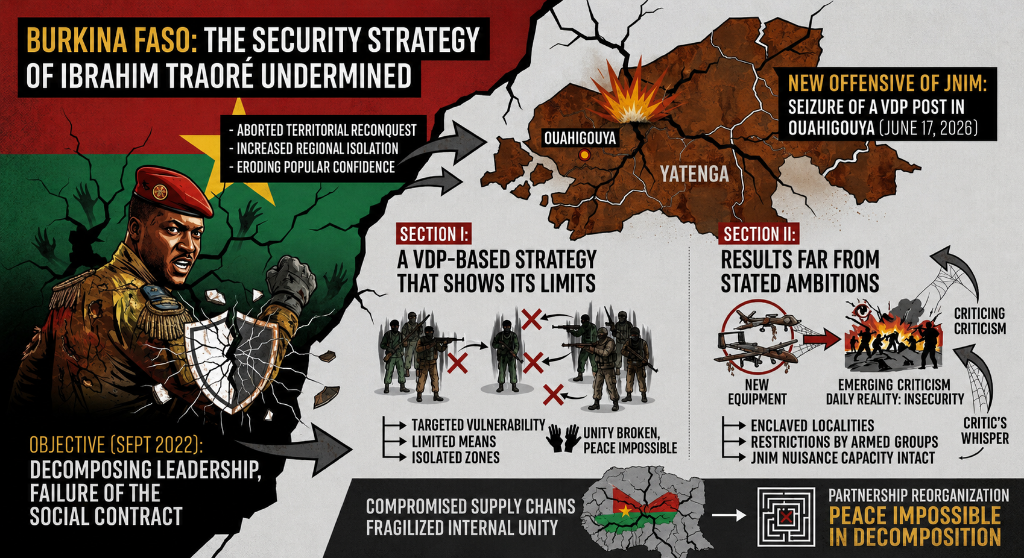
Burkina Faso faces mounting security challenges as the Group for the Support of Islam and Muslims (JNIM), an Al-Qaeda-affiliated faction operating in the Sahel, executed a coordinated assault on a Volunteers for the Defense of the Homeland (VDP) outpost near Ouahigouya on 17 June 2026. The attack, claimed by the group, marks a significant setback for the transitional government’s territorial recovery strategy under Captain Ibrahim Traoré.
Civilian defense units under strain
Since assuming power in September 2022 with a pledge to restore national sovereignty, Captain Traoré’s administration has leaned heavily on the VDP to bolster military presence in remote regions. However, these civilian-led units, often deployed in isolated areas with limited resources, have proven highly susceptible to insurgent tactics. The Ouahigouya offensive exemplifies this vulnerability, reinforcing concerns about the long-term viability of relying on such forces.
Persistent instability despite military advances
While the transitional authorities highlight advancements—such as the procurement of surveillance and combat drones—public sentiment reflects a stark contrast. Many communities remain under siege, with key localities cut off from essential services and others subjected to de facto control by armed factions. Analysts monitoring the Sahel crisis note that the JNIM retains significant operational flexibility, particularly in northern and eastern regions, where it continues to exploit gaps in state authority.
The recurring setbacks have reignited debates over the efficacy of the current security policy. Critics argue that the inability to safeguard civilians—a central justification for the 2022 civilian-led coup—now threatens the legitimacy of the transitional regime. As Ouagadougou strengthens its alliances within the Sahel States Confederation (AES) and prepares for intensified military operations in 2026, the Yatenga attack serves as a stark reminder of the limitations of a purely militarized approach to an asymmetric conflict.