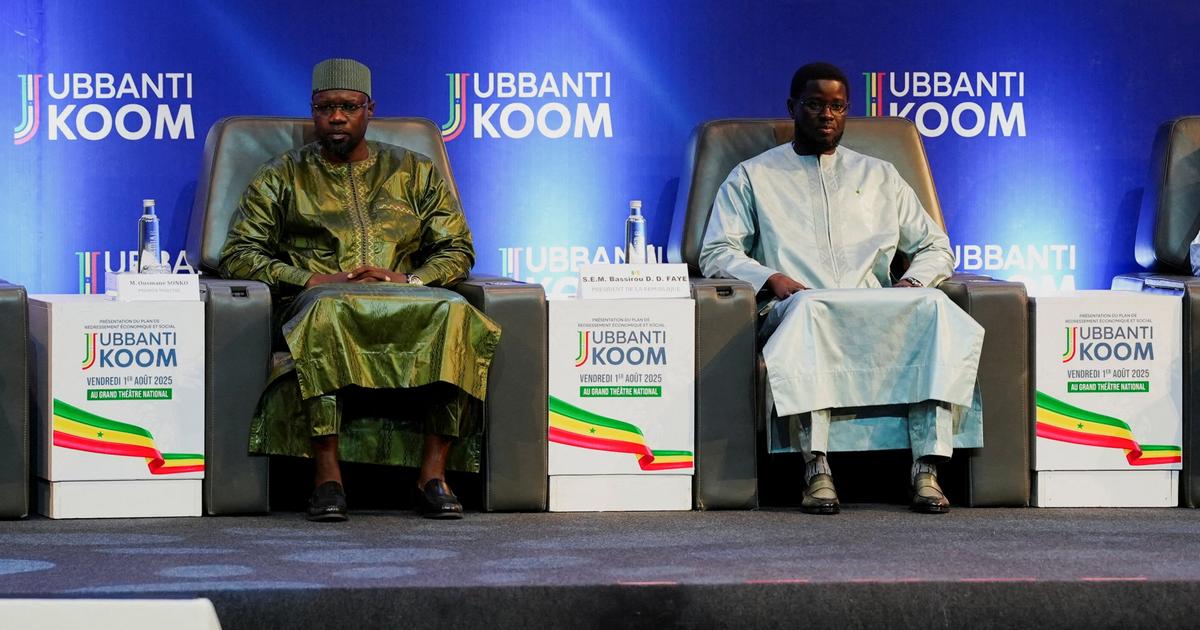
The dismissal of Ousmane Sonko by Bassirou Diomaye Faye on May 23, 2026, was not merely a clash of personalities. It marked the collapse of an untenable alliance built upon two fundamentally opposed economic visions—visions that had been quietly coexisting under the same banner for over two years. Since the April 2024 transition, Senegal’s leadership has grappled with three defining economic dilemmas: unsustainable debt, the management of hydrocarbon wealth, and the very nature of the capital fueling its policies.
Debt: The first fault line
Ousmane Sonko’s public revelation in September 2024 exposed a staggering reality: billions in undisclosed debt accumulated during Macky Sall’s administration. By March 2025, an IMF assessment confirmed the gravity, estimating hidden commitments at nearly €7 billion. Today, Senegal’s debt exceeds 100% of its GDP, with debt servicing consuming over €8.4 billion annually and refinancing needs nearing €9.1 billion. The country’s sovereign credit rating has been downgraded three times in twelve months.
Confronted with this crisis, Sonko refused any restructuring, framing his stance as a moral imperative—a refusal to legitimize the previous regime’s fiscal opacity. Faye, however, pursued a starkly different path. He engaged in direct negotiations with the IMF, welcoming a delegation in November 2025 and initiating a national dialogue in May 2026. Sonko’s strategy prioritized public denunciation, while Faye bet on dialogue and systemic engagement.
The consequences of Sonko’s approach became increasingly untenable. With a suspended €1.55 billion IMF program, closed international financial markets, and the looming specter of sovereign default by 2028, his position—while politically mobilizing—left the economy exposed. Bond markets reacted immediately to the visible fractures, with Senegalese euro- and dollar-denominated bonds plummeting at the first signs of discord.
Oil and gas: Contrasting visions of sovereignty
Hydrocarbon contracts became the second battleground. Sangomar’s first oil barrels flowed in June 2024, operated by Australia’s Woodside with an 82% stake. The Greater Tortue Ahmeyim (GTA) gas project, straddling the Senegal-Mauritania border, commenced production in early 2025 with an estimated 500 billion cubic meters of reserves. Both leaders agreed on the need for renegotiation—Senko projected potential gains of €1.4 billion in savings and €1.6 billion in additional tax revenues for GTA from 2025 to 2040. But their methods diverged sharply.
Sonko waged a public campaign, issuing ultimatums to BP and labeling the contracts as “unfair and imbalanced.” Faye, since April 2025, described the process as “more than satisfactory,” emphasizing its adherence to standard procedures. The multinational corporations remained unmoved—Senko’s rhetoric did not translate into tangible leverage, while Faye’s engagement signaled stability. For investors, the message was clear: production continuity mattered more than political posturing.
This divergence was not tactical but doctrinal. Sonko embodied an absolutist view of economic sovereignty—one that equated rhetorical confrontation with negotiating power. Faye, in contrast, recognized that real economic sovereignty lay in maintaining production, attracting investment, and securing fiscal revenues. The state’s only tangible lever was the continued flow of oil and gas—nothing else.
The politics of financing: Two bases, two futures
The third fracture ran deeper: the very foundation of political power. Sonko’s Pastef party thrived on mass micro-contributions, diaspora support, and emerging entrepreneurs—often from digital and commercial sectors. This grassroots financing underpinned its parliamentary dominance, with 130 of 165 deputies owing their seats to Sonko personally, not the presidency. The loyalty was to the man, not the institution.
Faye’s coalition, “Diomaye Président,” rebuilt on a different base. Revived in a general assembly on March 7, 2026, it drew support from former civil servants, technocrats from previous administrations, and business networks prioritizing institutional stability over ideological rupture. The dismissal of Sonko on May 23 symbolized this shift: in a country where debt exceeds GDP and annual refinancing needs top €9 billion, posturing carries real costs. Markets respond to stability, not slogans.
Truth versus trust: The paradox of Senegal’s leadership
Was Faye’s approach correct and Sonko’s flawed? The question is misplaced. Sonko’s legacy is undeniable: by exposing hidden debt, he forced a long-overdue reckoning. Without his intervention, Senegal would have continued borrowing against falsified figures—a practice unchallenged since independence. Yet Sonko’s truth came at a price: market confidence eroded, borrowing costs rose, and the country’s fiscal options narrowed.
Faye’s pragmatism, conversely, embraced the brutal discipline of fiscal consolidation. His path demanded social sacrifices but aimed to restore credibility. Neither vision was complete without the other. The tragedy of Senegal is that the two leaders failed to reconcile these imperatives within a unified institutional framework. The presidency, designed for vertical authority, could not accommodate dual sovereignty—a radical truth-teller and a patient reformer.
The long game: Markets over rhetoric
There is a more unsettling interpretation: the multinational corporations that remained calm during two years of public confrontation may have been right to wait. They gambled on the durability of institutional processes over the volatility of political rhetoric—and they won. Multinational operators did not orchestrate the dismissal, but they benefited from it. The message is clear: real economic power ultimately trumps the performative assertions of political power. This is the reality of the actual state, stripped of rhetorical fictions.
As Senegal looks toward 2029, the horizon is now open. Sonko returns as a mobile political force, free to mobilize his base, campaign across the diaspora, and position the Pastef as a formidable opposition machine. Faye, unshackled from internal dissent, can finalize his IMF agreement, restructure debt, and present a narrative of stability. Each now plays their hand in the open. Senegalese citizens will face a stark choice: sovereignty through confrontation or sovereignty through management. Neither path is fully honest. Neither is entirely satisfactory. But the economic clock does not wait—and neither do the markets.