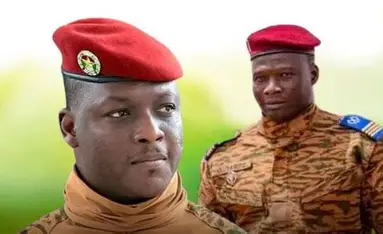
In Burkina Faso, the political landscape continues to generate considerable inquiry, particularly concerning the operational mechanisms within its most sensitive decision-making spheres. Over recent weeks, the extended absence of Commander Oumarou Yabré, who heads the intelligence services, has provoked extensive commentary and conjecture across political circles and social media platforms. While no official statement has been issued to clarify this period of discretion, it unfolds against a backdrop where matters of security governance remain central to national concerns.
Observations suggest potential reconfigurations in the distribution of responsibilities within the security apparatus. Some analysts postulate that Captain Ibrahim Traoré might be assuming a more direct oversight role in highly sensitive dossiers. However, official Burkinabè authorities have not corroborated these assertions, necessitating a cautious interpretation.
Within governance structures where security imperatives are paramount, intelligence agencies are indispensable to strategic decision-making. Their function involves gathering, analyzing, and disseminating critical information, enabling authorities to foresee threats and formulate appropriate responses. Consequently, any perceived alteration in their operational dynamics or hierarchical structure invariably captures the attention of observers, even in the absence of formal announcements regarding reorganization.
Commander Oumarou Yabré’s conspicuous absence during the recent Tabaski festivities intensified the prevailing inquiries. For some analysts, such discretion could simply stem from operational imperatives or a deliberate choice, common within intelligence operations. Others perceive it as indicative of evolving internal power dynamics. Nevertheless, without an official explanation, drawing definitive conclusions remains premature.
Historical precedent indicates that periods of heightened security pressure often compel leaders to exercise more direct supervision over strategic files. Such a practice, if indeed occurring, does not inherently signify discord among officials. It can instead reflect urgent coordination requirements, exceptional circumstances, or a deliberate strategy to centralize specific decision-making processes.
At present, publicly available information offers no substantiation for any deterioration in the relationship between Ibrahim Traoré and Oumarou Yabré. The Burkinabè authorities have refrained from commenting on any prospective reorganization of intelligence services or shifts in the responsibilities of principal security actors.
In an environment where speculation propagates rapidly, maintaining prudence is paramount. The verifiable facts remain constrained, and conjecture cannot supersede authenticated information. Any substantial institutional evolution will necessitate assessment based on officially confirmed elements or demonstrably robust evidence.