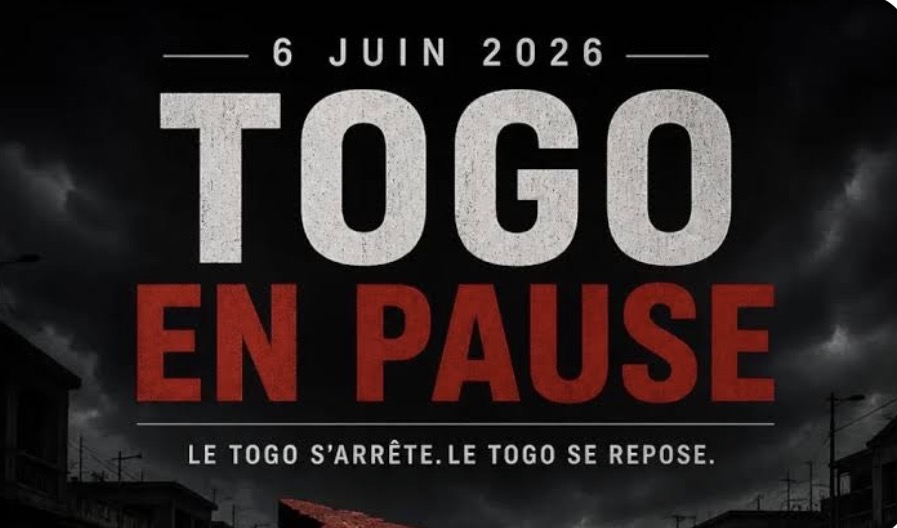
June 6, 2026, is not just another date on the calendar—it’s a deliberate act of defiance. For nearly six decades, Togo has operated under a deeply entrenched system where power has been monopolized, recycled, and shielded from scrutiny. This isn’t about one leader or one family; it’s a militaro-political and ethnic machinery designed to perpetuate itself, regardless of the cost to the people. Through the call to “Togo en Pause,” led by the M66 movement and supported across the resistance spectrum, citizens are making a bold statement: they refuse to play a part in a game rigged against them.
Elections come and go. Institutions function on paper. Speeches are delivered with rehearsed precision. Yet beneath the surface, the system remains unchanged—a closed circuit of power where dissent is crushed, freedoms are curtailed, and dissenting voices are silenced. These aren’t isolated incidents; they are the system’s operating system.
Breaking the cycle: the youth rejects the status quo
The generation now coming of age in Togo has known only one reality: a political landscape where promises are made to be broken and where the voice of the people is systematically drowned out. They’ve witnessed crackdowns on protests, harassment of activists, and media outlets brought to heel. They’ve felt the weight of territorial inequities, social stigma, and deep-rooted divisions. But they are refusing to accept this as fate.
“Togo en Pause” is their response—a peaceful yet resolute strategy to withdraw rather than engage. The goal isn’t to flood the streets with bodies, but to leave them empty. To halt daily routines, close shops, and suspend activity isn’t an act of surrender—it’s a deliberate message. It says, without violence: “If you won’t listen, feel our absence.” On June 6, every closed door and silent street becomes a political statement in itself.
Power locked in place
Togo’s power structure is built on a foundation of military, ethnic, and civilian alliances that have held firm for generations. Key positions in the army, security forces, public administration, and state-owned enterprises are held by tightly knit networks of loyalty. The system doesn’t reward merit or serve the people—it preserves power at all costs.
Both citizens and the diaspora understand this all too well. Behind the facade of economic partnerships and modernization rhetoric, the underlying structures remain frozen in time. Poverty persists, inequalities deepen, and opportunities remain scarce for the majority. “Togo en Pause” is a collective act of clarity: refusing to normalize what should never be accepted as normal.
A movement without borders
The simplicity of this call is its strength. It reaches everyone—workers, shopkeepers, students, civil servants, artisans, farmers, and those living abroad. Each person, in their own way, can participate by withdrawing their support from the system. June 6 is not an ordinary day; it’s an assertion of dignity. To take part is to reject hollow political rituals, empty promises, and cycles of stagnation. It’s to declare: “We are not extras in your political theater.”
A test of collective courage
Choosing to stay home, to pause work, to limit movement—this is no small decision. It involves risking income, facing potential backlash, and stepping into the unknown. It challenges years of resignation fueled by fear and division. June 6 asks a fundamental question: will we continue to tolerate a system that offers no future, or will we dare to demand change?
The message isn’t tied to a slogan or a single organization. It’s rooted in a long history of unheard frustrations and long-suppressed voices. It embodies a will that transcends generations.
June 6: not a beginning, not an end—but a turning point
On this day, Togo isn’t just pausing its routine—it’s pausing to reflect. It’s a moment where the people say, unequivocally, that they will no longer sustain a system that has dominated for over six decades. June 6 is a standstill. But it’s also an opening. A pause to breathe. A pause to reconsider. And perhaps, a pause to rise again—stronger, and with a renewed sense of purpose.
The Togo of June 6 will be silent.
But what follows could speak volumes.