The recent detention of two French nationals in northern Togo has cast a stark light on the troubling direction of governance in the country. Charged on Monday after several days in the custody of intelligence services, their fate appears to have been sealed by a direct order from Faure Gnassingbé. According to reports, the president personally instructed his Justice Minister, Pacôme Adjourouvi, to « resist any external interference » in the case.
From constitutional reform to institutional distortion
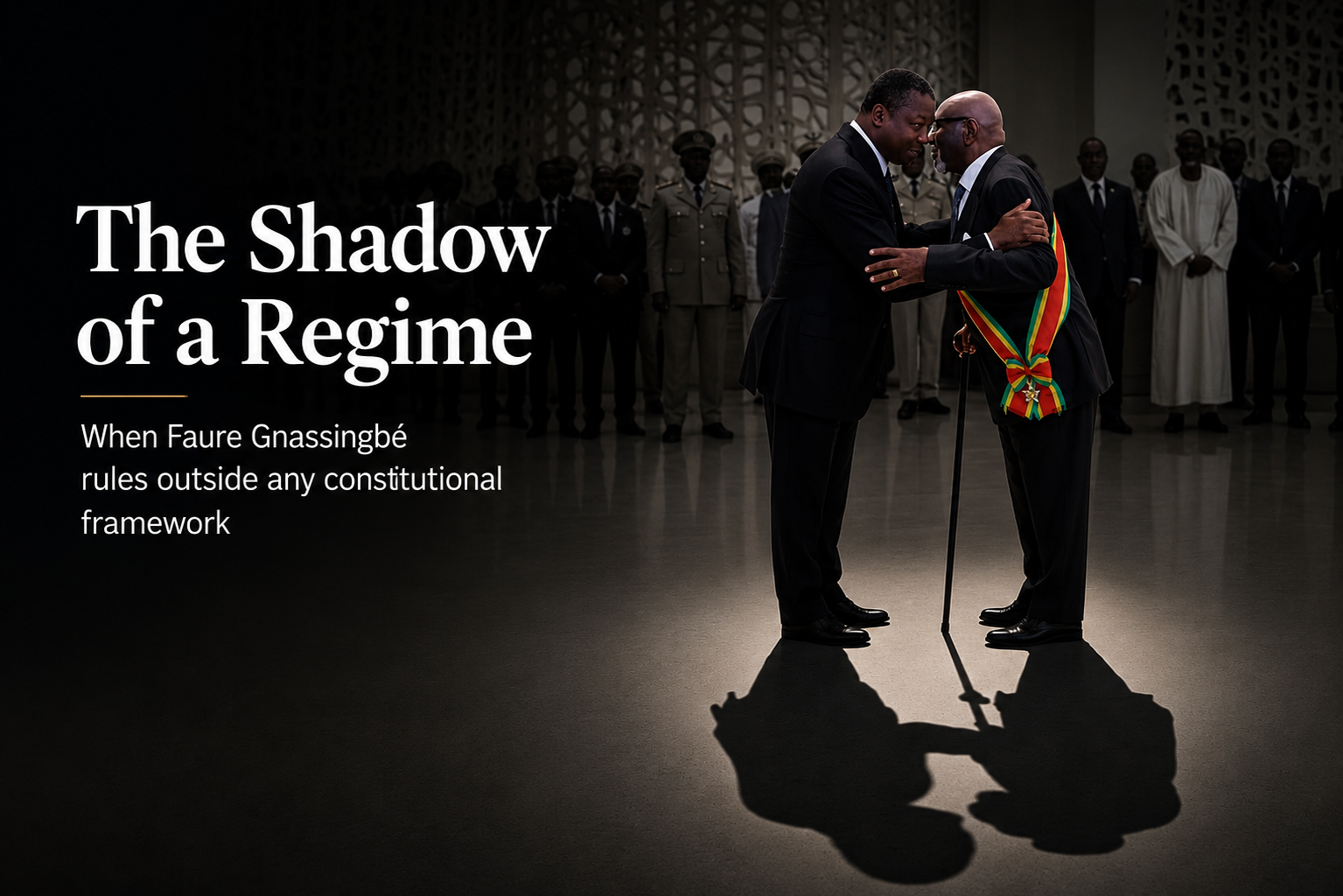
Beyond this diplomatic incident, deeper questions loom over Togo: who truly holds power, and under what legitimate authority? Faure Gnassingbé, in a flagrant breach of the nation’s constitutional framework, has engineered a radical restructuring of governance. By shepherding through a new Constitution and installing a ceremonial President of the Republic while assuming the role of President of the Council himself, he has created a precedent unlike any seen elsewhere. This makeshift institutional design strips titles of substance, replacing institutional checks with unchecked executive authority.
The move underscores a dangerous trend. Rather than relinquishing control, Gnassingbé is reshaping the rules to serve his interests a tactic reminiscent of a high-stakes gambler reshuffling the deck when the hand no longer favors him. By issuing direct orders to judges and manipulating tailor-made institutions, he has rendered the separation of powers a hollow concept.
A constitutional overhaul with no democratic mandate
The 2024 reform, railroaded by the ruling Union for the Republic (UNIR) through a National Assembly where it holds 108 of 113 seats, transformed Togo from a presidential to a parliamentary system at least on paper. The figurehead President of the Republic Jean-Lucien Savi de Tové now wields no real executive power. Instead, all key responsibilities national policy direction, military command, civil and military appointments, international representation, and regulatory authority have been transferred to the President of the Council, a position permanently occupied by Gnassingbé since May 3, 2025.
Unlike the truncated presidential mandates under the 1992 Constitution, the new system removes all term limits for the President of the Council. With the leader of the majority party automatically assuming the role, democratic alternation is effectively erased. The outcome was predetermined: the ballot in the 2024 legislative elections, widely boycotted by opposition forces, ensured the UNIR’s dominance. This is no transition it is the consolidation of dynastic power under a new title.
The weaponization of justice
The case of French journalists Sébastien Perez Pezzani and Gaël Mocaër arrested while filming for a France Télévisions program is not an isolated act. It fits a pattern of repression where intelligence services and the Ministry of Justice act on direct presidential directives. The reported instruction to « resist any pressure » lays bare a command chain that bypasses judicial independence entirely. When the head of state dictates rulings to magistrates, the separation of powers ceases to exist.
This practice has been evident in the suppression of protests in June 2025, the prosecution of dissenting voices, and the handling of sensitive legal cases. Law is no longer a pillar of justice it is a political tool, wielded or neutralized as needed.
Legitimacy in crisis: power without consent
Who truly governs Togo? The answer is unambiguous: a leader who first ascended to power in 2005, spent two decades solidifying control, and now has redrawn the nation’s institutions to retain it indefinitely. Critically, the Togolese people were never consulted via referendum on this foundational change. The legislative elections were held amid widespread boycott and protest, further eroding the process’s legitimacy. Even the Senate, with a third of its members appointed by the President of the Council, serves to reinforce executive dominance.
This is not a transition it is the entrenchment of personal rule behind a facade of institutional formality. Titles shift, procedures multiply, but the locus of decision-making remains unchanged: Faure Gnassingbé, now President of the Council, leader of the majority, commander-in-chief, and ultimate authority.
A powder keg of political tension
When arbitrary rule replaces constitutional order, when institutions become empty vessels, and when justice is subservient to political whims, the social contract frays. Togo is no longer grappling with a constitutional disagreement. It faces a regime that governs outside stable, predictable republican norms. The question is no longer « who governs? », but rather: how long can this system persist before internal fractures and popular pressure force it to collapse?