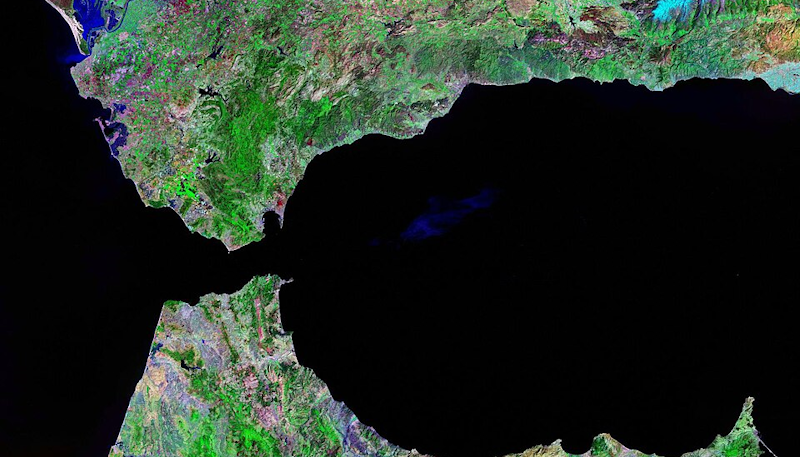
Tensions between Rabat and Madrid escalate as Washington deepens its ties with Morocco, reshaping alliances in North Africa and the Mediterranean. A pivotal shift in U.S. policy now places the Sahrawi conflict and Spain’s North African enclaves—Ceuta and Melilla—at the center of a rapidly evolving geopolitical landscape.
Since late July, Washington has sent clear signals reinforcing its partnership with Rabat. From political backing for Morocco’s autonomy plan in Western Sahara to economic cooperation and security coordination, the two nations appear to be forging a relationship that could redefine regional power dynamics.
This strategic alignment follows a dramatic surge in migration to Ceuta, where tens of thousands crossed into the Spanish enclave within hours, overwhelming local authorities and drawing sharp criticism from Brussels. While the origins of the influx remain debated, the timing has intensified diplomatic pressures between Morocco and Spain, drawing in a new player: the United States.
Western Sahara: Morocco’s autonomy plan gains momentum in Washington
In December 2020, the U.S. recognized Moroccan sovereignty over Western Sahara in exchange for the normalization of relations between Rabat and Israel—a historic decision that broke decades of international stalemate. Six years later, Morocco is working to preserve this diplomatic victory.
Symbolic gestures, such as naming a major highway in Western Sahara after former U.S. President Donald Trump, underscore Rabat’s strategy to maintain American support. “This is part of Morocco’s broader effort to court the Trump administration,” said a regional analyst. The kingdom’s priority remains securing continued U.S. backing for its autonomy proposal, especially as international negotiations on the conflict enter a critical phase.
By framing the dispute as a regional stability issue tied to broader U.S. interests in North Africa and the Middle East, Morocco aims to keep Washington aligned with its position until a lasting resolution is achieved.
Economic enticements fuel deeper U.S.-Morocco cooperation
Beyond politics, economic interests are accelerating the rapprochement. In late July, the U.S. ambassador to Morocco traveled to Laâyoune, the capital of Western Sahara, to finalize a landmark agreement. The deal includes a U.S. grant to establish a major hydrogen and ammonia production facility—an investment that aligns with Washington’s push for energy diversification and American corporate involvement in the region.
Analysts view this project as evidence of a dual-track U.S. strategy: leveraging political support for Morocco while advancing economic opportunities that benefit American firms. The convergence of interests—political alignment, economic incentives, and shared security concerns—has created a robust foundation for the alliance.
Polisario in the crosshairs of U.S. policy
Another development has raised concerns among supporters of the Sahrawi Arab Democratic Republic. Two U.S. lawmakers recently introduced a proposal to review the possibility of designating the Polisario Front as a foreign terrorist organization. The move comes amid broader efforts in Congress to counter Iranian influence across the Middle East and North Africa.
While no credible evidence links the Polisario to Iran or Hezbollah, Morocco has seized on the geopolitical climate to reframe the Western Sahara conflict. “Rabat consistently ties its dispute with the Polisario to Israel’s regional engagements,” noted the analyst. By positioning the issue within the framework of U.S. priorities, Morocco seeks to reinforce its narrative and secure continued American support.
Ceuta and Melilla: a new front in U.S.-Morocco relations
The most significant shift, however, involves Ceuta and Melilla—territories Spain has long claimed as its own. Recent U.S. statements suggest a subtle but meaningful departure from Madrid’s position. “Washington has signaled it no longer views these enclaves as definitively Spanish,” the analyst explained. This evolving stance appears to grant tacit support to Morocco’s longstanding claims over the territories.
For decades, Rabat has asserted that Ceuta and Melilla are occupied lands. Spain, meanwhile, upholds their status as integral parts of its national territory. If the U.S. were to formally endorse Morocco’s position, it could strain relations between Washington and Madrid, potentially altering the strategic balance in the Western Mediterranean.
Ceuta’s migration crisis: deliberate pressure or spontaneous event?
The timing of the migration surge at Ceuta has fueled speculation about Morocco’s role. Within 24 hours, nearly 50,000 migrants crossed into the Spanish enclave, overwhelming Spanish border forces and triggering urgent EU consultations. While some suggest the crisis was orchestrated, analysts argue it was largely spontaneous before being politically exploited by Rabat.
The episode served as a reminder to Spain that Morocco views Ceuta’s status as unresolved. “The crisis was leveraged to send a message,” the analyst noted, “reinforcing Rabat’s position in the territorial dispute.”
Madrid’s balancing act between Washington and Algiers
In response to the shifting dynamics, Spanish Prime Minister Pedro Sánchez traveled to Algiers to strengthen bilateral ties, particularly in energy. While this move may raise eyebrows in Rabat, analysts believe it does not signal a fundamental shift in Spain’s stance on Western Sahara. Madrid continues to support Morocco’s autonomy plan, even as it navigates a more unpredictable transatlantic relationship.
For Spain, the challenge is clear: adapt to a U.S.-Morocco partnership that could reshape the region’s geopolitical map. The Ceuta crisis, however, is driven by a separate agenda—one rooted in Morocco’s territorial ambitions.
What’s at stake for Spain and the transatlantic alliance
The potential U.S. endorsement of Morocco’s claims on Ceuta and Melilla introduces a new layer of uncertainty for Spain. Historically, Madrid has relied on its alliances with Washington and NATO to safeguard its security and territorial integrity. A shift in U.S. policy could erode these guarantees, opening the door to long-term negotiations over the enclaves’ status.
While a full-blown crisis is not imminent, the current trajectory suggests that the sovereignty question over Ceuta and Melilla could resurface in future diplomatic discussions. “The issue is not about to explode tomorrow,” the analyst said, “but the seeds of a political renegotiation have already been sown.”
A reshaped Mediterranean power balance
The U.S.-Morocco partnership is evolving into a cornerstone of North African geopolitics. Rabat is capitalizing on this moment to solidify its diplomatic gains, while Washington prioritizes strategic and economic interests. For Spain, the challenge is to recalibrate its approach in a region where alliances are becoming increasingly fluid.
Western Sahara and Ceuta—once separate disputes—are now converging into a single diplomatic battleground. The outcome will not only redefine Morocco’s regional influence but also test the resilience of U.S.-European relations in the Mediterranean.