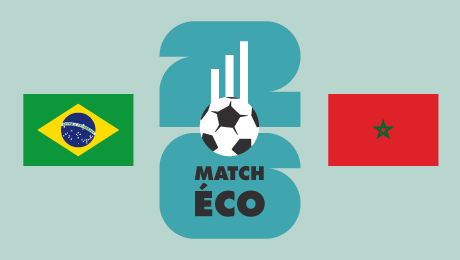
When assessing the economic landscape ahead of the 2026 World Cup, one matchup stands out with surprising results. While Brazil enters the competition as a heavyweight, it is Morocco that appears poised to outperform Brazil across key metrics.
Brazil’s sizeable economy, yet fragile foundations
Boasting a population of 212 million and ranking as the world’s tenth-largest economy, Brazil remains a global economic powerhouse.
Its GDP per capita, adjusted for purchasing power parity, reached $22,000 in 2024—more than double Morocco’s $10,000. This disparity reflects Brazil’s advanced economic development, supported by a diversified industrial base, leading agricultural sector, and a rapidly expanding services industry.
Yet beneath this impressive facade lies a concerning fiscal reality. Brazil’s national debt stands at 83% of GDP in 2024, compared to Morocco’s 70%. While both nations grapple with high public debt levels, Brazil’s situation is under closer scrutiny due to persistent budget deficits and steep interest payments. Morocco, meanwhile, is implementing bold structural reforms to curb its debt, particularly in preparation for hosting the 2026 World Cup.
Brazil 1 – Morocco 1
Morocco’s social and strategic edge
Morocco’s strength becomes most evident in social and strategic indicators. The Moroccan minimum wage hits $275 in 2026, surpassing Brazil’s $226—a reminder that higher GDP per capita does not always translate to better wages for low-income workers.
The North African nation also outpaces Brazil in defense spending, allocating 3.5% of GDP compared to Brazil’s mere 1%. This reflects Morocco’s assertive geopolitical strategy amid regional instability. Life expectancy also favors Morocco slightly, with 75 years against Brazil’s 76.
Final score: Brazil 2 – Morocco 3
Economically, Morocco emerges as the unexpected winner, mirroring its recent sporting achievements. Brazil retains significant advantages but struggles to convert them into broad-based prosperity. Morocco, by contrast, demonstrates how a developing economy can, through ambitious policies, compete with far larger nations.
Stay tuned as the action unfolds on the pitch tonight—will the economic upset be matched on the field?