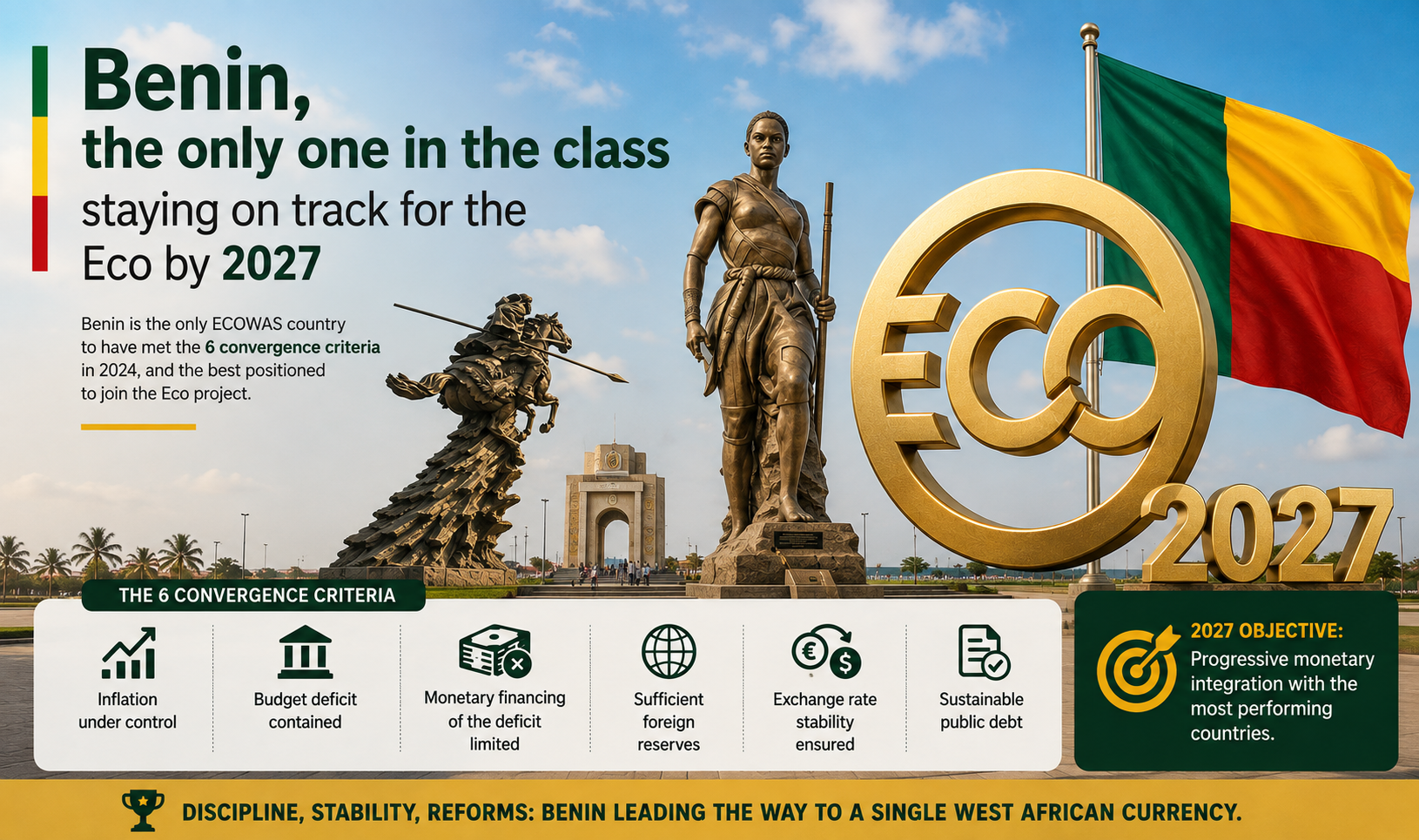
The Economic Community of West African States (CEDEAO) remains committed to launching the Eco, a proposed regional currency, by 2027. However, the economic disparities across member states suggest an uneven transition. Amid this landscape, Bénin has emerged as a frontrunner in meeting the stringent convergence criteria required for monetary integration.
Historical background and regional ambitions
The concept of a single West African currency has long been a cornerstone of CEDEAO’s economic integration strategy. Yet, the journey from political ambition to economic reality faces significant hurdles, including inflation, public deficits, debt levels, foreign reserves, and exchange rate stability. The 2027 target now appears to favor a phased approach, allowing the most prepared nations to adopt the Eco first while others continue aligning their economies.
Bénin’s exceptional macroeconomic performance
In 2024, Bénin distinguished itself as the sole CEDEAO member to meet all six convergence criteria outlined for the Eco. These benchmarks assess various economic dimensions, including inflation control, fiscal discipline, debt sustainability, and foreign reserve adequacy. Achieving these standards simultaneously reflects a coherent and disciplined macroeconomic policy framework.
Key criteria shaping the Eco’s foundation
The convergence criteria serve as the technical backbone of the Eco project, ensuring participating nations adhere to shared economic principles. These indicators encompass:
Inflation control: Keeping price increases within sustainable limits to preserve purchasing power and monetary stability.
Fiscal deficit limits: Ensuring national budgets remain within agreed thresholds to prevent excessive borrowing.
Monetization of deficits: Preventing excessive money supply expansion that could fuel inflation.
Foreign reserves: Maintaining sufficient reserves to cover several months of import needs.
Exchange rate stability: A critical factor for credible monetary integration.
Public debt sustainability: Keeping debt levels within manageable bounds to avoid financial strain.
These criteria collectively create a framework for economic discipline, essential for a durable monetary union.
A deliberate trajectory toward stability
Bénin’s achievement is the result of years of deliberate economic reforms, including enhanced revenue mobilization, improved public financial management, and sustained investment in infrastructure and public services. This approach has required careful balancing between fiscal discipline and developmental spending a challenge for any developing economy.
The next critical step for Cotonou is to maintain this performance consistently over time. While meeting the criteria in a single year signals positive intent, sustained compliance will cement Bénin’s credibility as a regional leader in macroeconomic stability.
An uneven regional landscape
The heterogeneity of West African economies poses a major challenge to uniform integration. Varying levels of debt, fiscal space, inflation rates, and public finance pressures complicate the prospect of a synchronized transition. Additionally, security crises, geopolitical tensions, and trade disruptions further complicate regional economic cohesion.
In response, a gradual implementation strategy may offer a more pragmatic pathway. Rather than mandating simultaneous adoption, the Eco could initially welcome the most prepared nations, allowing others to progress at their own pace.
Bénin’s strategic advantage
If this phased approach materializes, Bénin is poised to be among the first countries to adopt the Eco. This position would not only enhance its economic attractiveness but also strengthen its influence in regional policy discussions. Monetary integration extends beyond currency exchange; it demands tighter coordination in fiscal, financial, and economic policies across member states.
For Bénin, early adoption could yield strategic benefits, including improved economic credibility, enhanced trade integration, and greater regional influence.
Uncertainties and next steps
Despite the progress, the 2027 launch date remains uncertain. Success hinges on both sustained economic performance and collective political will among participating states. Key considerations include the governance structure of the Eco, the roles of regional institutions, and mechanisms for fiscal solidarity.
The recent departure of several CEDEAO members, particularly those in the Sahel Alliance, has reshaped the regional landscape. The Eco project must now adapt to a new institutional environment, one that differs from the original vision when the initiative was first proposed.
Consolidating an advantage
Bénin’s current lead is a significant milestone, but it is not guaranteed. The country must prioritize maintaining macroeconomic stability, controlling inflation, managing debt levels, and continuing structural reforms. As the 2027 deadline approaches, the true challenge will be sustaining its position at the forefront of the Eco’s integration process.
If the Eco materializes in a phased manner, Bénin could secure a prime position one where it has already navigated most of the technical and economic obstacles required for successful monetary integration in West Africa.