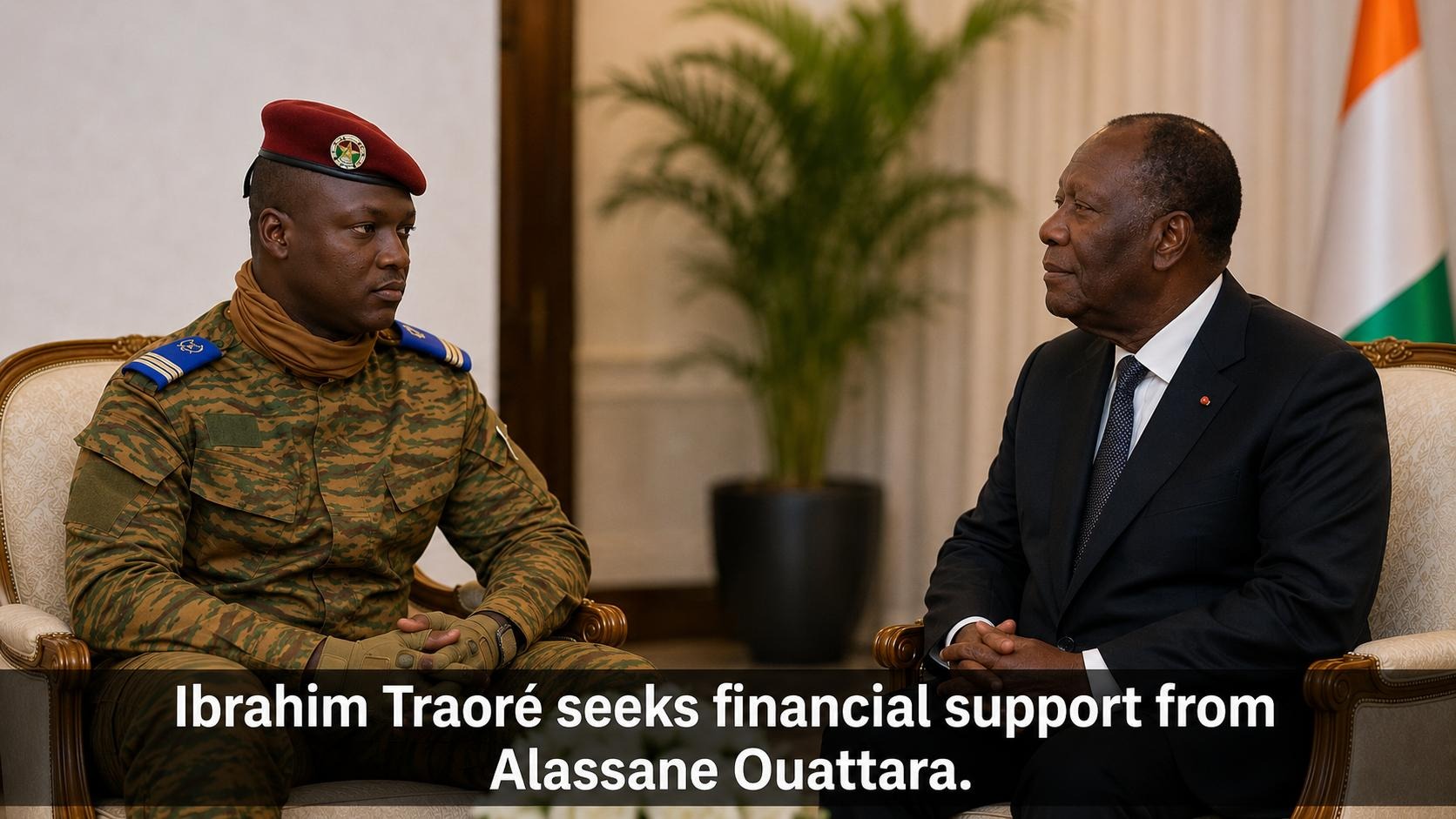
Transition regime faces harsh financial reality
After years of asserting economic sovereignty and severing ties with regional partners, Burkina Faso’s military leadership has made an about-face. Credible reports confirm that Captain Ibrahim Traoré dispatched an official delegation to Abidjan to request urgent financial assistance. This unprecedented move exposes the severe budgetary shortfall plaguing the transitional government.
What was once a government declaring complete financial independence has quietly abandoned its rhetoric. The request for emergency funds from Côte d’Ivoire—a nation previously accused of destabilizing efforts—reveals a stark contradiction between words and actions.
From self-reliance to financial dependency
The military government’s financial struggles are no longer deniable. Despite imposing patriotic support funds and exceptional taxes, state coffers remain dangerously depleted. The heavy military expenditures and regional isolation have pushed Burkina Faso to the brink, forcing Ibrahim Traoré to abandon his earlier stance of regional defiance.
This financial humility comes at a political cost. The same leader who once condemned Côte d’Ivoire now silently seeks its assistance. The irony is not lost on observers: a government that positioned itself as a champion of self-sufficiency must now beg for financial lifelines from a neighbor it once accused of meddling.
Diplomatic contradictions and economic survival
The mission to Abidjan underscores a painful truth: ideology alone cannot sustain a nation. While Ibrahim Traoré continues to promote the Alliance of Sahel States (AES), the reality of empty treasuries demands pragmatic solutions. The request for funds exposes the fragility of Burkina Faso’s economic strategy, revealing that sovereignty cannot be declared—it must be funded.
For a leader who built his legitimacy on rejecting foreign interference, this financial outreach represents a critical turning point. The people of Burkina Faso now face a sobering question: Can a government that cannot pay its bills still claim to lead with authority?