Burkina Faso’s military leadership, led by Captain Ibrahim Traoré, has long positioned Western partners as political adversaries, touting Russia as the solution to the country’s security, economic, and financial challenges. Yet recent diplomatic moves by Ouagadougou toward Brussels suggest a stark contrast between rhetoric and reality.
Diplomatic overtures to Brussels follow stalled Moscow partnerships
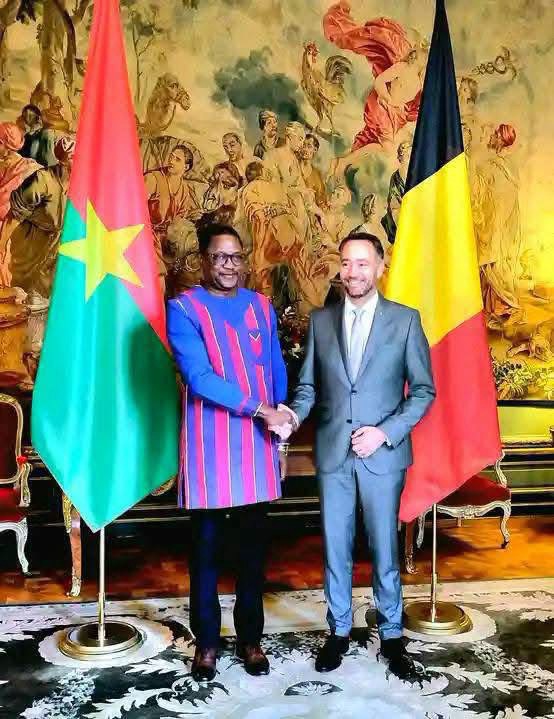
Between November 4 and 5, 2026, Burkina Faso’s foreign minister, Karamoko Jean Marie Traoré, held high-level meetings in Brussels with EU High Representative Kaja Kallas and Belgian Deputy Prime Minister and Foreign Minister Maxime Prévot. These discussions came just weeks after Burkina Faso participated in the Russia-Africa Economic and Humanitarian Forum in Moscow, where officials touted new strategic partnerships with Russia.
Despite the junta’s anti-Western rhetoric, the timing of these Brussels meetings underscores the government’s ongoing reliance on European financial support a reality at odds with its stated foreign policy.
Russia’s promises remain unfulfilled as budget pressures mount
The Burkina Faso government had framed its pivot to Russia as a long-term replacement for Western partnerships. During the Moscow forum, officials highlighted a memorandum of understanding between the AES’ Confederation of Investment and Development Banks and Russia’s VEB.RF, aimed at fostering trade and investment. Yet this agreement does not guarantee immediate or substantial financial flows.
With a 2026 budget projecting revenues of 3,431.5 billion CFA francs against expenditures of 3,918.3 billion leaving a deficit of 486.8 billion the need for external financing is undeniable. The IMF estimates a 4% GDP budget deficit for the year, signaling severe fiscal constraints. While not signaling empty treasuries, these figures highlight a pressing need for reliable funding sources.
So far, Moscow has not delivered the financial support Burkina Faso requires to cover its security, social, and infrastructure expenses. The gap between Russia’s symbolic commitments and tangible assistance leaves Ouagadougou with no alternative but to seek other partnerships.
Belgium pledges €40 million as Europe reasserts its role
During talks with Prévot, Belgium reaffirmed its commitment to provide €40 million in post-2027 development aid through Enabel, its international cooperation agency. This pledge marks a critical moment in Burkina Faso’s financial diplomacy, revealing the limitations of its anti-Western stance.
The agreement, while modest, underscores Europe’s enduring importance as a partner, despite the junta’s efforts to distance itself from Brussels. Upcoming meetings with EU officials and cooperation agencies like Enabel and Bio Invest signal a deeper engagement, further challenging the narrative of a complete break with Europe.
Double standards in Burkina Faso’s foreign policy
The core discrepancy lies not in Burkina Faso’s willingness to engage Brussels but in the inconsistency between its political messaging and its actions. While Traoré’s administration has framed the West as an obstacle to progress, it continues to negotiate critical financial support from European institutions.
How can Ouagadougou justify denouncing Western influence while actively pursuing funds from EU member states? The junta’s communication strategy risks misleading citizens, framing sovereignty as a matter of ideological purity rather than practical resource mobilization.
Similarly, if Russia was genuinely a viable substitute for Western aid, Burkina Faso’s leaders would be able to present concrete financial transfers, investment projects, or executed initiatives backed by Moscow none of which have materialized so far.
Sovereignty depends on results, not slogans
Burkina Faso’s future stability and development hinge on its ability to secure dependable financing, regardless of the partner’s political alignment. Criticizing the West rhetorically is one thing; replacing lost Western aid with viable alternatives is another entirely.
The junta must recognize that national progress cannot be built on anti-Western posturing alone. The Brussels meetings demonstrate that Ouagadougou still relies on Europe’s financial lifelines, even as it publicly rejects Western partnerships. Transparency about this reality is essential to align policy with practical needs.
Until Moscow delivers tangible financial support, Burkina Faso’s citizens and its leadership must confront a fundamental question: if anti-Western rhetoric has not yielded the promised Russian funding, what tangible benefits has this strategy brought to the country?
By Jeanne Ntouba — Journalist