Regional shifts in judicial cooperation
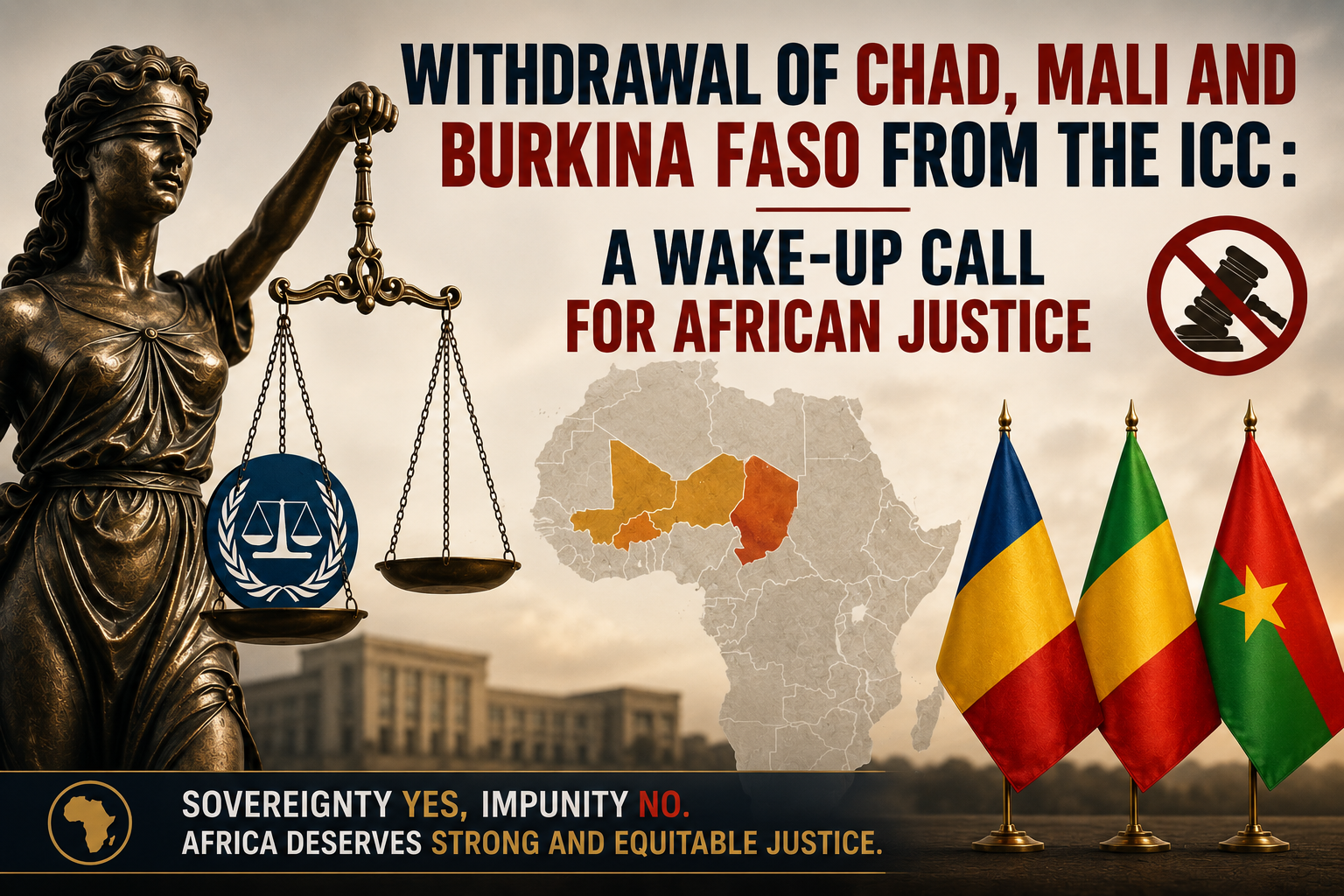
The decision by Chad to join Mali, Burkina Faso, and Niger in withdrawing from the Rome Statute of the International Criminal Court (ICC) marks a significant development in the evolving political and institutional landscape of the Sahel. While the withdrawal was formally announced on July 27, 2026, the decision reflects broader tensions between African governments and international judicial bodies.
Sovereignty vs. accountability: the core debate
The governments involved have framed their withdrawal as an assertion of national sovereignty, criticizing the ICC’s perceived ineffectiveness and selective application of justice. These concerns are not without merit. Since its establishment, the ICC has faced recurring criticism for its focus on African cases while powerful non-member states remain unscrutinized. This imbalance has fueled skepticism about the Court’s universal credibility.
However, rejecting the ICC’s shortcomings does not automatically justify abandoning its framework. Crimes falling under the Court’s jurisdiction such as crimes against humanity, war crimes, and genocide do not vanish with a state’s withdrawal. The fundamental question remains: how can justice be ensured when international mechanisms are weakened without first establishing robust national and regional alternatives?
Consequences for victims of conflict
The Sahel’s ongoing conflicts have left a trail of documented atrocities, including civilian massacres, forced displacements, and alleged abuses by both armed groups and state-aligned forces. Human rights organizations have repeatedly highlighted the challenges faced by victims in accessing justice and reparations. The withdrawal of these four nations risks exacerbating this situation, potentially closing avenues for accountability that the ICC provides.
While national justice systems can theoretically address grave crimes, their effectiveness hinges on independence, resources, and political will. Without these safeguards, sovereignty risks becoming a shield for impunity rather than a tool for justice.
The legal process behind withdrawal
It is crucial to recognize that withdrawal from the ICC is not an immediate process. For Chad, the formal notification triggered a one-year countdown before the country ceases to be bound by the Rome Statute. Until then, it remains legally accountable for crimes committed during its membership. Additionally, the Court retains jurisdiction over cases arising during the period of membership, ensuring that perpetrators cannot evade accountability simply by exiting the system.
This transitional period underscores a critical point: withdrawal does not erase past obligations. The challenge now lies in ensuring that future accountability mechanisms are not weakened by the absence of international oversight.
The promise and pitfalls of African justice
The argument for an independent African justice system is compelling. A continent-wide mechanism could offer proximity, cultural relevance, and potentially greater efficiency in addressing regional crimes. The trial of former Chadian dictator Hissène Habré demonstrates that such systems can deliver justice when properly implemented.
Yet, the promise of African justice remains largely unfulfilled. For it to be credible, institutions must ensure impartial investigations, protect witnesses, and pursue all perpetrators regardless of their political or military standing. Without these guarantees, the discourse on sovereignty risks being weaponized to shield powerful figures from scrutiny.
The broader impact on international justice
The cumulative effect of these withdrawals weakens the ICC’s global authority, particularly during a period when the Court faces institutional challenges, including leadership transitions and geopolitical pressures. Each departure reduces the Court’s reach, potentially emboldening states to prioritize narrow interests over universal legal principles.
A credible international justice system must apply equally to all. This universality requires states to submit to independent mechanisms, even when rulings may be politically inconvenient. The true test for Sahelian governments will be whether their withdrawal catalyzes the development of stronger, fairer domestic and regional judicial systems or leaves victims with fewer protections.
Conclusion: beyond sovereignty, toward justice
The withdrawal from the ICC is not a solution in itself. To substantiate their claims of judicial sovereignty, Sahelian nations must demonstrate tangible progress: fortified courts, protected magistrates, thorough documentation of crimes, and accessible reparations for victims. Only then can the argument for independence transcend rhetoric and become a reality.
The ultimate question is not whether African states can reject international oversight, but whether they can build systems that hold all perpetrators accountable equally and without exception.